7th–8th centuries · 6th century
The Authority of the Fathers in the East: The Theologian as "Confessor" and the Consensus Patrum
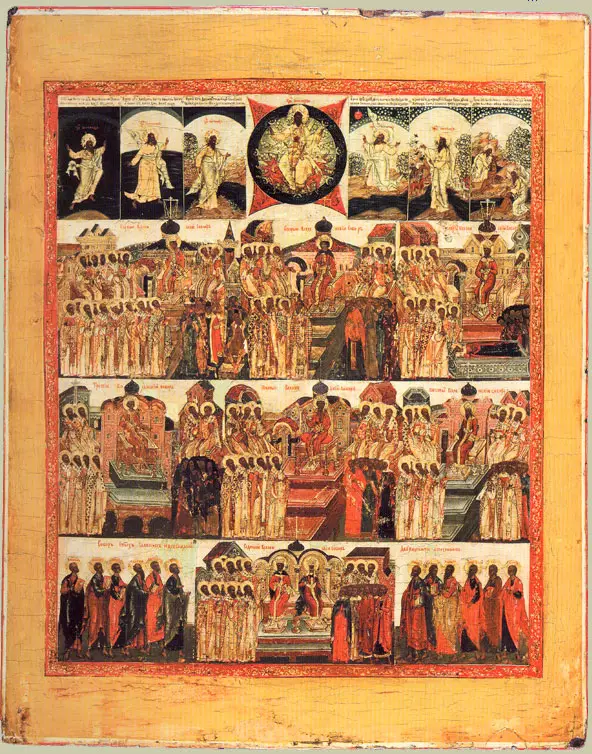
According to Lane, after the age of the fathers the Eastern church became "aggressively traditional": Scripture is to be understood according to the teaching of the fathers, the consensus of the fathers is affirmed at councils, and the highest level of authority belongs to the seven Ecumenical Councils. Maximus the Confessor understood the theologian's task as guarding what had been handed down: "We do not devise new formulas… but confess what was said by the fathers." According to Pelikan, truth was thought of as uniform and unchanging, "innovation" was almost a synonym for "blasphemy," and authority belonged to the consensus patrum – the agreement of the fathers as the expression of the mind of the Church. This principle was accepted by all parties to the disputes – Monothelites and Dyothelites, iconoclasts and iconodules, Greeks and Latins.
Positions
- Maximus the Confessor
- To confess with soul and lips means to affirm what the fathers taught
- Theodore the Studite
- A statement confirmed by the testimony of the fathers is needed; even the proclamation of another gospel by an angel or an emperor must be rejected
- Maximus's opponents
- Every formula not found in the fathers is plainly an innovation; nothing should be added to the language of the early councils
- The West (according to Lane)
- The supreme authority of the pope as the only apostolic see
Key points
- Pelikan: the difference between an apostle and a father is not one of kind but of degree; Athanasius is the "God-bearing teacher," Basil the "great eye of the Church". Apparent disagreements among the fathers were explained as different meanings of words or “improper” usage; not everything ancient is apostolic, but everything orthodox must be apostolic. Scripture is the highest authority, but behind the historical narrative stands a spiritual sense; its understanding is given to those "found worthy" of the Holy Spirit. Pelikan compares the councils that checked quotations against manuscripts to congresses of “antiquarians and paleographers”
- The Lateran Council of 649 and the Council of Constantinople of 680–681 checked collections of quotations against manuscripts
- Maximus acknowledges that the church's teaching is broader than conciliar definitions: deification is not included in the creed but belongs to the "mystery of the church's faith"
Outcome
The authority of the fathers was accepted by all disputing parties as a common principle, and the dispute was over whom to cite and how; lists of the Ecumenical Councils became a means of asserting one's own orthodoxy.
People
- Maximus the Confessor
- Sophronius of Jerusalem
- Theodore the Studite
- Nikephoros of Constantinople
- Photius
- John of Damascus
Terms
- consensus of the fathers – to ekklesiastikon fronema
- The agreement of the fathers as the expression of the mind of the catholic Church.
- inspired – theopneustos
- A word applied in the New Testament to the Old, but according to Pelikan also applicable to the fathers.
Place
Constantinople, Rome
Sources disagree
Pelikan describes the principle with examples from the 7th to the 15th centuries without a common date, singling out the 7th century (Maximus, Sophronius); Lane places the beginning of the process in the 5th century and carries the list of councils to 787.
Sources
- Jaroslav Pelikan – The Christian Tradition, vol. 2: The Spirit of Eastern Christendom (600–1700) (Russian edition), p. 94–96, 101–112, 115–116, 121–123, 172–173
- Tony Lane – Christian Thinkers (Russian edition), p. 70–71
Data compiled: 2026-11-17