2nd–5th centuries · 1st century
The Eucharist in the early Church: real presence and sacrifice
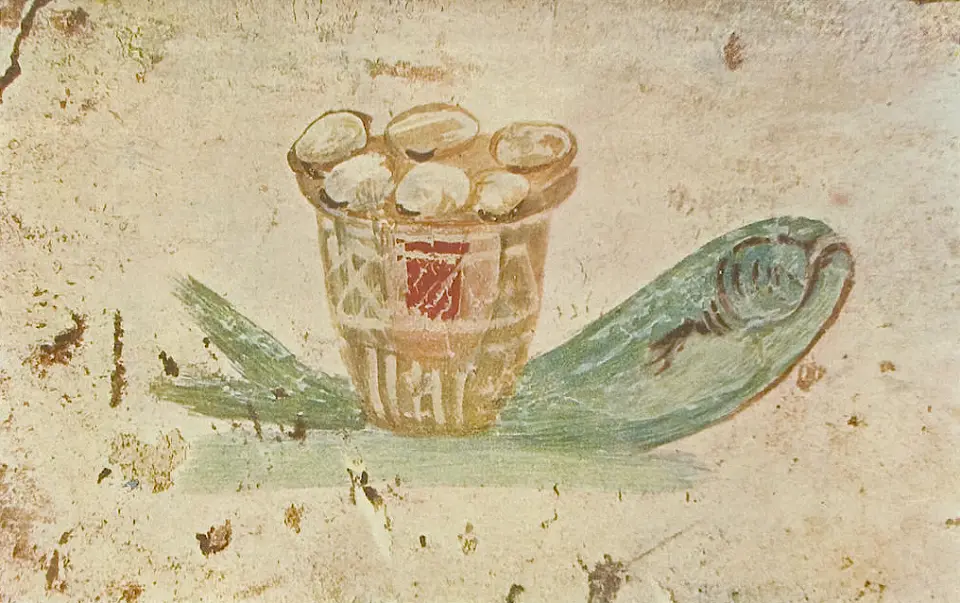
The baptized brought the "eucharistic sacrifice," and the bishop said the prayer of thanksgiving; by the mid-3rd century the Eucharist was limited to bread and wine, and the agape separated from communion (Hall). Ignatius called the bread the "medicine of immortality" (To the Ephesians 20), Irenaeus (Against Heresies 4.18.5) called it a Eucharist "of two realities, earthly and heavenly," and the language of body and blood was so realistic that pagans accused Christians of cannibalism. Pelikan stresses that until the 9th century the real presence was not a matter of controversy and the Fathers had the concepts neither for a purely symbolic interpretation nor for explaining a change. Cyprian gave one of the clearest pre-Nicene interpretations of the Eucharist as a sacrifice of remembrance that does not repeat Calvary. In the 4th–5th centuries Ambrose established in the West the teaching that the bread and wine are changed by the power of Christ's word, and Cyril of Alexandria derived Christology from the Eucharist.
Positions
- Ignatius
- The Eucharist is "the flesh of the Savior," against the Docetists (To the Smyrnaeans 7); yet "His blood" is "incorruptible love" (To the Romans 7)
- Tertullian
- The bread is the "figure" of Christ's body, yet the flesh of the communicant feeds on the flesh and blood of Christ
- Cyprian
- The sacrifice of Calvary is perfect; the eucharistic sacrifice is a remembrance, not a repetition
- Origen, Eusebius, Basil, Gregory of Nazianzus (per Berkhof)
- A symbolic or spiritual understanding
- Cyril, Gregory of Nyssa, Chrysostom, John of Damascus (per Berkhof)
- The flesh and blood of Christ are united with the bread and wine
- Nestorius and Eutherius of Tyana
- The bread and the body remain in their own ousia; for the believer, by faith, the bread becomes the Body of Christ
Key points
- González: for Justin (1 Apol. 66), in the Eucharist one receives the flesh and blood of Jesus, yet the bread also remains food that nourishes bodies
- Hall: around the 4th century the free eucharistic prayer gives way to a written text
- Berkhof: when the bishop became a priest, thanksgiving became the consecration of the elements, and the Supper a sacrifice offered by the priest
- Lane: for Ambrose (On the Mysteries 9.52), if the word of Elijah brought fire down from heaven, the word of Christ changes the nature of the elements
- Pelikan: Cyril, relying on John 6, taught that the Body in the Eucharist is the flesh of the Logos himself; Theodore taught the real presence but did not build his Christology on it
- Ferguson: the Didache (9–10) apparently preserves a meal context: the cup precedes the bread, and Jesus’ death and resurrection are not mentioned; communion separated very early from the meal, which developed separately as the agape. In Justin (1 Apol. 65–67) the Sunday assembly has readings, sermon, bread and wine with water, the “Amen” and communion sent to the absent. The most-cited 2nd-century Eucharistic text was Mal 1:11 (already Didache 14): Justin saw in bread and cup the Gentiles’ sacrifice of thanksgiving, Irenaeus, against Gnostics, “first fruits” of God’s creation, and Cyprian joined sacrifice and real presence (“the Lord’s passion is the sacrifice”). In the 4th century in some circles the idea of sacrifice widened to propitiation and to offering the crucified Christ, developed in the medieval West. Ignatius identified bread with Christ’s flesh, Irenaeus spoke of a heavenly reality added; a change of elements is clear only from the fourth century.
- Ayres and Humphries: after Augustine (to c. 650) there was no great dispute over eucharistic presence; most assumed a unique, transforming presence of Christ.
- Ayres and Humphries: Fulgentius linked the epiclesis with the unity of love in the Church; Facundus: the sacrament contains “the mystery” of the body and blood.
- Ayres and Humphries: Gregory the Great was credited with a vision of a bleeding Christ in the gifts; Isidore held offering for the dead apostolic tradition.
- Louth: by the early fifth century the centre of mystery theology shifts from baptism to the Eucharist. In the fourth century most received faith as adults, and initiation rites from baptism to communion grew ever more dramatic; then more people were baptized as infants, baptism became an ‘unconscious memory’, and the experience of the sacraments centred on the liturgy. Dionysius the Areopagite in the early sixth century calls the Eucharist the ‘rite of rites’. The first clear sign of this shift is On the Mystical Supper, preached by Theophilus of Alexandria (d. 412) on Maundy Thursday. For Theophilus Old Testament types are fulfilled in the sacraments too; Christ is present as God and man, “priest and victim” – words soon in liturgy; he twice cites 2 Peter 1:4 on sharing in the divine nature.
Outcome
The doctrine of the real presence lived in faith and liturgy before it was formulated; the line of "change" (Ambrose, Cyril) led, according to Berkhof and Lane, to the later doctrine of transubstantiation, while Augustine, according to Berkhof, slowed the development of the realistic theory.
People
- Ignatius of Antioch
- Justin Martyr
- Irenaeus of Lyons
- Tertullian
- Cyprian of Carthage
- Hippolytus of Rome
- Clement of Alexandria
- Origen
- Ambrose of Milan
- Cyril of Alexandria
- Theodore of Mopsuestia
- Nestorius
- Augustine
- Cyril of Jerusalem
- Fulgentius of Ruspe
- Facundus of Hermiane
- Isidore of Seville
- Theophilus of Alexandria
Terms
- Eucharist – eucharistia
- Thanksgiving; the sacrifice of thanksgiving and the bishop's prayer.
- agape
- A common meal without the consecrated gifts.
- change – μεταβολή
- In Justin, the change of the elements at consecration and/or the transformation of the communicant's body (Pelikan).
- transubstantiation
- The change of the very substance of bread and wine into the substance of the Body and Blood of Christ by divine power; as a term, from the mid-12th century.
Sources disagree
The books give no exact dates for the pre-Nicene Fathers; Lane dates Ambrose's episcopate 374–397; Pelikan places the debate between Cyril and the Antiochenes in the time of Theodore, Cyril and Nestorius.
Sources
Primary sources
- Ignatius of Antioch – Epistle to the Ephesians, ch. 20
- Ignatius of Antioch – Epistle to the Romans, ch. 7
- Ignatius of Antioch – Epistle to the Smyrnaeans, ch. 7
- Irenaeus of Lyons – Against Heresies, bk. IV, ch. 18
- Justin Martyr – First and Second Apology, pt. 1, ch. 65–67
- Didache (The Teaching of the Twelve Apostles), ch. 9–10
- Ambrose of Milan – On the Mysteries, ch. 9, para. 52
Textbooks
- Stuart G. Hall – Doctrine and Practice in the Early Church (Russian edition), p. 19–20
- Jaroslav Pelikan – The Christian Tradition: A History of the Development of Doctrine, vol. 1 (Russian edition), p. 35–36, 175–180, 250–252
- Louis Berkhof – History of Christian Doctrines (Russian edition), p. 185–186
- Justo L. González – A History of Christian Thought in One Volume (Abingdon, 2014), p. 45
- Tony Lane – Christian Thinkers (Russian edition), p. 48
- The Oxford Handbook of Sacramental Theology, ed. Hans Boersma, Matthew Levering (2015), p. 169–171, 171–172, 172–173, 173, 206–207, 206, 207, 217, 218–219
Related entries
- Grew out of: Hierarchical priesthood and the priesthood of all believers (2nd–3rd centuries)
- Developed in: Sacraments in the 4th century: mystagogy, baptism, the Eucharist and the Trinitarian debates (4th century)
In church history
- Early Christian worship, baptism, and church order (2nd–3rd c.)
Data compiled: 2026-11-17