late 1st – early 2nd century · 1st century
The Didache and the Apostolic Fathers: baptism, Eucharist and the way of life
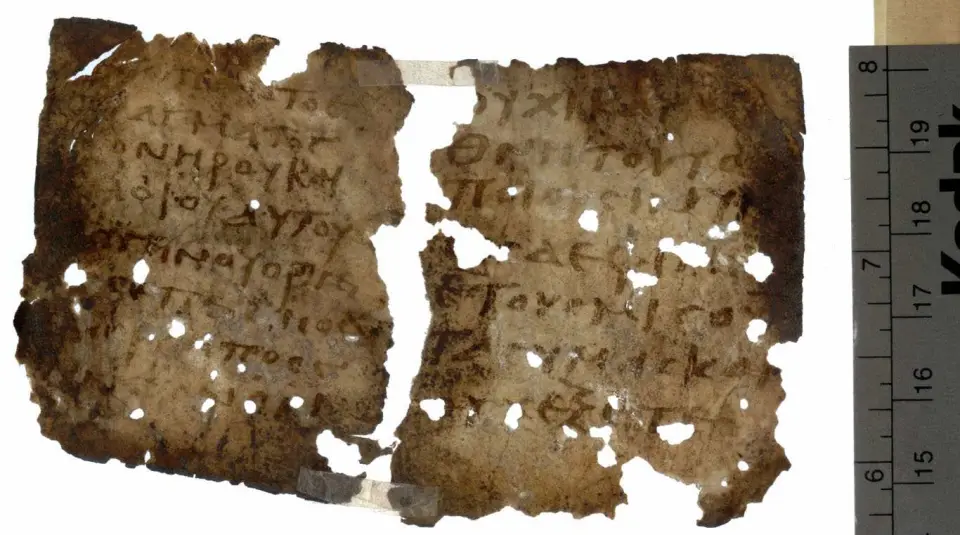
The Didache, or "Teaching of the Twelve Apostles," is the oldest surviving manual of church discipline, discovered in the 1870s. It prescribes baptism in the name of the Father, the Son and the Holy Spirit in living (running) water, and, if there is neither kind of water, by pouring water three times on the head (Didache 7); according to González it is the oldest text with this form of baptism. Catechumens memorized the moral code of the "Two Ways" – the way of life and the way of death; Hall stresses that no dogmatic knowledge was required for baptism. Chapters 9–10 give thanksgiving prayers over the cup and the bread, and chapter 14 bids them break bread on the Lord's day "that your sacrifice may be pure"; it is disputed whether they speak of a single meal or of an agape and a Eucharist. According to Berkhof, in the Apostolic Fathers the sacraments are the means by which the blessings of salvation are conveyed: baptism begins the new life and forgives sins, and the Supper imparts immortality.
Positions
- One reading (González)
- Chapters 9, 10 and 14 speak of a single meal
- Another reading (González)
- Chapters 9–10 are an agape (love feast), chapter 14 is the Eucharist in the strict sense
- Hermas and 2 Clement (Berkhof)
- Baptism forgives only past sins
Key points
- Lane: by Didache 7, running water is preferred; other water, cold or warm, is allowed, and when water is lacking, pouring three times on the head (so also González). The Didache reflects the transition from itinerant apostles and prophets to settled bishops (presbyters) and deacons
- The “Two Ways” is quoted almost verbatim in the Epistle of Barnabas (18–20) and appears in part in the Qumran Manual of Discipline
- Hall: the Two Ways probably originated among Jewish proselytes; baptism in the name of the Trinity shows theological depth already at an early stage
- González: by Didache 8, Christians differ from the "hypocrites", who fast on Monday and Thursday, by fasting on Wednesday and Friday and by saying the Lord's Prayer three times a day; he sees the Didache as an expression of moralism and legalism
Outcome
The Didache is a major source for early liturgy and church order (González); in the Apostolic Fathers the idea of sacraments as means of conveying grace takes shape (Berkhof).
People
- Hermas
Terms
- catechumen
- A new convert preparing for baptism; his name was entered in a book beside that of his sponsor (Hall).
- Two Ways
- A moral code: the way of life (love of God and neighbor, the Sermon on the Mount, the last five commandments) and the way of death (a list of sins).
Place
Syria (probably) or Palestine
Sources disagree
Lane: late 1st century (questioned), probably Syria; González: late 1st or early 2nd century, Syria or Palestine, the manuscript found in 1875; Hall gives no date and speaks of "the earliest times"; Berkhof places the teaching of the Apostolic Fathers c. 100.
Sources
Primary sources
- Didache (The Teaching of the Twelve Apostles), ch. 7–10, 14
- Epistle of Barnabas, ch. 18–20
Textbooks
- Stuart G. Hall – Doctrine and Practice in the Early Church (Russian edition), p. 15–16
- Louis Berkhof – History of Christian Doctrines (Russian edition), p. 21
- Justo L. González – A History of Christian Thought in One Volume (Abingdon, 2014), p. 29–30
- Tony Lane – Christian Thinkers (Russian edition), p. 15–16
In church history
- The Didache (the Teaching of the Twelve Apostles) (the late 1st – early 2nd century)
- Writings of the "Apostolic Fathers" (Didache, Papias, Epistle of Barnabas, 2 Clement) (100–160)
- The discovery of the Didache in Istanbul (1875)
Data compiled: 2026-11-17