c. 190–272 · 2nd century
Dynamic monarchianism (adoptionism): Theodotus and Paul of Samosata
Dynamic monarchianism preserved the unity of God (monarchia) by turning the divine in Christ into an impersonal power (dynamis). In Rome, under Bishop Victor, the teaching of Theodotus that Christ was a "mere man" was condemned (Eusebius, Church History 5.28); his followers were called psilanthropists, later Artemonites. The most prominent representative was Paul of Samosata, bishop of Antioch: the power of God dwelt in Jesus as in Moses and the prophets, differing only in quantity; baptism was the decisive event, and "Jesus Christ is from below" (ibid. 7.30). A synod in 268 condemned Paul, but under the protection of Queen Zenobia he kept his see until 272.
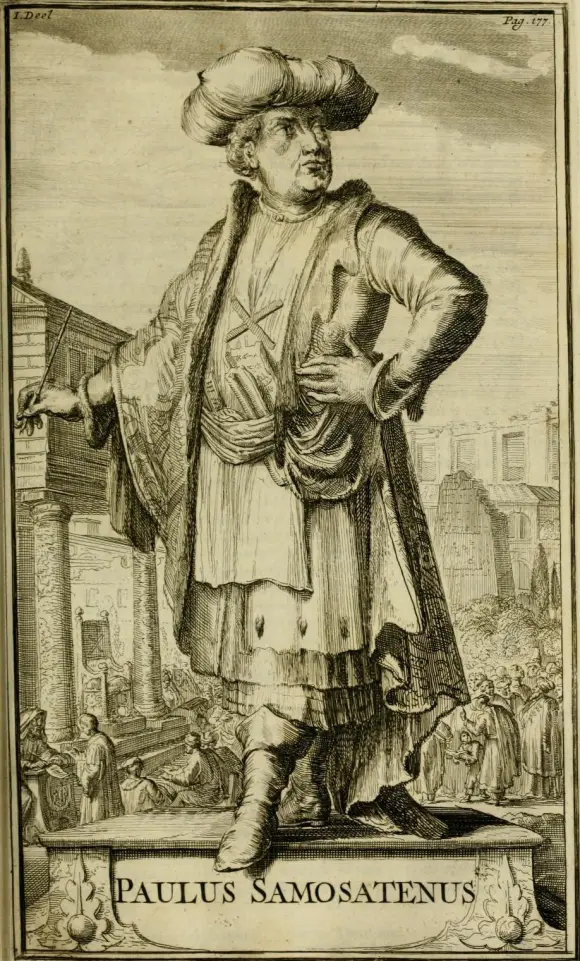
Positions
- Theodotians
- Christ is a mere man; the divine nature is an impersonal power
- Paul of Samosata
- Jesus is a man in whom the Logos dwelt as an impersonal power; the union is not ontological; Jesus was gradually deified
- Origen and his followers (according to González)
- The Word is a hypostasis alongside the Father, really united with humanity
Key points
- Paul was accused of forbidding hymns to Christ (Eusebius, Church History 7.30)
- Pelikan: in the mid-3rd century orthodoxy did not yet have a formula for "thinking of Jesus Christ as God"
- Hall: Paul has ideas later developed by Arius and Apollinaris; the synod may also have had political motives
- Berkhof: dynamic monarchianism is a counterpart of the Ebionite heresy and a forerunner of the Socinians and Unitarians
Outcome
Paul was deposed by the synod of 268 and expelled in 272; the Eastern churches did not recognize the baptism of his followers; the sect died out (Berkhof).
People
- Theodotus the Cobbler
- Artemon
- Paul of Samosata
- Victor of Rome
- Zenobia
Terms
- psilanthropists – psilos anthropos
- "mere man".
- dynamic monarchianism – dynamis, monarchia
- A modern designation; the term "monarchian", according to Pelikan, was introduced by Tertullian.
- consubstantial – homoousios
- Of one essence: with the Father according to the Godhead, with us according to the humanity. The most disputed, non-biblical word of the creed.
Place
Rome, Antioch
Sources disagree
Theodotus – the time of Victor, 189–199 (Hall), 3rd century (Berkhof). Paul: elected bishop c. 260 (González), mid-3rd century (Pelikan); synod of 268, expulsion in 272 (Hall). Theodotus is called "the Tanner" (Hall), "the Cobbler" (Pelikan), "of Byzantium" (Berkhof).
Sources
Primary sources
- Eusebius of Caesarea – Church History, bk. V, ch. 28; bk. VII, ch. 27–30
Textbooks
- Stuart G. Hall – Doctrine and Practice in the Early Church (Russian edition), p. 52, 75–76
- Jaroslav Pelikan – The Christian Tradition: A History of the Development of Doctrine, vol. 1 (Russian edition), p. 184–186
- Louis Berkhof – History of Christian Doctrines (Russian edition), p. 52–53
- Justo L. González – A History of Christian Thought in One Volume (Abingdon, 2014), p. 108–109
Related entries
- Developed in: "Logos-man" and "Logos-flesh": the Antiochene and Alexandrian christologies (4th–5th centuries)
In church history
- Monarchianism: dynamic and modalist (Noetus, Sabellius, Paul of Samosata) (late 2nd c. – 272)
Data compiled: 2026-11-17