c. 200–253 · 2nd century
Clement and Origen: the incarnate Logos and the created soul of Jesus
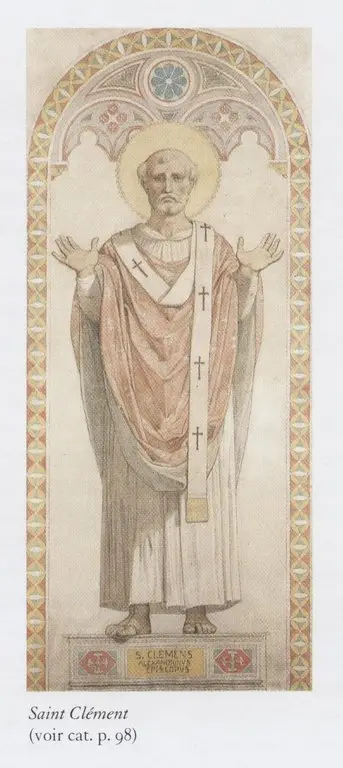
Both Alexandrians, according to Berkhof, teach that at the Incarnation the Logos assumed human nature in its fullness – body and soul. Clement affirmed the reality of Christ's body against the docetists, but held that he ate only so that his companions would not form a docetic impression (Stromata 6.9); Pelikan writes that his christology had a docetic flavor, though he was not a docetist. Origen taught the created soul of Jesus: one of the rational spirits remained faithful, and its mind was inseparably united with the Logos, like iron and fire, and through it with the body (On First Principles 2.6.3–6); Christ is "something composite" (cf. Against Celsus 1.66). He also taught the exchange of properties (communicatio idiomatum; On First Principles 2.6.3), which became, according to González, one of the basic tenets of Alexandrian christology.
Positions
- Clement
- Christ had a real body, but it did not need food (Stromata 6.9)
- Origen
- Two natures in inseparable union, the created soul of Jesus, the steps of the epinoiai
- Berkhof
- Clement did not fully succeed in avoiding docetism; Origen hardly succeeded in preserving the unity of the two natures
Key points
- González: Origen understood the need in Christ not only for a human body but also for a human mind, which some Alexandrians later abandoned
- Berkhof: in Origen the soul of Christ preexisted, the body was deified by the Logos, and at his glorification Christ became omnipresent
- Hall: the ideas of two natures and their unmixed union became common Christian property, but Origen is usually not mentioned because of his teaching on preexistent souls
- Pelikan: Clement held that Christ came to reveal the true philosophy
Outcome
The exchange of properties became one of the basic tenets of Alexandrian christology (González); Origen introduced the teaching on the soul of Jesus to resolve difficulties arising from the Logos doctrine (Hall).
People
- Clement of Alexandria
- Origen
- Celsus
Terms
- communication of properties – communicatio idiomatum
- The transfer of the properties of one of Christ's natures to the other: the actions and states of the humanity may be ascribed to the divinity and vice versa. In Luther and strict Lutherans, the basis of the ubiquity of Christ's body.
- something composite – syntheton ti chrema
- The union of the divine and the human in Christ (Origen against Celsus).
- aspects – epinoiai
- Aspects of the Word: Wisdom, Word, Life, Truth; the lower ones (Shepherd, High Priest) reflect the incarnation.
Place
Alexandria
Sources disagree
Clement – c. 190 to before 216 (Lane), late 2nd – early 3rd centuries (Pelikan); Origen – c. 202–250 (González), c. 203–253 (Hall); Berkhof: 2nd–3rd centuries.
Sources
Primary sources
- Clement of Alexandria – The Stromata, bk. VI, ch. 9
- Origen – On First Principles (De Principiis), bk. II, ch. 6
- Origen – Against Celsus, bk. I, ch. 66; bk. V, ch. 39
Textbooks
- Stuart G. Hall – Doctrine and Practice in the Early Church (Russian edition), p. 73–75
- Jaroslav Pelikan – The Christian Tradition: A History of the Development of Doctrine, vol. 1 (Russian edition), p. 56–58
- Louis Berkhof – History of Christian Doctrines (Russian edition), p. 48
- Justo L. González – A History of Christian Thought in One Volume (Abingdon, 2014), p. 94–95
- Tony Lane – Christian Thinkers (Russian edition), p. 25–26
Related entries
- Develops: Origen: Eternal Creation, the Pre-existence of Minds and a Pre-mundane Fall – from Gregory of Nyssa to the Condemnation of 553 (3rd–6th centuries)
Data compiled: 2026-11-17