c. 200–215 · 2nd century
Clement of Alexandria: Philosophy as a "Covenant with the Greeks," Faith and Knowledge
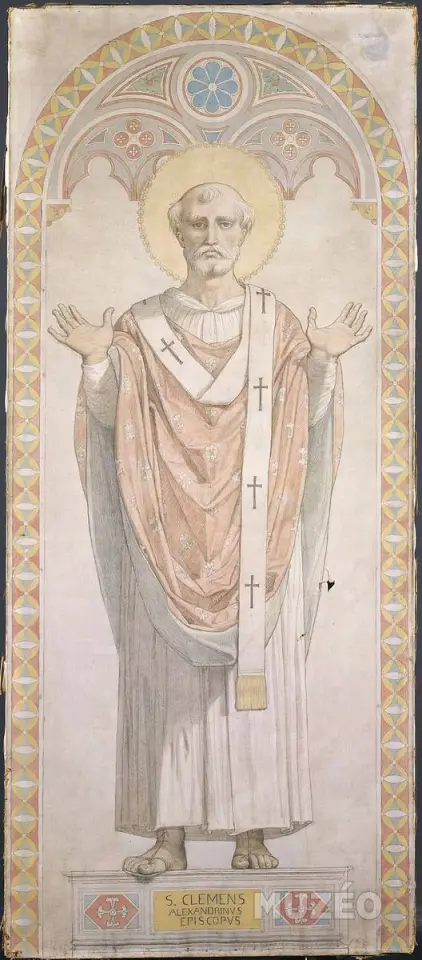
In Alexandria Hellenic learning combined with the gospel and produced the Alexandrian type of theology (Berkhof); its background was the Neoplatonism of Plotinus (González). Clement, continuing the line of Justin and Athenagoras, did not doubt that there is truth in Greek philosophy: philosophy was given to the Greeks, as the Law to the Jews, to lead them to Christ (Stromata 1.5). Faith is necessary for knowledge, but knowledge is also necessary for faith (Stromata 2.4; 5.1); for Tertullian faith is everything, for Clement it is the first step, on which the knowledge of the Christian Gnostic is built. His three works – the Protrepticus, the Paedagogus and the Stromata – correspond to stages of instruction: the Word "first exhorts, then trains, and finally teaches" (Paedagogus 1.1).
Positions
- Clement, Justin, Athenagoras
- There is truth in philosophy; it is God's covenant with the Greeks (Stromata 6.8)
- Tertullian
- Faith is all that is needed
- Berkhof
- Clement is less orthodox than Irenaeus and Tertullian: he did not hold to the Rule of Faith as strictly and excessively exalted reason
Key points
- The philosophers, according to Clement (Stromata 1.17; 5.14), borrowed from the Jews, but also knew the truth by the direct action of God
- "Knowledge must be believed," "faith must be known" (Stromata 2.4)
- Clement applied Galatians 3:24 to philosophy – a "tutor to Christ" (Stromata 1.5)
- Berkhof: the allegorical method opened the door to arbitrary interpretation
- Shelley: Clement held philosophy a preparation for Christianity: to the Greeks what the law was to the Hebrews, leading them as children to Christ. He differed from Gnostics in Christian conduct: illumination comes to the pure in heart, the humble, who love virtue for its own sake. The basis of possible mystical union with God is the image of God implanted in creation. Unlike the Valentinians, who rejected creation as the work of an evil god, Clement puts creation at the center: God planted the good seed of truth in all rational creatures, and any truth comes from the Creator. After Clement Greek thought joined Christian thought, without which the achievements of the early councils would have been impossible
Outcome
The concept of philosophy as a "tutor" to Christ; according to Lane, a theory of religious knowledge first appears in Clement.
People
- Clement of Alexandria
- Pantaenus
- Plotinus
Terms
- Christian Gnostic
- A Christian who has passed from faith to knowledge, whose goal is the contemplation of God.
- pedagogue – paidagogos
- A tutor; the true Pedagogue is the Word of God.
Place
Alexandria
Sources disagree
Hall: Clement left Alexandria in 202 or 203, died in 215 (216) or 221; González: successor of Pantaenus probably in 200, died between 211 and 216; Lane: head of the school c. 190, died before 216; Berkhof: 2nd–3rd centuries.
Sources
Primary sources
- Clement of Alexandria – The Stromata, bk. I, ch. 5, 17; bk. II, ch. 4; bk. V, ch. 1, 14; bk. VI, ch. 8
- Clement of Alexandria – The Instructor (Paedagogus), bk. I, ch. 1
Textbooks
- Stuart G. Hall – Doctrine and Practice in the Early Church (Russian edition), p. 64–65
- Jaroslav Pelikan – The Christian Tradition: A History of the Development of Doctrine, vol. 1 (Russian edition), p. 75–78
- Louis Berkhof – History of Christian Doctrines (Russian edition), p. 46–47
- Justo L. González – A History of Christian Thought in One Volume (Abingdon, 2014), p. 77–80
- Tony Lane – Christian Thinkers (Russian edition), p. 24–26
- Bruce L. Shelley – Church History in Plain Language (Russian edition), Ch. 8, sec. «Пастырь философов»
Related entries
- Develops: The Second-Century Apologists: Christianity as the True Philosophy and Justin's Doctrine of the Logos (140–180)
- Developed in: Origen, On First Principles: The First System of Theology (c. 220)
In church history
- Clement of Alexandria and the Alexandrian school of theology (late 2nd c. – 215/216)
Data compiled: 2026-11-17