4th century · 4th century
Church and empire in the 4th century: Eusebius, Theodosius, Ambrose
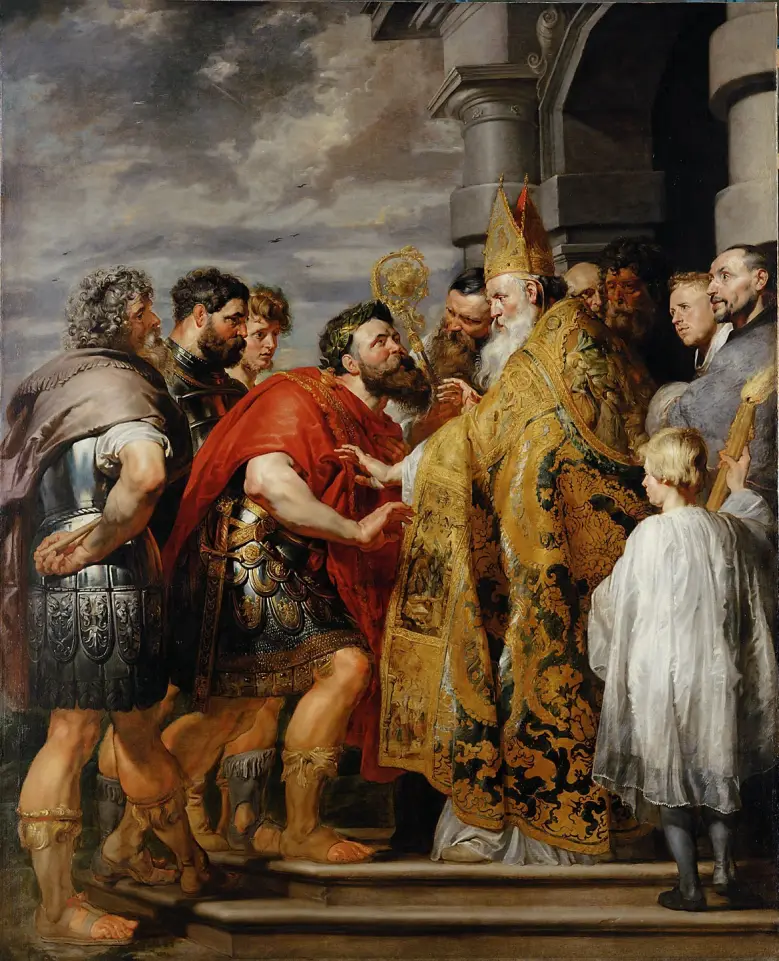
Eusebius of Caesarea regarded the conversion of Constantine and the founding of a Christian empire as a natural stage of Christianity and presented the emperor (Eusebius, Oration in Praise of Constantine 1–2) as receiving from the Word "a transcript of the Divine sovereignty" and governing in imitation of God, and as "acting as interpreter to the Word of God", recalling the whole human race to the knowledge of God; critics accused him of "baptizing" the Eastern conception of a "divine" monarch. Theodosius' edict Cunctos populos (380) required all peoples to remain in the religion "which the divine Apostle Peter handed over to the Romans", and, according to Hall, Theodosius sought to identify Church and Empire. Ambrose of Milan, by contrast, introduced principles of the church's independence: "the Church belongs to God, therefore it ought not to be assigned to Caesar," "the Emperor is within the Church, not above it" (Ambrose, Sermon against Auxentius 35–36). In 390 he obtained Theodosius' public penance.
Positions
- Eusebius
- The union of church and empire is a natural stage of Christianity; the emperor is the interpreter of the Word
- Theodosius
- The Nicene confession is binding on all subjects; decrees against heretics
- Ambrose
- The church belongs to God and is not handed over to Caesar; the emperor is "the son of the Church" (Sermon against Auxentius 36) and subject to church penance
Key points
- Lane: Eusebius was more a historian than an outstanding theologian; the Byzantine monarchs readily accepted his interpretation of their status
- Hall: the edict of 380 speaks of the religion of the pontiff Damasus and Peter of Alexandria, while Theodosius is silent about Paul. By 451 the organization of the Church increasingly reproduced the administrative divisions of the Empire: dioceses, metropolitans, five patriarchates
- Ambrose's three clashes: the altar of Victory (384; Ambrose, Letter 17), the refusal to hand over a basilica to the Arians (385–386), Theodosius' penance for Thessalonica (390)
- Shelley: in Ambrose’s church in Milan services follow the Roman rite, unlike the Byzantine; “orthodox” means “right,” “catholic” “universal”. East and West each claimed the one true form of Christianity; their differing relation to Christian emperors symbolizes their diverging fates. In Orthodoxy Constantine’s reign is regarded as the summit of Rome’s evolution into a religious monarchy: the cult of the Unconquered Sun, imperial religion under Aurelian, joined in Constantine’s day a new view of monarchy – the emperor in the world was as the sun in the sky, its representative on earth. Having defeated his enemies with the Christian God’s help, Constantine placed the empire under the protection of the cross. The Christian mind, enchanted by the conversion, made unlimited monarchy part of its world view and the state the bearer of religion. From Nicaea (325) to the Seventh (787) the emperor convened and presided over Councils – hence “Church of the seven Councils”. Some independent-minded Christians see in this the Church’s enslavement by the state or a fall from primitive freedom, while for Eastern Christians Constantine remains the holy founder of “Christendom”
- Lyman: Eusebius saw legalized Christianity as the fruit of universal history; Augustine’s City of God saw a hidden pilgrimage not tied to institutions
Outcome
In the East Eusebius' interpretation became the basis for understanding imperial power; in the West Ambrose's principles, according to Lane, became a foundation for the Middle Ages, and González contrasts the Eastern view of the emperor above church authorities with the Western one: the emperor is a member of the church, not above it.
People
- Eusebius of Caesarea
- Constantine the Great
- Theodosius I
- Ambrose of Milan
- Damasus of Rome
- Symmachus
- Justina
Place
Caesarea, Milan, Thessalonica
Sources disagree
Lane: Eusebius was bishop from 313/314 to 339/340; Ambrose's episodes in 384, 385–386 and 390; Hall: Theodosius' edict in 380.
Sources
Primary sources
- Eusebius of Caesarea – Oration in Praise of Constantine, ch. 1–2
- Ambrose of Milan – Sermon against Auxentius on the Giving Up of the Basilicas, para. 35–36
- Ambrose of Milan – Letter 17 (to Valentinian II), letter 17
Textbooks
- Stuart G. Hall – Doctrine and Practice in the Early Church (Russian edition), p. 106–107, 154–155
- Tony Lane – Christian Thinkers (Russian edition), p. 34–35, 48–49
- Bruce L. Shelley – Church History in Plain Language (Russian edition), Ch. 9, sec. «Церковь обретает власть»; Ch. 15, sec. «Ключ к православию», «Воля Божья в обществе людей»
- The Oxford Handbook of Systematic Theology, ed. John Webster, Kathryn Tanner, Iain Torrance (2007), p. 512
Related entries
- Rejected in: Augustine, The City of God: the meaning of history, the two cities and the relation to the state (413–427)
Data compiled: 2026-11-17