1260–1274 · 13th century
Thomas Aquinas: The Synthesis of Reason and Revelation, the Summa contra Gentiles and the Summa Theologiae
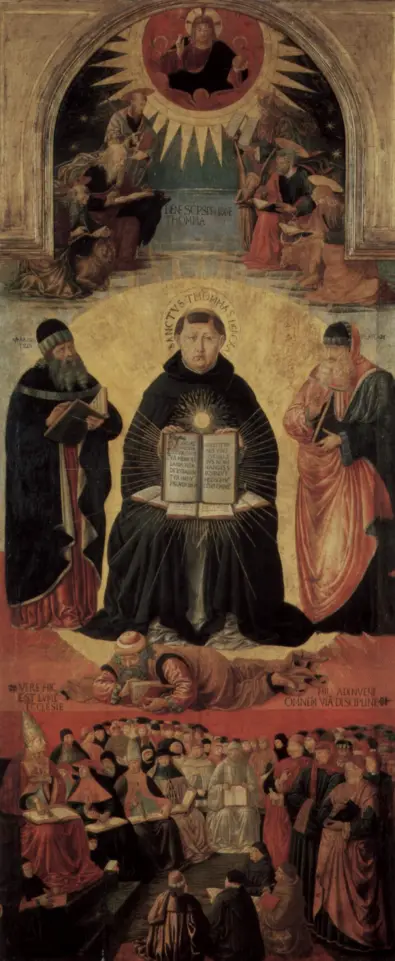
Following Albert the Great, who distinguished philosophy and theology by their principles, Thomas distinguished truths accessible to reason from truths that surpass it: the articles of faith are above reason but do not contradict it. Philosophy is autonomous but not infallible; Aristotle was accepted with corrections (for example, against the eternity of the world). Grace does not destroy nature but perfects it (Summa Theologiae I, q. 1, a. 8) – Lane compares the system to a two-story house. In the Summa contra Gentiles (early 1260s) books 1–3 argue from reason, and the fourth sets out the Trinity, the incarnation, the sacraments and the resurrection. The Summa Theologiae, intended to replace the Sentences, remained unfinished.
Positions
- Opponents of Aristotle
- Wanted to ban him
- Bonaventure
- To keep to the Platonist worldview
- Thomas Aquinas
- To accept Aristotle's philosophy, corrected; grace perfects nature
- Critics, including Luther (according to McGrath)
- It is risky to identify Aristotle's First Unmoved Mover with the Christian God
Key points
- Some truths accessible to reason God nevertheless revealed, to make them certain (Summa Theologiae I, q. 1, a. 1: otherwise they would be known only by a few, after a long time, and "with the admixture of many errors")
- The structure of the Summa Theologiae: 512 questions; objections, arguments, "reply"
- Aristotle is "the Philosopher," Augustine the chief theological authority after the Bible
- McGrath: scholasticism is not a system of views but a way of organizing theology
- Shelley: Aquinas separated philosophy from theology and reason from revelation, yet saw no contradiction; reason proves God’s existence, revelation the Trinity.
Outcome
Thomism is a new system; Thomas's teaching at first met with official condemnations, but he was canonized in 1323 and named "Universal Doctor of the Church" in 1567; by the late 16th – early 17th century the Summa had replaced the Sentences as the main text.
People
- Thomas Aquinas
- Albert the Great
- Aristotle
- Augustine
- Bonaventure
Terms
- nature and grace
- Grace does not destroy human nature but perfects it.
Place
Paris; Cologne
Sources disagree
Lane: Summa contra Gentiles – early 1260s, Summa Theologiae – the last ten years of his life (to 1274); González gives his lifespan as 1226–1274, Lane as 1225–1274.
Sources
Primary sources
- Thomas Aquinas – Summa Theologiae, pt. I, q. 1, art. 1, 8
Textbooks
- Justo L. González – A History of Christian Thought in One Volume (Abingdon, 2014), p. 252–257
- Alister McGrath – Reformation Thought (Russian edition: «Theological Thought of the Reformation»), p. 101–105
- Tony Lane – Christian Thinkers (Russian edition), p. 123–128
- Bruce L. Shelley – Church History in Plain Language (Russian edition), Ch. 20, sec. «Вершина познания»
Related entries
- Response to: The Arrival of Aristotle in the West: Universities, Three Thirteenth-Century Responses and the Condemnation of the Averroists (1270) (13th century (condemnation – 1270))
- Developed in: Thomas Aquinas: The Five Ways and the Doctrine of Analogy (1264–1274)
- Developed in: Thomas Aquinas on the Trinity: two processions and "subsisting relations" (13th century)
- Rejected in: Duns Scotus, Ockham and Nominalism: The Breakdown of the Medieval Synthesis of Faith and Reason (14th–15th centuries)
In church history
- Thomas Aquinas and Bonaventure: the Peak of Scholasticism (1221–1274)
- Thomism from Leo XIII to Ressourcement Thomism: Aeterni Patris, Nouvelle théologie, retrieval (from 1879)
Data compiled: 2026-11-17