c. 185 – 254 · 2nd century
Origen of Alexandria: school, On First Principles, the Hexapla, Against Celsus
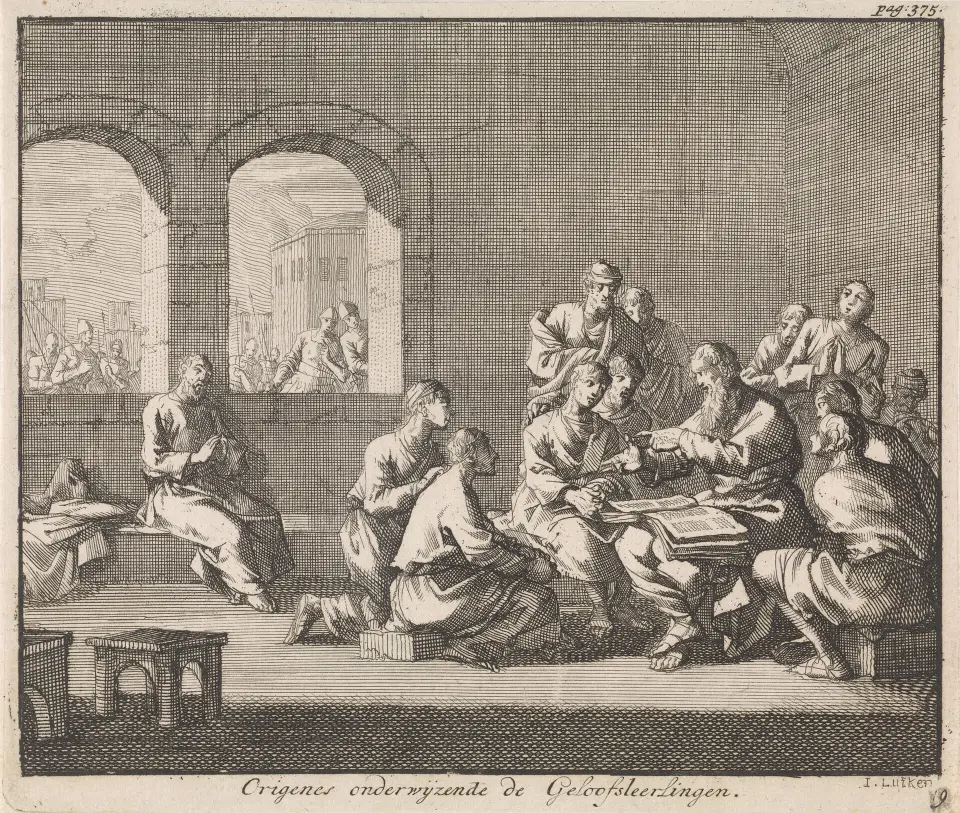
Origen was the son of the martyr Leonides, who died under Septimius Severus. At 18 Bishop Demetrius appointed him to prepare catechumens, and he then headed the philosophical school of Alexandria. Later he came into conflict with Demetrius, one reason being Origen's ordination by Palestinian bishops without the consent of his own bishop. In the 230s he moved to Caesarea in Palestine and taught there for another twenty years with the support of the wealthy Ambrose.
Among his works are On First Principles, the first attempt in Christian history at systematic theology; the Hexapla, which set six versions of the Old Testament in parallel columns; and Against Celsus, the most substantial reply to pagan criticism of Christianity. Even in his lifetime his views provoked controversy (Methodius of Olympus), and later they were partly condemned as heresy.
During the Decian persecution in 250 Origen was tortured and soon died of his wounds in Tyre.
Key points
- On First Principles – the first systematic Christian dogmatics; the Hexapla; Against Celsus
- Conflict with Bishop Demetrius of Alexandria; move to Caesarea in Palestine
- Disputed with Beryllus of Bostra and Methodius of Olympus; later partly condemned
- Tortured during the Decian persecution (250); died of his wounds in Tyre
- Shelley: the eighteen-year-old Origen took over the Alexandrian school; conflict with Bishop Demetrius led him to Caesarea (230). He produced the Hexapla and the first complete system of faith, On First Principles; he saw the exposition of Scripture as his chief work.
- Gunton: Origen in Alexandria, a “theologian of culture”, was more positive than Irenaeus toward philosophy and readier to compromise with culture.
- McGinn: Origen founded Eastern mystical theology; his threefold path is the ancestor of the scheme of purgation, illumination and union
People
- Origen
- Leonidas
- Demetrius of Alexandria
- Ammonius Saccas
- Ambrose of Milan
- Gregory Thaumaturgus
- Beryllus of Bostra
- Methodius of Olympus
Place
Alexandria; Caesarea in Palestine; Tyre
Sources disagree
The birth year (c. 185) is approximate; he died, per the books, two or three years after being tortured under Decius (250), i.e. c. 253–254.
Sources
- Stuart G. Hall – Doctrine and Practice in the Early Church (Russian edition), p. 51, 68–75
- Justo L. González – The Story of Christianity, vol. I (Russian edition), sec. «Ориген Александрийский»
- Tony Lane – Christian Thinkers (Russian edition), p. 26–30
- Justo L. González – A History of Christian Thought in One Volume (Abingdon, 2014), p. 79, 87–96, 109–110
- Jaroslav Pelikan – The Christian Tradition: A History of the Development of Doctrine, vol. 1 (Russian edition), p. 27, 35, 58–59, 127–130, 136, 202–203
- Louis Berkhof – History of Christian Doctrines (Russian edition), p. 190–194
- J. North – A History of the Church (Russian edition), p. 45, 48
- Bruce L. Shelley – Church History in Plain Language (Russian edition), Ch. 8, sec. «Ориген и жажда истины»; Ch. 8, sec. «Ориген и жажда истины», «Теология для мыслителей»
- The Cambridge Companion to Christian Doctrine, ed. Colin E. Gunton (1997), p. 35–36
- The Oxford Handbook of Mystical Theology, ed. Edward Howells, Mark A. McIntosh (2020), Ch. 4, sec. «Eastern Christian Mysticism»
More on the doctrine
- Origen, On First Principles: The First System of Theology (c. 220)
- Alexandrian Exegesis: Clement and Origen – Inspiration, the Three Senses of Scripture and the Hexapla (c. 200–253)
- Origen: the "restoration of all things" (apokatastasis) and its condemnation (3rd century (condemnation – 6th century))
Data compiled: 2026-11-09