1529–1531 · 16th century
The Kappel Wars and the death of Zwingli
The alliance of Switzerland's Protestant cantons alarmed the Catholic cantons, which formed their own league. The First Kappel War began in 1529 and ended in a bloodless truce.
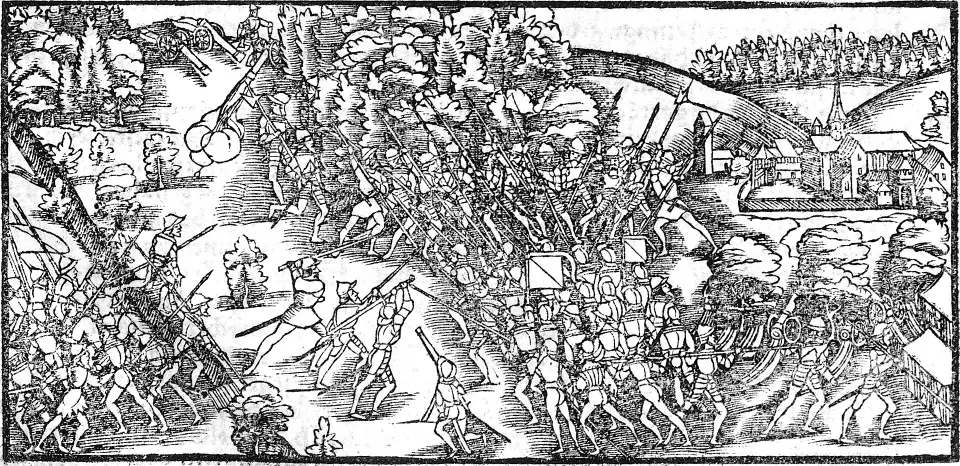
In 1531 five Catholic cantons suddenly attacked Zurich. At the Battle of Kappel on 11 October the Zurich army was routed. Zwingli, who accompanied it as chaplain, was killed.
The Peace of Kappel soon followed, granting each canton freedom to choose its confession. Leadership of the Reformed church passed to Zwingli's successor Heinrich Bullinger. Under him the consolidation of the Reformed tradition began.
Key points
- The First Kappel War (1529) – a bloodless truce
- The Battle of Kappel (11 October 1531) and Zwingli's death
- The Peace of Kappel: freedom of confessional choice by canton
- Zwingli's successor – Heinrich Bullinger
- Stephens: because of Zwingli’s early death his theology was mediated by others, above all Bullinger, who succeeded him in Zurich and stayed there until 1575, eleven years after Calvin’s death. Zwingli’s theology is “the first expression of Reformed theology”, spread by Bullinger through letters, writings and Zurich students. The Second Helvetic Confession (1566) has a stronger role for Word, sacraments, the Spirit and incorporation into Christ, but Bullinger kept Zwinglian divine sovereignty, the distinction of Christ’s two natures and the freedom of the Spirit. From Zwingli come the state’s role in the church, opposition to images and “prophecy”; Zwingli has a theology of the covenant, Bullinger a covenant theology
- Shelley: Zwingli’s reforms spread rapidly through German-speaking Switzerland: Bern joined in 1528, Basel in 1529, then other cantons; they also gained support in Strasbourg, where Bucer, second in influence only to Luther and Melanchthon, sympathized with Zwingli. Conflicts between cantons led to the battle of Kappel (11 October 1531), where Zwingli died; Bullinger led the Reformation in Zurich, and by 1540 Geneva had become the centre of Reformed Christianity
People
- Huldrych Zwingli
- Heinrich Bullinger
Place
Kappel (Switzerland)
Sources
- Tony Lane – Christian Thinkers (Russian edition), p. 173–175
- Justo L. González – The Story of Christianity, vol. II (Russian edition), Part 1, ch. 5
- Justo L. González – A History of Christian Thought, vol. III: From the Protestant Reformation to the Twentieth Century (Abingdon, rev. ed. 1987), p. 74, 86
- Alister McGrath – Reformation Thought (Russian edition: «Theological Thought of the Reformation»), p. 16, 251–252, 379
- The Cambridge Companion to Reformation Theology, ed. David Bagchi, David C. Steinmetz (2004), p. 91, 110
- Bruce L. Shelley – Church History in Plain Language (Russian edition), Ch. 26, sec. «Значение кальвинизма»
Data compiled: 2026-11-09