1–4 October 1529 · 16th century
The Marburg Colloquy
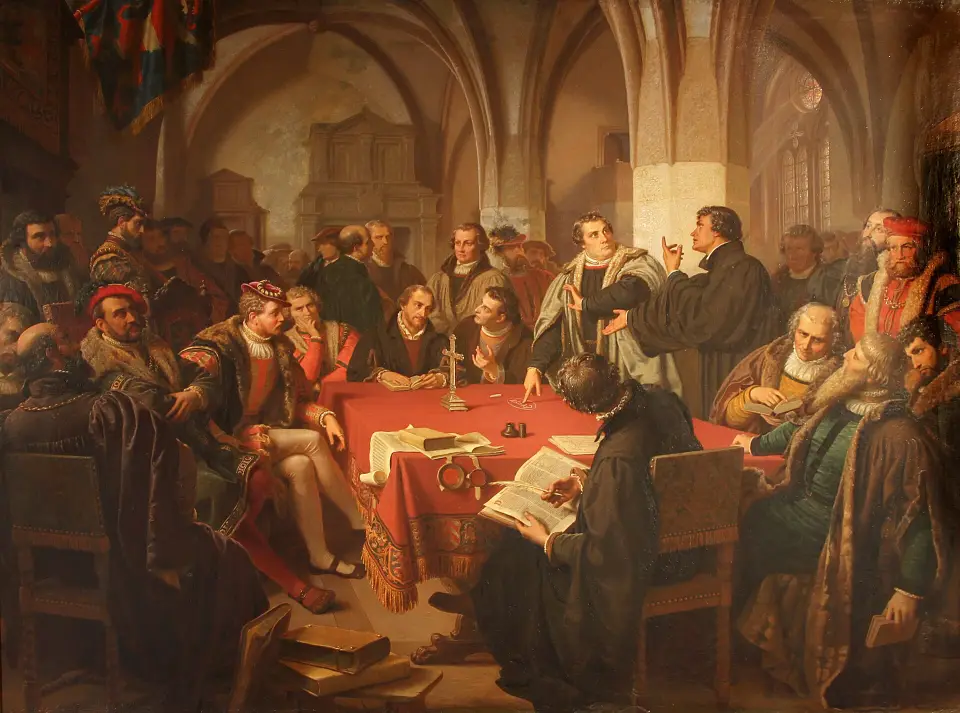
Landgrave Philip of Hesse sought to forge a united evangelical front. To this end he gathered at Marburg Castle Luther, Melanchthon and Bucer on the German side and Zwingli and Oecolampadius on the Swiss side.
The parties agreed on fourteen articles of faith and on five of six points of the fifteenth. But they could not agree on the presence of Christ in the Eucharist. Luther insisted on a real bodily presence "in, with and under" the bread and wine. Zwingli, by contrast, read the words "this is my body" as merely signifying.
The colloquy's failure sealed a permanent split between the Lutheran and Reformed traditions of the Reformation.
Key points
- Agreement on 14 articles, disagreement over the real presence
- Luther: "We have a different spirit"
- Melanchthon feared complications with the emperor
- The split of Protestantism into Lutherans and Reformed
- Lugioyo: at the Marburg Colloquy Luther took a piece of chalk and wrote 'Hoc est corpus meum' on the desk, and would not be moved from the literal sense of these words
People
- Martin Luther
- Huldrych Zwingli
- Philip of Hesse
- Philip Melanchthon
- Martin Bucer
- Johannes Oecolampadius
Place
Marburg
Sources
- Tony Lane – Christian Thinkers (Russian edition), p. 162, 165, 174
- Alister McGrath – Reformation Thought (Russian edition: «Theological Thought of the Reformation»), p. 256–257, 340, 379
- Justo L. González – A History of Christian Thought, vol. III: From the Protestant Reformation to the Twentieth Century (Abingdon, rev. ed. 1987), p. 85, 113, 117, 129
- J. North – A History of the Church (Russian edition), p. 246
- Louis Berkhof – History of Christian Doctrines (Russian edition), p. 187–188
- The Oxford Handbook of Christology, ed. Francesca Aran Murphy (2015), p. 337
More on the doctrine
Data compiled: 2026-11-09