1643–1649 · 17th century
The Westminster Assembly and the Westminster Confession
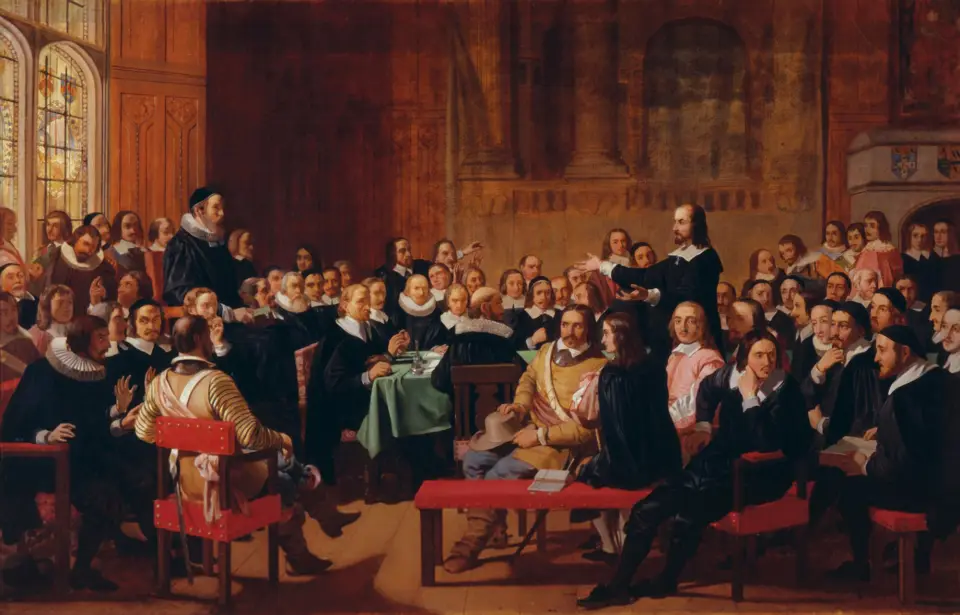
In 1640 Charles I was forced to summon Parliament. The Long Parliament, bound to the Scots by the Solemn League and Covenant (1643), convened the Westminster Assembly. It brought together some 121–151 English divines and Scottish commissioners. The Assembly met over a thousand times from 1643 to 1649 to establish a presbyterian settlement for the British Isles.
The result was the Westminster Confession of Faith, adopted by the Church of Scotland in 1646–1647. It came together with the Larger and Shorter Catechisms (1647) and a Directory for Public Worship. This was the classic statement of 17th-century Reformed orthodoxy, in harmony with the decisions of the Synod of Dort. The document became the doctrinal standard of Presbyterianism throughout the English-speaking world, though the Church of England itself never adopted it.
Key points
- The Long Parliament and alliance with the Scots (Solemn League and Covenant, 1643)
- The Westminster Confession (1646–1647) and catechisms (1647)
- Consonance with the decisions of the Synod of Dort
- Became the standard of Presbyterianism, but not adopted by the Church of England
- Shelley: when civil war began and royalists left London, Parliament was free to carry out the Church reforms the Puritans wanted: dozens of Puritan theologians were summoned to Westminster to create new forms of worship and church government. The Westminster Assembly (1643–1649) issued the Westminster Confession in place of the Thirty-Nine Articles, and the Larger and Shorter Catechisms; for this alone it is among Christian history's most important gatherings, and many Presbyterians and Congregationalists still use these documents. In 1645 Parliament ordered presbyteries and elected elders throughout the country, but the system never gained full strength: Parliament never governed the whole country, and after the king's defeat the Army seized power
Place
Westminster (London)
Sources disagree
The Church of Scotland's adoption date is given as 1646 or 1647 in different books; the range 1646–1647 is used.
Sources
- Justo L. González – A History of Christian Thought in One Volume (Abingdon, 2014), p. 371–373
- Justo L. González – A History of Christian Thought, vol. III: From the Protestant Reformation to the Twentieth Century (Abingdon, rev. ed. 1987), p. 300–303
- Justo L. González – The Story of Christianity, vol. II (Russian edition), Part 2, ch. 17; ch. 20
- Tony Lane – Christian Thinkers (Russian edition), p. 208–210
- J. North – A History of the Church (Russian edition), p. 272
- Bruce L. Shelley – Church History in Plain Language (Russian edition), Ch. 30, sec. «Против помазанника Божьего»
More on the doctrine
- For whom did Christ die: limited atonement from Gottschalk to Dort, Westminster and Owen (1618–1733)
- The Experience of Conversion and Assurance of Salvation: the Puritans, the Westminster Confession, Pietism, Edwards and Finney (1584–1835)
Data compiled: 2026-11-09