1725–1791 · 18th century
John Wesley, George Whitefield, and the Birth of Methodism
At Oxford, brothers John and Charles Wesley formed a circle nicknamed the "Holy Club," later "Methodists." John became an Anglican deacon (1725) and priest (1728). In 1735 he went as an unsuccessful missionary to Georgia. There the calm of Moravian Brethren during a storm shook his confidence in his own faith.
Back in London, he attended a meeting on Aldersgate Street on 24 May 1738. While listening to Luther's preface to Romans, he felt his "heart strangely warmed" and found assurance of the forgiveness of sins. He soon after visited Zinzendorf at Herrnhut. Later, however, he broke with the Moravians over their quietism.
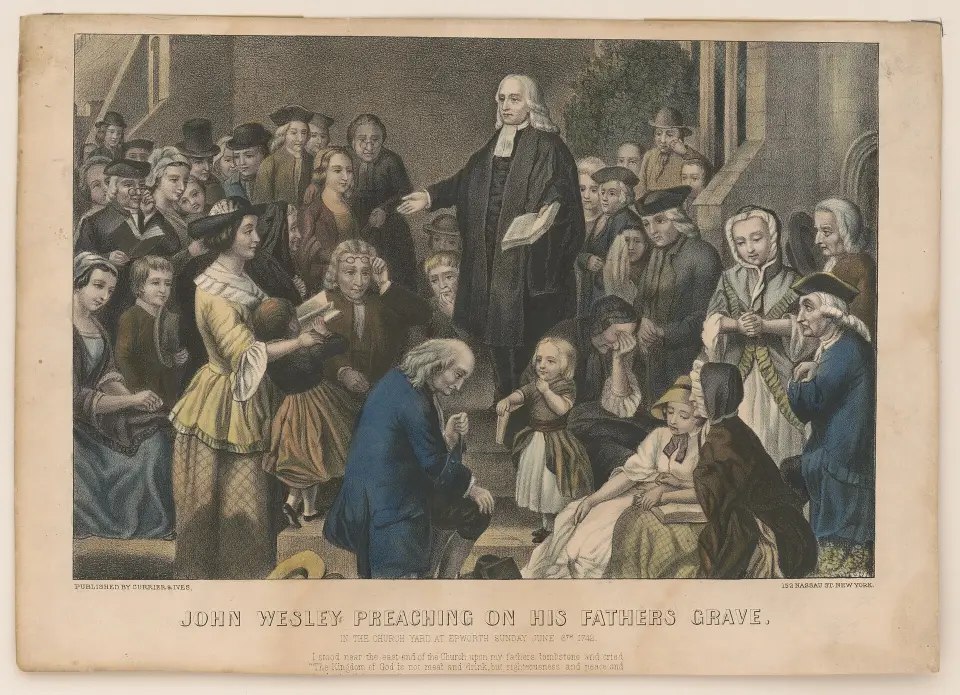
Whitefield was Wesley's friend from the Holy Club and, unlike him, a firm Calvinist. He was the first to preach in the open air at Bristol. Wesley followed, riding up to 7,500 km a year ("the world is my parish"). He organized societies, classes and annual conferences. His disagreement with Whitefield over predestination led to the separate Calvinistic Methodist Church of the Countess of Huntingdon.
Wesley always considered himself a member of the Church of England. Yet the need to ordain ministers for America (1784, Francis Asbury and Thomas Coke) eventually made Methodism a separate denomination.
Key points
- The Oxford "Holy Club" (1725) and the failed Georgia mission (1735)
- The Aldersgate experience (24 May 1738) – "heart strangely warmed"
- Field preaching by Whitefield and Wesley; organizing Methodist societies
- The 1784 ordinations for America and Methodism's separation
- Shelley: in January 1736 on the ship to Georgia Wesley feared death in a storm while Moravians, even women and children, calmly sang psalms. Wesley wrote: “the most glorious day of my life”, but he was then unfit to lead the awakening – his piety had not found strength. Early in the 18th c. no one expected religious revival in England: the Enlightenment pushed religion to the periphery, Puritan zeal was past; the Latitudinarians (Archbishop Tillotson) condemned religious “enthusiasm” and stressed conduct, generosity and tolerance. In the 1730s a wave of preaching to the unconverted swept America, Scotland, Wales and England; Edwards, the Erskines, Harris and Whitefield preceded Wesley. Evangelicals’ main beliefs go back to Puritanism, but Puritans cared more for politics, Evangelicals for converting souls. John Wesley (1703–1791) grew up at Epworth; his mother Susanna bore nineteen children and taught them “to fear the rod and cry softly”. After the rectory fire at six he called himself “a brand plucked from the burning”; he studied at Oxford and was ordained in 1728. After reading Taylor, à Kempis and Law, he judged it “impossible to be half a Christian” and gave himself wholly to God. At Oxford Charles gathered students and John became leader; the name “Methodists” stuck, and the club fed the poor and visited prisoners. In October 1735 the Wesley brothers sailed to Georgia to preach to Indians; the episode was a fiasco: John fled the colony, writing: “I went to America to convert the Indians. But who will convert me?” In England (1738) he heard from the Moravian Böhler that justification by faith is a personal experience of God’s forgiveness, not mere doctrine. On 24 May 1738 at Aldersgate, hearing Luther read, Wesley’s “heart strangely warmed”: he gained assurance of forgiveness and purpose for fifty years. In summer 1738 Wesley visited the Moravians in Saxony: he saw “full assurance of faith” but also self-satisfaction and the cult of Count Zinzendorf. From the Moravians he learned justification by faith and took small groups; Edwards’s Northampton account stirred him with the Spirit’s movement. In February 1739 Whitefield began preaching in the open air to miners near Bristol: “tears made white gutters” on their cheeks; Wesley, who thought saving souls outside church almost a sin, preached at Bristol at his call: the Methodist revival began. After 1739 Wesley took the Gospel to the poor: “I look on all the world as my parish”; he preached to prisoners, on ships and in the open air. He travelled at least 4,500 miles a year, about 250,000 in his life; he married in 1751 but stayed “married to his mission”. Wesley was an “administrative genius”: Methodist societies appeared across England, Ireland and Wales; their members stayed in the Church of England and attended parish churches for worship and Communion. After the Moravians Wesley divided societies into classes of about twelve: first to collect a penny weekly, then for testimony and prayer. He hired lay preachers without calling them priests or letting them administer the sacraments; in 1744 he summoned them to an Annual Conference that shaped policy and doctrine – always in agreement with his decisions. By 1748 the Methodists had become, like German pietists, a church within the Church; Wesley rejected charges of separation: “I live and die a faithful son of the Church of England”. Charles Wesley wrote more than seven thousand hymns; some historians hold the hymns the Revival’s greatest legacy. The Methodist Church in America became a separate denomination at the Christmas Conference in Baltimore (1784). Wesley preached almost to the end and died in London on 2 March 1791; after him English Methodists separated from the Church of England. His influence went beyond the Methodist church: it renewed religious life and spurred overseas missions and social causes. Evangelicals are described by Bebbington’s four marks: conversionism, activism, biblicism, crucicentrism; Kidd adds the Spirit in revival. At the start of the Age of Progress the movement of Wesley and Whitefield was the greatest force in English religious life
- Holifield: American Methodists saw baptism as a seal of a conditional covenant and the Supper as a converting ordinance, though Wesley held both high.
- Larsen: the evangelical network arose in the 1730s in Britain and North America around Wesley and Whitefield, with links to continental Pietists.
- Holmes: Wesley’s conversion came at a Moravian meeting while Luther was read, yet Moravians and Pietistic Lutherans are not usually called ‘evangelical’. Apart from Christian perfection Wesley thought himself a faithful interpreter of Anglican theology; Charles objected to his brother’s ordinations. Whitefield denounced Anglican moral and doctrinal laxity but departed from the Church of England in no defined doctrine. 18th-century British evangelical leaders were preachers and hymnwriters, not theologians; Wesleys Arminian, Whitefield Calvinist, no new arguments. Evangelical practices – field preaching, the gospel invitation, Howel Harris’s ‘enthusiasm’ in Wales – had no serious theological work behind them.
People
- John Wesley
- Charles Wesley
- George Whitefield
- Nikolaus Ludwig von Zinzendorf
- the Countess of Huntingdon
- Francis Asbury
- Thomas Coke
Place
Oxford; Georgia; London; Bristol; England; the United States
Sources disagree
The date of the Aldersgate experience (24 May 1738) is unanimous across the books.
Sources
- Tony Lane – Christian Thinkers (Russian edition), p. 215–218
- Justo L. González – A History of Christian Thought, vol. III: From the Protestant Reformation to the Twentieth Century (Abingdon, rev. ed. 1987), p. 315–322
- Justo L. González – The Story of Christianity, vol. II (Russian edition), Part 2, ch. 23
- J. North – A History of the Church (Russian edition), p. 299–301
- Justo L. González – A History of Christian Thought in One Volume (Abingdon, 2014), p. 376–380
- Louis Berkhof – History of Christian Doctrines (Russian edition), p. 113–114, 163–164
- Bruce L. Shelley – Church History in Plain Language (Russian edition), Ch. 34, sec. «Головня из огня»; Ch. 34, sec. «Евангельское пробуждение»; Ch. 34, sec. «Маленький исполин»; Ch. 34, sec. «Тепло святого сердца»; Ch. 34, sec. «Тепло святого сердца»; «В поля, навстречу миру»; Ch. 34, sec. «В поля, навстречу миру»; Ch. 34, sec. «Структура методистов»; Ch. 37, sec. «Евангелики в мире»
- The Oxford Handbook of Sacramental Theology, ed. Hans Boersma, Matthew Levering (2015), p. 469
- The Cambridge Companion to Evangelical Theology, ed. Timothy Larsen and Daniel J. Treier (2007), p. 22, 254, 254–255, 255, 256
More on the doctrine
- John Wesley: Prevenient Grace, Assurance and Christian Perfection; Whitefield and the Moravians (1738–1791)
Data compiled: 2026-11-09