the 30s AD · 1st century
The choosing of the Seven, the martyrdom of Stephen, and the dispersion of the "Hellenists"
A conflict arose between the "Hebrews" and the "Hellenists" within the Jerusalem Jewish-Christian community. Because of it, the apostles appointed seven men to a ministry, all bearing Greek names.
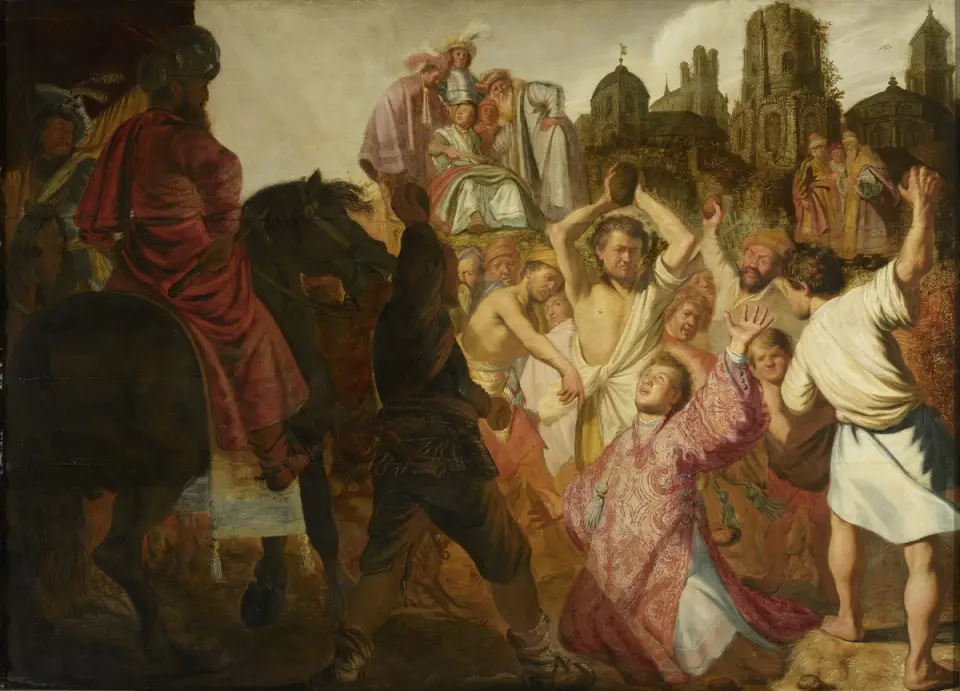
One of them, Stephen, preached in the synagogues. He was accused of insufficient reverence for the Temple and condemned to death by the Sanhedrin. He thus became the church's first martyr ("martyr" meaning "witness").
The first persecution was directed mainly against the "Hellenist" Christians. The apostles themselves were able to remain in Jerusalem. Scattering through Judea and Samaria, the "Hellenists" for the first time carried Christianity beyond Jerusalem. They brought the message to Samaria, Damascus, Phoenicia, Cyprus and Antioch. In Samaria Philip founded a church that recognized the apostles' authority, and converted an Ethiopian official. It was then that the Gentile Cornelius came to believe.
Key points
- The conflict was within the Jewish-Christian community, not between Jews and Gentiles
- Stephen was accused of insufficient reverence for the Temple and became the church's first martyr
- The apostles were able to remain in Jerusalem; mainly the "Hellenists" were scattered
- Philip founded a church in Samaria and converted an Ethiopian official; Cornelius came to believe
- Shelley: about AD 36 persecutors seized suspected “Nazarenes”, Saul the Pharisee among their leaders; Hellenists fled Jerusalem, the apostles were left alone. The exiles founded churches in Samaria, Syria, Cyprus and Egypt; the “men of Cyprus and Cyrene” (Acts 11:20) first began turning to pagans
- Haacker: Paul the persecutor acted on his own initiative, not by office: imprisonment, beatings, forced blasphemy, a vote for death sentences (Acts 26:10); his motive was 'zeal' on the model of Phineas and Elijah, and rabbinic Judaism did not follow this militant line. Paul's conversion was not a change of religion but a vision of the risen Jesus with a calling; 'Saul, Saul…' led not to judgment but to service. Paul may not have received the call to the Gentiles at once: Gal. 1:16 speaks only of God's intention, and in Acts 26 Luke 'telescopes' two visions.
People
- Stephen
- Philip
- Peter
- John the Apostle
- Saul (Paul)
- Cornelius
Place
Jerusalem; Judea; Samaria
Sources disagree
Neither book gives an exact year; the dating is approximate, based on the context of the book of Acts.
Sources
- Justo L. González – The Story of Christianity, vol. I (Russian edition), Ch. «Иерусалимская церковь», sec. 1.4; ch. «Благовествование среди язычников», sec. 1.7
- J. North – A History of the Church (Russian edition), p. 13
- Bruce L. Shelley – Church History in Plain Language (Russian edition), Ch. 2, sec. «Эллинисты»
- The Cambridge Companion to St Paul, ed. James D. G. Dunn (2003), p. 41–42, 42, 42–43, 43
Data compiled: 2026-11-09