1521–1556 · 16th century
Ignatius Loyola and the founding of the Society of Jesus
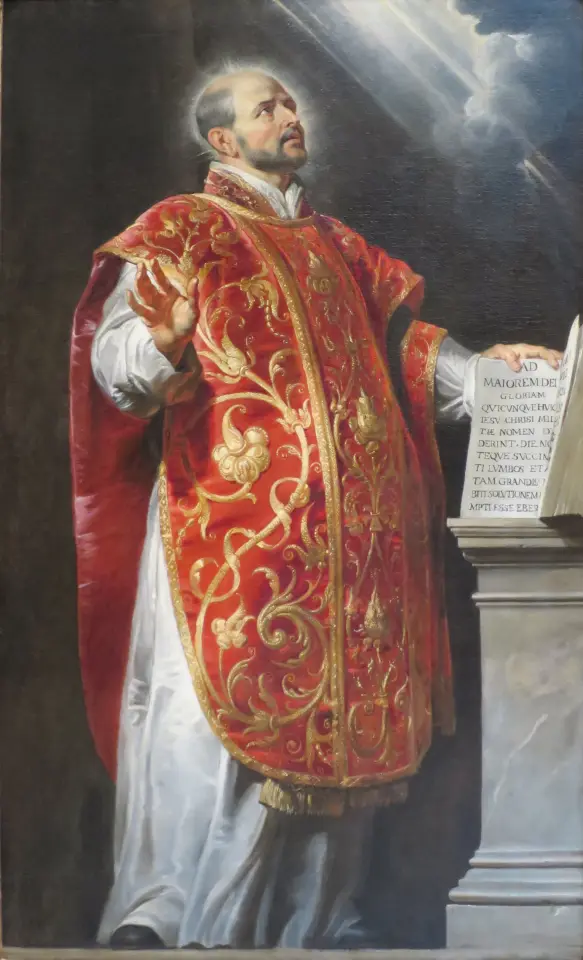
The Basque nobleman Ignatius Loyola was wounded defending Pamplona in 1521. He then underwent a spiritual conversion and dedicated himself to the Virgin at Montserrat.
Loyola wrestled with doubts about the completeness of his confession. At Manresa he had an experience somewhat similar to Luther's. But it led him to complete submission to the church hierarchy. The result was the "Spiritual Exercises".
After a failed attempt at mission in Palestine, he spent twelve years studying in Barcelona, Alcalá, Salamanca and Paris. In Paris future companions gathered around him, including Francis Xavier. In August 1534 at Montmartre a group of nine men took vows of poverty, chastity and obedience to the pope.
In 1540 Pope Paul III approved the new order – the Society of Jesus. By Loyola's death in 1556 it had over a thousand members in Europe, Brazil, India, the Congo and Ethiopia. It had become the chief instrument of Catholic reform, the struggle against Protestantism, and overseas missions.
Key points
- Wounding at Pamplona (1521) and Loyola's conversion
- The "Spiritual Exercises", the fruit of the Manresa experience
- The vows at Montmartre (August 1534)
- Approval of the Society of Jesus by Paul III (1540); Loyola as first general
- Shelley: in 1521 at Pamplona a cannonball shattered the leg of a young Spanish aristocrat; recovering, he read lives of the saints and a life of Christ. At Montserrat he exchanged his nobleman’s clothes for a pilgrim’s rags and dedicated his sword and dagger to the Black Madonna; about a year at Manresa – asceticism, months of despair, then a breakthrough: by the Cardoner Ignatius Loyola became, in his words, ‘another’. Loyola gathered the first companions (Faber, Laynez, Xavier and others); the rule added a fourth vow, loyalty to the pope; a lifelong general led it. Ignatius’ Spiritual Exercises prescribe four “weeks” of meditation (§4: on sins, the life of Christ, the Passion, the Resurrection; about thirty days in all); Loyola believed man is free to choose between God and Satan. The Jesuits sought to be “all things to all men”; at Loyola’s death (1556) the order had a thousand members and missionaries on four continents.
- McGinn: Ignatius was jailed by the Inquisition; his Spiritual Diary records visions and tears day by day, mostly at the Eucharist
People
- Ignatius of Loyola
- Paul III
- Francis Xavier
- Diego Laínez
Place
Pamplona; Montserrat; Manresa; Paris; Rome
Sources
Primary sources
- Ignatius of Loyola – Spiritual Exercises, para. 4
Textbooks
- Justo L. González – The Story of Christianity, vol. II (Russian edition), Part 1, ch. 12
- J. North – A History of the Church (Russian edition), p. 278–279
- Justo L. González – A History of Christian Thought, vol. III: From the Protestant Reformation to the Twentieth Century (Abingdon, rev. ed. 1987), p. 221–225, 241
- Tony Lane – Christian Thinkers (Russian edition), p. 218–220
- Justo L. González – A History of Christian Thought in One Volume (Abingdon, 2014), p. 344–345
- Bruce L. Shelley – Church History in Plain Language (Russian edition), Ch. 28, introduction; Ch. 28, sec. «Игнатий Лойола», «Общество Иисуса»; Ch. 28, sec. «Игнатий Лойола»; «Облик современного католичества»; Ch. 28, sec. «Общество Иисуса»
- The Oxford Handbook of Mystical Theology, ed. Edward Howells, Mark A. McIntosh (2020), Ch. 4, sec. «Reformed Catholic Mysticism»
Data compiled: 2026-11-09