1531–1555 · 16th century
The Schmalkaldic League, the Schmalkaldic War, and the Peace of Augsburg
On 27 February 1531 Protestant princes and cities formed the Schmalkaldic League to defend against the emperor. The Peace of Nuremberg in 1532 temporarily halted persecution.
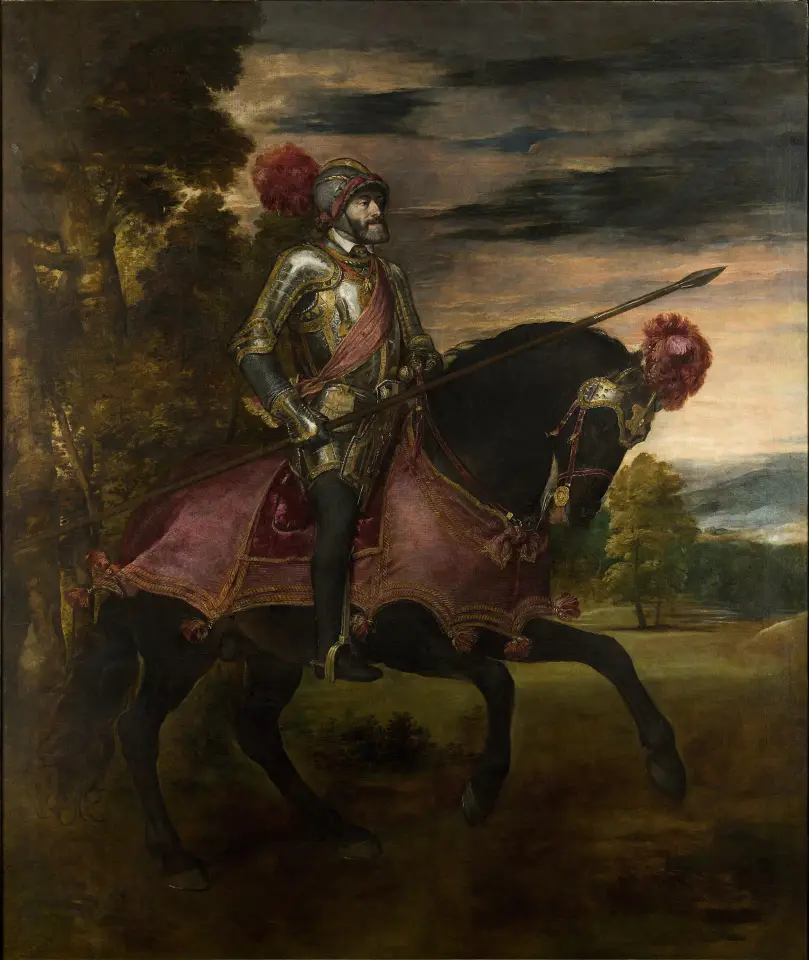
Luther died on 18 February 1546. After his death Charles V crushed the League in the Schmalkaldic War, at the Battle of Mühlberg on 24 April 1547. He imposed on the Protestants first the Augsburg and then the milder Leipzig Interim. This provoked bitter adiaphoristic and other disputes within Lutheranism.
A revolt of Protestant princes led by Maurice of Saxony forced the emperor into the Peace of Passau. In September 1555 the Peace of Augsburg established the principle "cuius regio, eius religio" (whose realm, his religion). It recognized only Catholicism and Lutheranism and left the Reformed outside the law. Charles V soon abdicated.
Key points
- Founding of the Schmalkaldic League (27 February 1531)
- Defeat of the League at Mühlberg (24 April 1547)
- The Augsburg and Leipzig Interims and the adiaphorist controversy
- The Peace of Augsburg (September 1555): "whose realm, his religion"
- Kusukawa: after Charles V’s harsh reaction the Protestant princes signed the Augsburg Confession at Schmalkalden (30 Dec. 1530), and the league was formally constituted in February 1531. Disagreements with southern Germany (above all on the Supper) hampered the League: southerners joined only after the Wittenberg Concord (1536). The Apology gained legal status when the League adopted it with the Augsburg Confession in 1537; after the League’s defeat (1547) the Augsburg Interim restored Catholic rites, and Melanchthon yielded on adiaphora (Leipzig Interim, 1548).
- Shelley: at Augsburg in 1530 Melanchthon presented Lutheranism with the Augsburg Confession, Luther being absent; the emperor was unwilling to reconcile and resolved to destroy heresy. Lutheran princes formed the Schmalkaldic League (1531); civil wars flared from 1546 to 1555. The Peace of Augsburg (1555) ended the princes’ wars: each territory’s ruler decided whether his subjects were Catholic or Lutheran; it ‘banned all Protestant sects except Lutheranism’, bishops turned Lutheran gave up their property, and Lutheranism reached Scandinavia. The peace, a by-product of the Christian-ruler idea, recognised the prince’s right to persecute dissenters, and the innocent suffered for dissent. The territorial principle foreshadowed the end of ‘Christendom’ – neighbours imposed different faiths; the peace ignored Calvinists entirely. After Augsburg Luther kept teaching the Bible in Wittenberg, but some of his actions in old age are hard to defend: quoting Time, he approved Philip of Hesse’s bigamy and condemned dissenting reformers for what he had charged against popes. For Bainton, by his death (1546) Luther was a “crotchety old man”, yet personal flaws do not diminish achievements that transformed the West.
People
- Charles V
- Martin Luther
- Maurice of Saxony
- Philip Melanchthon
- Matthias Flacius Illyricus
Place
Schmalkalden; Mühlberg; Augsburg; Passau
Sources
- Alister McGrath – Reformation Thought (Russian edition: «Theological Thought of the Reformation»), p. 353, 379–380
- Justo L. González – The Story of Christianity, vol. II (Russian edition), Part 1, ch. 4, 9
- Justo L. González – A History of Christian Thought, vol. III: From the Protestant Reformation to the Twentieth Century (Abingdon, rev. ed. 1987), p. 66, 112–113, 122–128
- Justo L. González – A History of Christian Thought in One Volume (Abingdon, 2014), p. 295, 355–356
- J. North – A History of the Church (Russian edition), p. 243
- The Cambridge Companion to Reformation Theology, ed. David Bagchi, David C. Steinmetz (2004), p. 75–76, 77
- Bruce L. Shelley – Church History in Plain Language (Russian edition), Ch. 24, sec. «Долгое влияние Лютера»; Ch. 31, sec. «Подавление инакомыслящих»
Data compiled: 2026-11-09