1340–1495 · 14th century
Lorenzo Valla Exposes the 'Donation of Constantine'; Humanism and Printing
Petrarch (1304–1374) began a revival of classical Latin and of interest in individual consciousness. It gave rise to Renaissance humanism. After 1453 Byzantine scholars poured into Italy with Greek manuscripts.
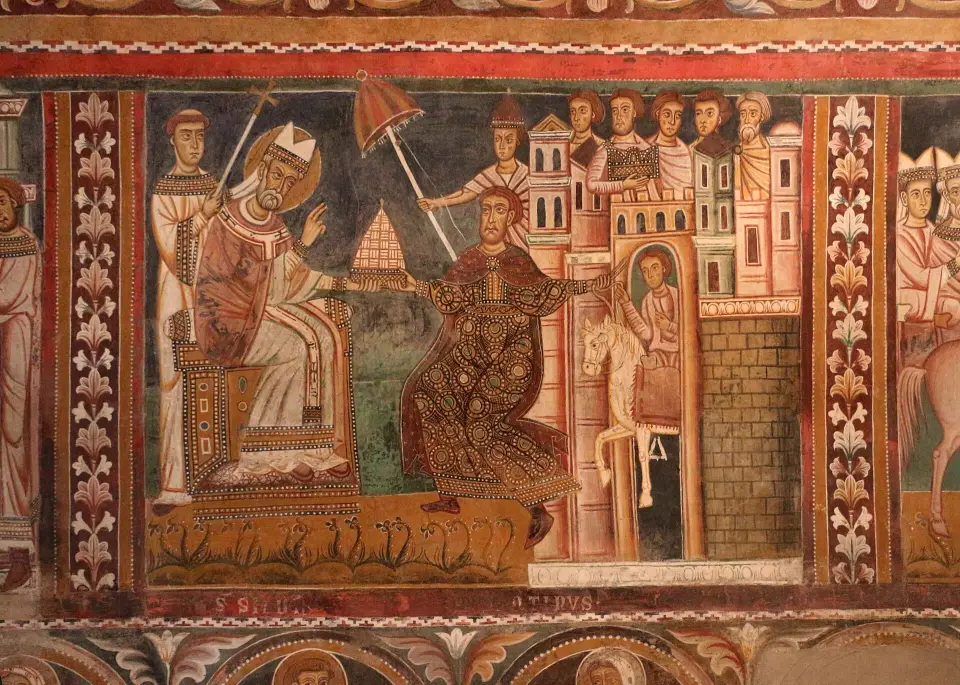
The papal secretary Lorenzo Valla applied new methods of textual criticism to the "Donation of Constantine". Papal claims to secular power had rested on it for centuries. Valla convincingly proved it a forgery – notably, with the pope's own support. He also disproved the legend of the Apostles' Creed's apostolic authorship.
Around 1454 in Mainz, Johannes Gutenberg printed the first reliably datable documents, and a Latin Bible in 1456. Printing spread to Italy (1464, 1476) and England (1476) and reached Aldus Manutius's workshop in Venice (1495). It made critical editions of texts possible. It also prepared the ground for the wide dissemination of the coming Reformation's ideas.
Key points
- Petrarch and the birth of humanism ('ad fontes')
- Lorenzo Valla's exposure of the 'Donation of Constantine' as a forgery
- Valla's disproof of the Apostles' Creed's apostolic authorship
- Gutenberg's invention of printing (c. 1454) and its spread across Europe
- Lyman: textual criticism, with its aims of restoration and authenticity, became part of the engine of reform in the Reformation. The Magdeburg Centuries and Ecclesiastical Annals were duelling church histories: the past as corruption of early practice or as growth under the Spirit
People
- Francesco Petrarca
- Lorenzo Valla
- Johannes Gutenberg
- Aldus Manutius
Place
Rome; Italy; Mainz; Venice
Sources
- Justo L. González – A History of Christian Thought in One Volume (Abingdon, 2014), p. 271–272, 279
- Justo L. González – A History of Christian Thought, vol. III: From the Protestant Reformation to the Twentieth Century (Abingdon, rev. ed. 1987), p. 23–24
- Alister McGrath – Reformation Thought (Russian edition: «Theological Thought of the Reformation»), p. 22–25, 60–69, 82, 85, 376
- Justo L. González – The Story of Christianity, vol. I (Russian edition), Ch. 28, sec. 28.2–28.3
- The Oxford Handbook of Systematic Theology, ed. John Webster, Kathryn Tanner, Iain Torrance (2007), p. 512
Data compiled: 2026-11-09