early 2nd c. – 165 · 1st century
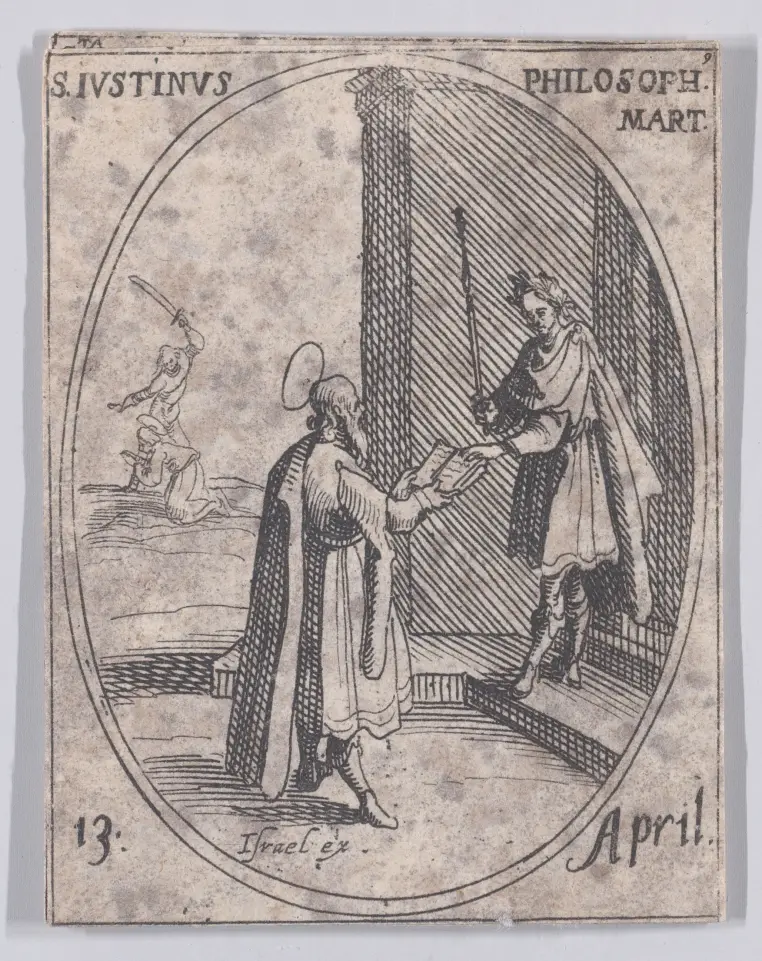
Justin Martyr – apologist and teacher of the Logos
A Greek from Palestine, Justin sought the truth among the Stoics, Peripatetics, Pythagoreans and Platonists and came to Christianity as the "true philosophy": according to the Dialogue with Trypho (2–8), he left a Stoic for a Peripatetic, then a Pythagorean and the Platonists, until an old man by the sea turned him to the prophets, and he found “this philosophy alone to be safe and profitable.” In Rome he opened a school where he taught in a philosopher's cloak. He wrote two Apologies addressed to emperors and the Dialogue with Trypho the Jew; his teaching on the "seeds of the Logos" became central to his theology.
Justin left valuable descriptions of early baptism and the Eucharist. He was executed in Rome for refusing to offer sacrifice to the gods, probably after being denounced by a rival philosopher, Crescens: in the Second Apology (ch. 3) Justin himself expects “to be plotted against and fixed to the stake… perhaps by Crescens.”
Key points
- Two Apologies and the Dialogue with Trypho the Jew
- Description of baptism and the Eucharist in the First Apology (chs. 61–67)
- Kept his own Christian "school" in Rome
- Executed, probably after a denunciation by Crescens (2 Apol. 3); in the Second Apology (ch. 2) the prefect Urbicus condemns not Justin but the Christians Ptolemaeus and Lucius
- Shelley: Justin sought truth among Stoics, Pythagoreans and Platonists without quenching his thirst; an old man by the sea pointed him to the prophets, and Justin became a Christian by reading Scripture; Tatian, Theophilus, Hilary, Victorinus and Augustine came the same way. Per the official trial record in Rome, Justin lived above Timothy’s baths at Martin’s house, taught all who came and declared: “Yes, I am a Christian”. Like Stoics, Cynics and Gnostics, Christians opened schools in large cities and drew pupils with lectures
People
- Justin Martyr
- Trypho
- Crescens
- Urbicus
Place
Palestine – Ephesus – Rome
Sources disagree
The dating of the Apologies ranges from the 140s to 165; one book (Hall) even gives, elsewhere in the same book, a contradictory date of "115." The execution is usually placed in the 160s (165).
Sources
Primary sources
- Justin Martyr – Dialogue with Trypho, ch. 1–8
- Justin Martyr – First and Second Apology, pt. 1, ch. 61–67; pt. 2, ch. 2–3, 8, 13
Textbooks
- Tony Lane – Christian Thinkers (Russian edition), p. 16–18
- Justo L. González – A History of Christian Thought in One Volume (Abingdon, 2014), p. 43–45
- Stuart G. Hall – Doctrine and Practice in the Early Church (Russian edition), p. 14–15, 36–37
- J. North – A History of the Church (Russian edition), p. 32–33
- Jaroslav Pelikan – The Christian Tradition: A History of the Development of Doctrine, vol. 1 (Russian edition), p. 21–26, 39–44, 196–201
- Justo L. González – The Story of Christianity, vol. I (Russian edition), sec. «Христианская вера и языческая культура»
- Bruce L. Shelley – Church History in Plain Language (Russian edition), Ch. 6, sec. «Вопрос об апокрифах»; Ch. 8, sec. «Свет миру»
More on the doctrine
- The Second-Century Apologists: Christianity as the True Philosophy and Justin's Doctrine of the Logos (140–180)
- Truth among the Pagans: The Seminal Logos, Natural Law and Philosophy as Tutor (2nd–3rd centuries)
Data compiled: 2026-11-09