c. 180 · 2nd century
Irenaeus: recapitulation – Christ as the new Adam
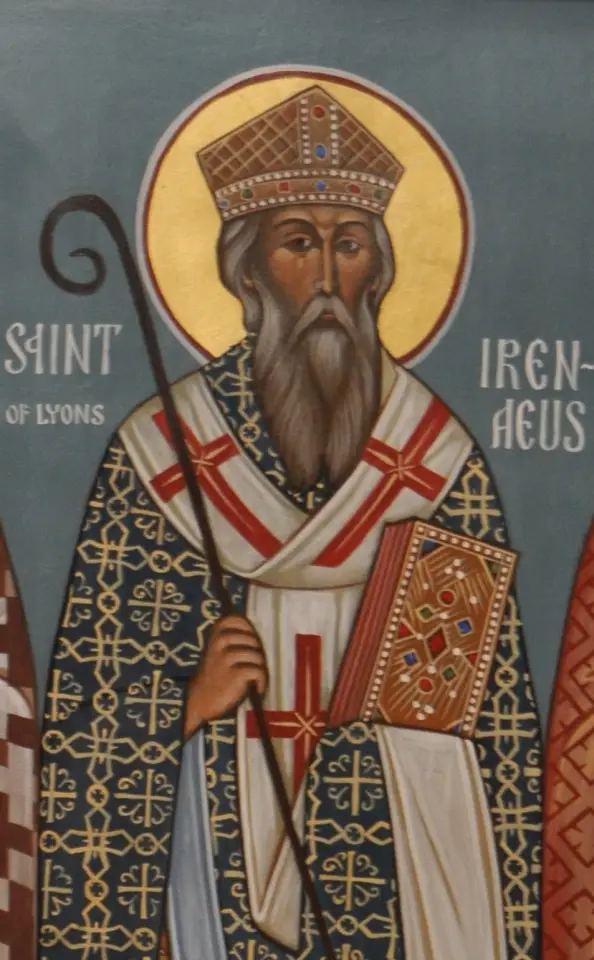
Irenaeus calls the work of Christ "recapitulation" (anakephalaiosis, a term from Eph 1:10; literally – placing under a new head): Christ became the head of a new humanity, as Adam was the head of the old. The incarnation is a new beginning, yet not opposed to creation but its continuation and fulfilment: in Christ the history of Adam is repeated in reverse – the virgin earth and Mary (Against Heresies 3.21.10), the disobedience of one virgin and the obedience of another (5.19.1), the temptation in paradise and in the desert (5.21.2), the tree and the cross (5.16.3; Demonstration 32–34). Christ passed through every stage of human life (Against Heresies 3.18.7), becomes the leaven of a new humanity, imparts immortality to those united with him by faith, and by his obedience makes up for Adam's disobedience. According to Berkhof, Irenaeus sees redemption partly as deliverance from the power of Satan, but Christ's death satisfied the justice of God, not Satan.
Positions
- Berkhof
- Irenaeus has two strands – moralistic and mystical – that hardly correspond to Scripture; but he connects them with Christ's obedience and suffering in our place, payment of a debt to God and propitiation
- González
- Recapitulation is Irenaeus's basic doctrine, without which his theology cannot be understood; the initial victory over Satan is not the resurrection but the incarnation
Key points
- Hall: against the Gnostics Irenaeus proposes a biblical scheme: creation, fall, redemption, judgment and glory; Adam, "childishly naive", was easily deceived. Irenaeus left much unsaid
- González: Christ's whole life is part of the recapitulation; in his death and resurrection he uses death, the weapon of evil, for victory
- Berkhof: the living union of Christ with the redeemed is what Anselm failed to express; the influence of John on Irenaeus is greater than that of Paul
- Russell: Irenaeus introduces recapitulation against the Valentinians (Eph 1:10): the Word made man “summed up” all things, man included (Against Heresies 3.16.6); birth from the Virgin is a new beginning, but from “our” flesh (3.21.10), and Irenaeus anticipates “what is not assumed is not healed”. Theophilus of Alexandria developed recapitulation’s cosmic side in his Cross homily: Christ reigns from the Cross, “all the earth rejoices”. The sacrifice’s effects permeate all material reality, healing its disorder; the individual Christian appropriates them symbolically in the sacraments
Outcome
Salvation is understood as the restoration and completion of the image of God in man (Hall); according to Berkhof, recapitulation became the basis of the Greek "physical" theory of salvation.
People
- Irenaeus of Lyons
Terms
- recapitulation – anakephalaiosasthai
- A term from Eph 1:10: Christ goes again over Adam's path and fulfils his destiny.
Sources disagree
Hall: c. 180; González: c. 170–202; Berkhof: 2nd–3rd centuries without an exact date.
Sources
Primary sources
- Irenaeus of Lyons – Against Heresies, bk. III, ch. 16, 18, 21; bk. V, ch. 16, 19, 21
- Irenaeus of Lyons – Demonstration of the Apostolic Preaching, ch. 32–34
Textbooks
- Stuart G. Hall – Doctrine and Practice in the Early Church (Russian edition), p. 45–46
- Louis Berkhof – History of Christian Doctrines (Russian edition), p. 43–44, 119
- Justo L. González – A History of Christian Thought in One Volume (Abingdon, 2014), p. 69–71
- The Oxford Handbook of Christology, ed. Francesca Aran Murphy (2015), p. 202–203, 204
Related entries
- Develops: The work of Christ in the Apostolic Fathers, the Apologists and the Gnostics (2nd – first half of the 3rd century)
- Develops: The Anti-Gnostic Fathers and Irenaeus: the Image of God, Freedom and the Fall as Interrupted Growth (2nd century)
- Developed in: Athanasius, On the Incarnation of the Word, and the Greek doctrine of salvation as deification (c. 318 or 335–337)
In church history
- Irenaeus of Lyons and his work Against Heresies (c. 130 – 202 (chief work written c. 180))
Data compiled: 2026-11-17