1854 · 19th century
The dogma of the Immaculate Conception (the bull Ineffabilis Deus)
The question of Mary's immaculate conception had divided theologians for centuries. Franciscans, following Duns Scotus, taught immaculate conception; Dominicans, following Aquinas, taught sanctification before birth. In 1483 Sixtus IV declared the question open.
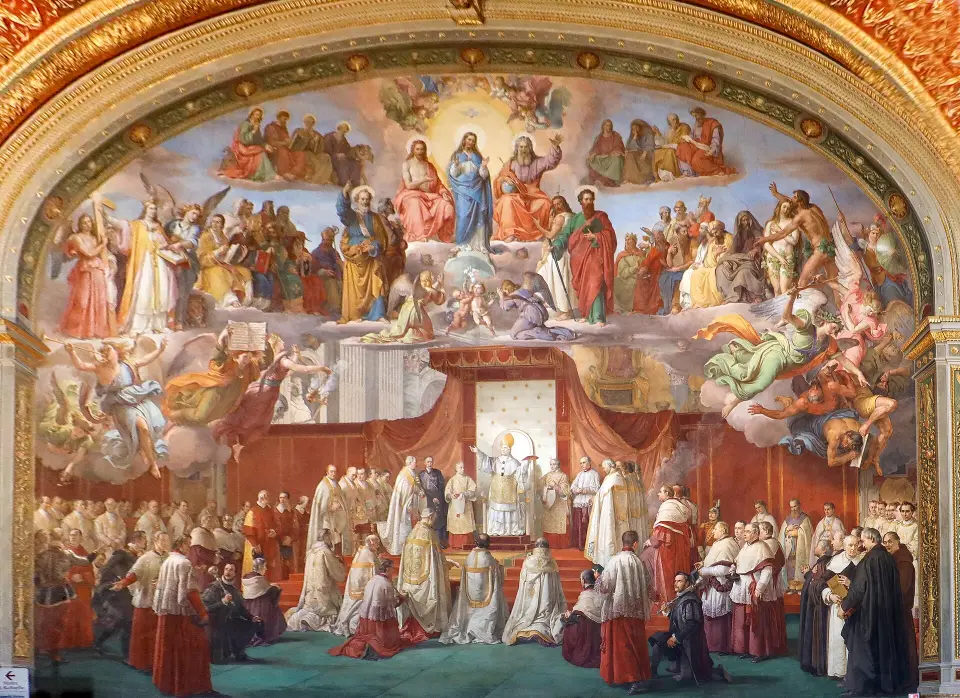
After polling bishops in 1849, Pope Pius IX in 1854 proclaimed a dogma by the bull Ineffabilis Deus. It declared that Mary, by a special grace of God, was preserved from all sin, including original sin, from the moment of her conception.
The bull was accepted with almost no controversy. It was the first time in history a pope alone, without convening a council, defined a dogma of faith. This prepared the ground for the proclamation of papal infallibility at the First Vatican Council.
Key points
- The Franciscan–Dominican dispute over Mary's conception; Sixtus IV (1483) left the question open
- Pius IX's 1849 poll of bishops
- The bull Ineffabilis Deus (1854): Mary preserved from original sin from conception
- The first solo papal dogmatic definition in history, without a council
- A trial run for the future dogma of papal infallibility
- Shelley: on 8 December 1854 Pius IX defined the immaculate conception ex cathedra – by the pope alone, not a Council, with 54 cardinals and 140 bishops present; whether the pope alone, without a Council, can adopt a dogma became one of the key problems of the First Vatican Council
People
- Pius IX
- John Duns Scotus
- Sixtus IV
Place
Rome
Sources
- Tony Lane – Christian Thinkers (Russian edition), p. 299–300
- Justo L. González – A History of Christian Thought, vol. III: From the Protestant Reformation to the Twentieth Century (Abingdon, rev. ed. 1987), p. 407–408
- Justo L. González – A History of Christian Thought in One Volume (Abingdon, 2014), p. 400
- J. North – A History of the Church (Russian edition), p. 321
- Justo L. González – The Story of Christianity, vol. II (Russian edition), Part 3, ch. 29, section «Пий IX»
- Bruce L. Shelley – Church History in Plain Language (Russian edition), Ch. 36, sec. «Непогрешимость папы»
Data compiled: 2026-11-09