1296–1368 · 13th century
The Hesychast Controversy: Gregory Palamas against Barlaam of Calabria
In 1318 Gregory Palamas withdrew to Mount Athos, where he systematized hesychasm – a prayer tradition of union with God through stillness and the Jesus Prayer. From 1330 he disputed with the monk Barlaam of Calabria over the nature of the light of the Transfiguration on Mount Tabor and over deification.
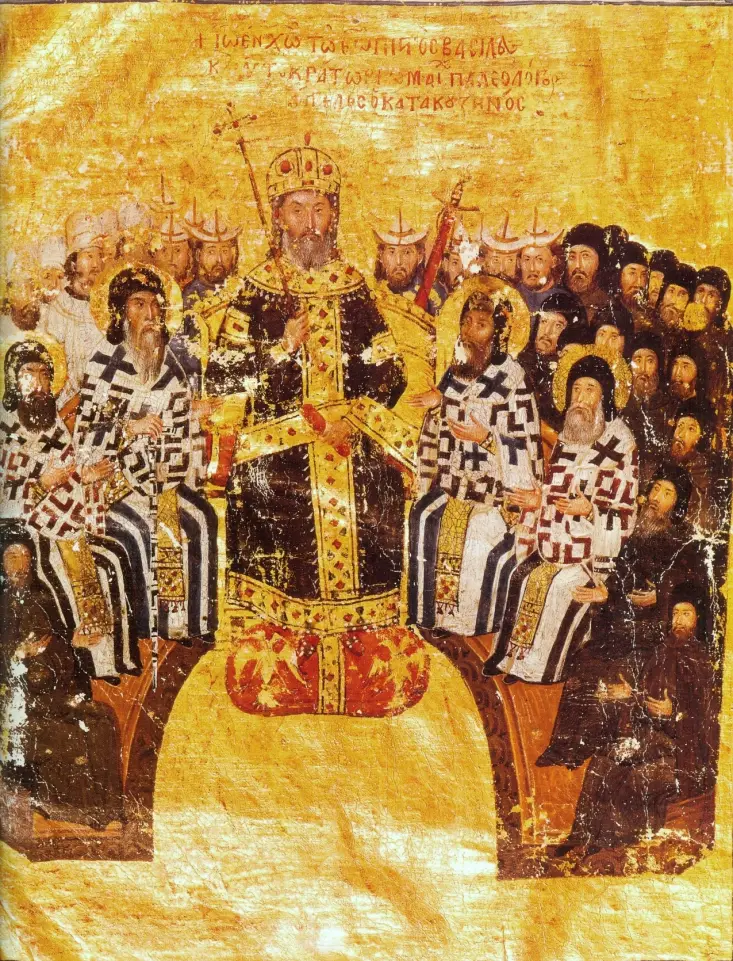
Councils in Constantinople in 1341 rejected Barlaam's charges. But after a palace coup Palamas was excommunicated in 1344. From 1347, when he became bishop of Thessalonica, the new emperor favored him. The 1351 council cleared him of all charges. The decisions of the Palamite councils (1341, 1351, and 1368) made his teaching the norm of Orthodoxy, and Palamas became a saint of the Eastern Church. He died in 1359. The West did not accept this teaching, adding another point of division between the churches.
Key points
- The systematization of hesychasm on Athos; the dispute with Barlaam of Calabria (from 1330)
- Palamas's excommunication (1344) and his vindication by the 1351 council
- The Palamite councils (1341, 1351, 1368) establishing the teaching as Orthodox norm
- The West's refusal to accept the teaching
- Gunton: in the fourteenth century Palamas gave the doctrine of the Trinity the form it now takes in most Orthodox theologies.
- McGinn: Hesychast “prayer of the heart” seeks peace and a vision of light through regulated breathing and repeating the name of Jesus; through the Philokalia (late 18th c.) Athonite themes reached the Slavic lands: Seraphim of Sarov, Theophan the Recluse, The Pilgrim’s Tale
People
- Gregory Palamas
- Barlaam of Calabria
- John VI Kantakouzenos
Place
Mount Athos; Constantinople; Thessalonica
Sources
- Tony Lane – Christian Thinkers (Russian edition), p. 84–86
- Jaroslav Pelikan – The Christian Tradition, vol. 2: The Spirit of Eastern Christendom (600–1700) (Russian edition), p. 91, 365–366, 369, 398, 406–418
- Justo L. González – A History of Christian Thought in One Volume (Abingdon, 2014), p. 237–238
- The Cambridge Companion to Christian Doctrine, ed. Colin E. Gunton (1997), p. 30
- The Oxford Handbook of Mystical Theology, ed. Edward Howells, Mark A. McIntosh (2020), Ch. 4, sec. «Eastern Christian Mysticism»
More on the doctrine
Data compiled: 2026-11-09