1527–1536 · 16th century
Henry VIII's break with Rome and the Act of Supremacy
Henry VIII sought an annulment of his marriage to Catherine of Aragon from Pope Clement VII. The pope, dependent on Emperor Charles V, did not grant it. Henry then appointed Thomas Cranmer Archbishop of Canterbury and secretly married Anne Boleyn.
Acts of Parliament in 1534 declared the king "the only supreme head on earth" of the Church of England. They declared the marriage to Catherine void. Dissenters were made guilty of treason, including the former chancellor Thomas More. More was executed in 1535.
This was a schism without doctrinal reform. Henry had earlier written against Luther and received from the pope the title "Defender of the Faith". He had no intention of changing Catholic doctrine. But he soon began dissolving the English monasteries and confiscating their property.
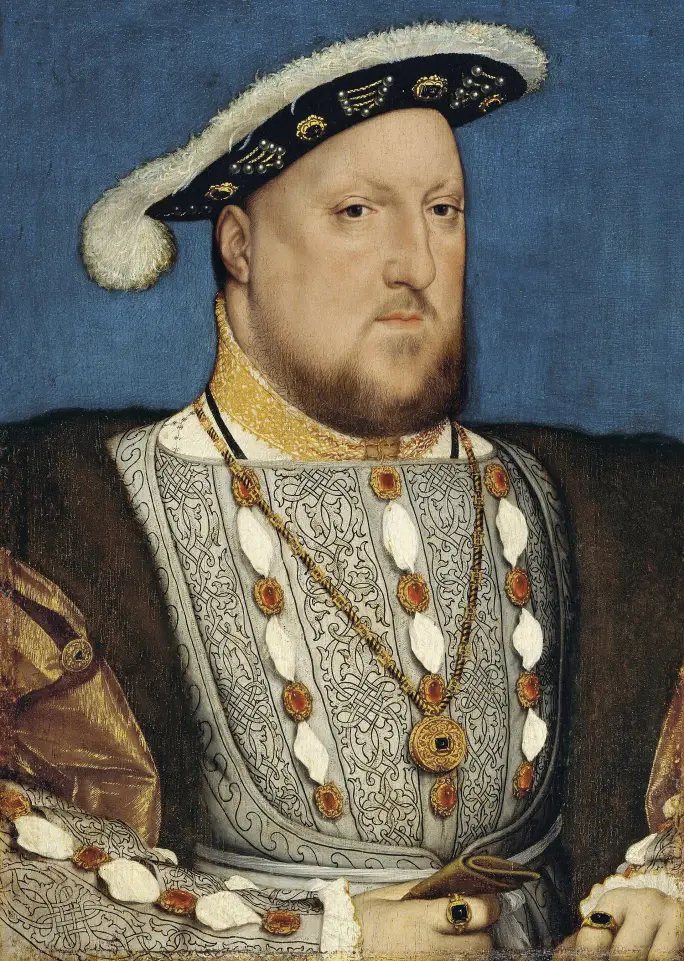
Key points
- Henry VIII's divorce case against Catherine of Aragon
- The Act of Supremacy (1534): the king as head of the Church of England
- The execution of Thomas More (1535)
- The start of the dissolution of the English monasteries (1536–1539)
- Brooks: Cranmer, raised by Henry and confirmed by papal bulls, had to push the king’s argument and found it a biblical basis (Lev 18, 20; Deut 25), and on the road “from canon to statute” grounded royal supremacy in Scripture (Rom 12) and Luther’s On Secular Authority (1523). At Nuremberg (1532) he drew close to Osiander, who backed the Tudor cause; Collinson sees in this skilful use of royal fickleness, not capitulation. In a 1535 letter Cranmer wrote that papal laws ‘suppress Christ’ and make the bishop of Rome ‘god of this world’; in sermons at Paul’s Cross he called the pope Antichrist, citing Scripture and the Fathers, and in his 1536 report to Henry listed sermons against ‘the bishop of Rome’ and his laws as contrary to God’s Word. Meanwhile he moved toward Luther’s ‘justification by faith alone’, studying Bede, Lombard, Hugh of St Victor, Aquinas and Bernard. The high point for Cranmer’s reformers was the Great Bible (April 1539), whose preface he wrote in 1540; the nadir was the Act of Six Articles, a buttress of “the old religion” on penance and the mass, and Cromwell’s execution (1540). Cranmer’s plans for preaching and approved homilies failed in the Canterbury Convocation in 1542, though he kept to biblical and patristic study.
- Trueman: in Cambridge in the 1510s–1520s a circle called ‘Little Germany’ formed in the White Horse tavern (Robert Barnes; Gardiner also attended). In Oxford Wolsey brought the best of Cambridge to Cardinal College – and it backfired: young fellows read Hus, Wyclif, Bucer, Oecolampadius, Zwingli and Luther and were jailed in a ‘fish cellar’. Tyndale’s and Frith’s dependence on continental originals shows the literary debt of the English reformers.
- Shelley: the break began with succession: in 1527 Henry asked Clement VII to annul his marriage to Catherine, and the pope delayed, she being Charles V’s aunt. The Act of Supremacy (1534) made the king “the only supreme head on earth of the Church of England”, though he could not ordain bishops or define the faith. Doctrine did not change under Henry: England rejected Rome but made belief private and religious rites an instrument of the state. In 1521 Henry wrote the Defence of the Seven Sacraments against Luther and received the papal title “Defender of the Faith”, still held by monarchs, and the Six Articles (1539) confirmed clerical celibacy, private Mass and confession: Henry evidently wanted an Anglo-Catholic Church instead of the Roman. Monks were unloved in England: one writer called them ‘filthy, wretched lepers who took the tenth egg from poor wives’. In 1536 Henry closed the lesser monasteries and let monks move to other houses or secular life – half chose society; monastic property (about a tenth of the nation’s wealth) went to the crown and was sold or given to barons and gentry, and the king weakened his opponents and gained new allies.
People
- Henry VIII
- Catherine of Aragon
- Anne Boleyn
- Clement VII
- Thomas Cranmer
- Thomas More
- William Tyndale
Place
England
Sources
- J. North – A History of the Church (Russian edition), p. 259–262
- Justo L. González – A History of Christian Thought in One Volume (Abingdon, 2014), p. 275, 328–330
- Justo L. González – The Story of Christianity, vol. II (Russian edition), Part 1, ch. 8
- Tony Lane – Christian Thinkers (Russian edition), p. 150
- Justo L. González – A History of Christian Thought, vol. III: From the Protestant Reformation to the Twentieth Century (Abingdon, rev. ed. 1987), p. 17, 184–187, 190, 194
- Alister McGrath – Reformation Thought (Russian edition: «Theological Thought of the Reformation»), p. 56, 238
- The Cambridge Companion to Reformation Theology, ed. David Bagchi, David C. Steinmetz (2004), p. 162–163, 163–164, 165, 172–173
- Bruce L. Shelley – Church History in Plain Language (Russian edition), Ch. 27, introduction; sec. «Разрыв Англии и Рима»; Ch. 27, sec. «Разрыв Англии и Рима»; Ch. 27, sec. «Проклятие на корону» (introduction), «Двойная политика Генриха»; Ch. 27, sec. «Двойная политика Генриха»
Data compiled: 2026-11-09