588 (title dispute) – pontificate 590–604 – mission to England 596/597–c. 599 – 607 (title "Universal Bishop") · 6th century
The pontificate of Gregory the Great and the mission of Augustine of Canterbury to England (590–604)
Gregory was a Roman aristocrat, a former prefect of Rome, and a monk. In 590, during a plague, he was elected pope against his will. He is generally regarded as the last of the fathers of the ancient Church and the first pope in the modern sense.
Gregory filled the vacuum of civil authority left by the collapse of the Western empire. He organized the grain supply of Rome, restored its fortifications, and made peace with the Lombards. In effect he became ruler of the church lands, "the patrimony of St. Peter".
Already in 588 he and Pope Pelagius II had protested in vain against the Patriarch of Constantinople's adoption of the title "Universal". Yet in 607 that very title ("Universal Bishop") was granted to his own successor, Boniface III. This event is traditionally seen as the beginning of the papacy.
Theologically, Gregory softened and simplified Augustine's teaching. He developed the doctrine of purgatory and is called its "inventor". He also developed the doctrine of the Mass as a sacrifice and of the basic elements of penitential practice: contrition, confession, satisfaction. His influence on medieval Western theology was defining.
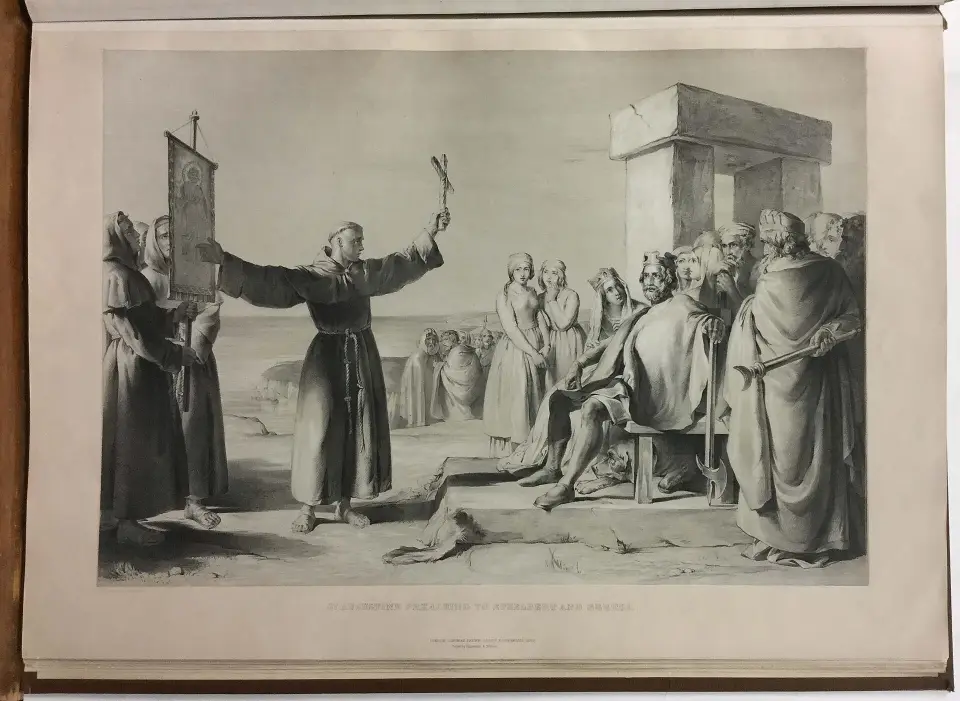
In 596/597 he sent a mission to Britain led by the monk Augustine. Augustine landed in Kent and converted King Ethelbert, who was married to a Frankish Christian. He became the first Archbishop of Canterbury, making Canterbury the spiritual capital of England. Negotiations with the Celtic Christians over recognizing Rome's authority (602–603), however, came to nothing.
Key points
- Gregory fills the political vacuum in Rome: grain supply, defense, peace with the Lombards
- Dispute over the title "Universal" (588); his own successor Boniface III received the same title (607) – the start of the papacy
- Development of the doctrine of purgatory, the Mass as sacrifice, and penitential practice
- Mission of Augustine of Canterbury to Kent (596/597); conversion of King Ethelbert
- Augustine becomes the first Archbishop of Canterbury; negotiations with the Celtic church fail
- Synod of Whitby (663): Northumbria chooses Roman customs (the date of Easter) over Celtic-Irish ones
- Shelley: in 596 Gregory the Great sent Augustine with forty monks; by legend, seeing English boys he punned on “Angles – angels”. The Christian queen Bertha helped Augustine; King Ethelbert gave land for a monastery at Canterbury. At Whitby in 664 King Oswiu and his queen differed on the date of Easter; Celtic advocates cited Columba, Roman ones Peter; the king would not estrange the “keeper of heaven’s gate”, and after Whitby the British Isles were drawn into Rome’s orbit. Gregory (born c. 540) of a senatorial family became prefect of Rome in 573 but left office and founded seven monasteries; he lived in extreme asceticism at St Andrew’s; in 579 he became deacon and envoy to Constantinople, returning as abbot in 585. In 590 Rome suffered plague and Pelagius II died; Gregory, elected against his will, was ordained on 3 September 590. He began with public penance – seven processions; a later legend tied the plague’s end to Michael over Hadrian’s mausoleum. Gregory was the first monk on the papal throne: he surrounded himself with monks, upheld Benedict’s rule and guaranteed monasteries freedom. The Roman Church owned vast lands around Rome, in southern Italy and Sicily (“patrimony of St Peter”), Italy's richest landowner; Gregory personally attended to Sicilian estates, and this practical management was the basis of the papacy’s authority. When Lombards destroyed local administration, the patrimony's managers fed the population and collected taxes as imperial officials had; Gregory headed this system. He appointed a military governor to defend central Italy and made peace with two Lombard chiefs; from 595 the pope played a larger role in dealings with the Lombards than any imperial representative – hence “consul of God”. After Gregory the pope was not only a leader of Christians but a figure in European politics. Gregory spoke of the world's end: “If we love such a world, we love not our joys but our wounds”. Pride was for him a “vicious dog”; in the Moralia he calls it the root of all vices. His Pastoral Rule: the pastor must not be too absorbed in outward affairs, yet must not neglect them
- McGinn: “Saint Benedict gave the monks of the West a Rule. Gregory gave them a mysticism”: longing for God, compunction, contemplation
People
- Gregory the Great
- Augustine of Canterbury
- Ethelbert of Kent
- Pelagius II
- Boniface III
- John the Faster
- Maurice
Place
Rome, Kent, Canterbury (England)
Sources disagree
Bruce (Shelley) dates the Synod of Whitby to 664; the site record places it in 663.
Sources
- Tony Lane – Christian Thinkers (Russian edition), p. 103–106, 104
- Louis Berkhof – History of Christian Doctrines (Russian edition), p. 100, 122, 124, 170, 191
- Jaroslav Pelikan – The Christian Tradition: A History of the Development of Doctrine, vol. 1 (Russian edition), p. 11, 78–79, 378–387
- Justo L. González – A History of Christian Thought in One Volume (Abingdon, 2014), p. 189–191, 211–212
- Justo L. González – The Story of Christianity, vol. I (Russian edition), Ch. 20, sec. 20.1, 20.3
- J. North – A History of the Church (Russian edition), p. 106–110
- Alister McGrath – Reformation Thought (Russian edition: «Theological Thought of the Reformation»), p. 35–36
- Bruce L. Shelley – Church History in Plain Language (Russian edition), Ch. 17, sec. «Миссионер на службе государства»; ch. 16, sec. «Евангелие в Англии»; Ch. 16, sec. «Евангелие в Англии»; Ch. 17, introduction; Ch. 17, sec. «Григорий родился…»; Ch. 17, sec. «На осколках разбитого мира» и «Миссионер на службе государства»; Ch. 17, sec. «На осколках разбитого мира»; Ch. 17, sec. «Место Григория в истории» и «На осколках разбитого мира»
- The Oxford Handbook of Mystical Theology, ed. Edward Howells, Mark A. McIntosh (2020), Ch. 4, sec. «Western Monastic Mysticism»
More on the doctrine
- Gregory the Great: the primacy of Peter and the rejection of the title "universal" (590–604)
- Purgatory: from Gregory the Great to the Council of Florence and indulgences (6th–16th centuries)
- Moderate Augustinianism after Orange: Gregory the Great and the Drift toward Merit (6th–9th centuries)
Data compiled: 2026-11-09