1202–1261 · 13th century
The Fourth Crusade and the Sack of Constantinople
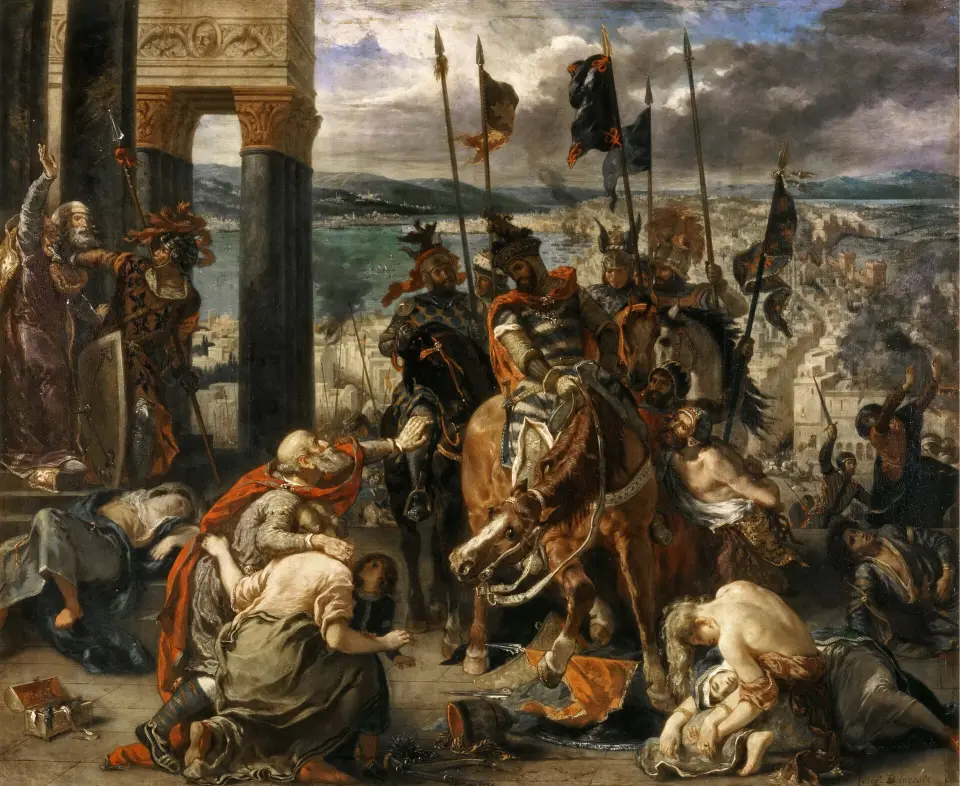
The crusaders were in debt to the Venetians. They first sacked the Christian city of Zara against Pope Innocent III's prohibition. Then, drawn into a Byzantine dynastic dispute, they took and sacked Constantinople in 1204. They never reached the Holy Land. A Latin Empire was established in Byzantium's place, lasting until 1261, with Baldwin of Flanders as emperor.
East and West were formally reunited for a time under a Catholic patriarch. Innocent III was initially outraged but came to see it as God's will. Most of the Greek people and clergy, however, regarded it as the lowest point in East-West relations.
The hatred of the Latins born of this sack undid every later attempt at reunion. It also hastened the fall of a weakened Byzantium in 1453.
Key points
- The sack of Zara against the pope's prohibition
- The capture and sack of Constantinople (1204)
- The founding of the Latin Empire (until 1261)
- The 'lowest point' in East-West relations, hastening Byzantium's fall
- Shelley: in 1198 Innocent III threw all his strength into reviving the crusading spirit, but the few knights could not pay Venice for ships; the Venetians persuaded them to pay by seizing Christian Zara (1202), and Innocent excommunicated those who joined the plunder. Then the Venetians turned the crusaders on Constantinople; after its fall in 1204 they founded the Latin Empire and forgot the Holy Land. The pope wrote: “You spared nothing sacred, neither children, nor old men, nor women, nor men”, yet missed no political maneuver and appointed the archbishop of Constantinople in Rome's interest. The Latin Empire lasted until 1261, the city never recovered, the schism deepened; Constantinople fell to the Turks in 1453
People
- Innocent III
- Baldwin of Flanders
Place
Zara; Constantinople
Sources
- J. North – A History of the Church (Russian edition), p. 176–178
- Jaroslav Pelikan – The Christian Tradition, vol. 2: The Spirit of Eastern Christendom (600–1700) (Russian edition), p. 90, 396, 419
- Justo L. González – The Story of Christianity, vol. I (Russian edition), Ch. 24, sec. 24.2; ch. 26
- Justo L. González – A History of Christian Thought in One Volume (Abingdon, 2014), p. 230, 236–237
- Bruce L. Shelley – Church History in Plain Language (Russian edition), Ch. 19, sec. «Хроника крестовых походов»
Data compiled: 2026-11-09