1558–1571 · 16th century
The Elizabethan Settlement and the Thirty-Nine Articles
Elizabeth I came to the throne in 1558. For the sake of national unity she deliberately avoided doctrinal disputes. In 1559 a Protestant prayer book was restored in a moderated version combining the 1549 and 1552 communion formulas. An Act of Uniformity came with it. Mary's dissenting bishops were removed without reprisals.
The revised "Thirty-Nine Articles" grew out of Cranmer and Ridley's "Forty-Two Articles". Convocation approved them in 1563, and they were promulgated in 1571. They affirmed a moderate Calvinism – the sufficiency of Scripture for salvation and justification by faith alone. Yet they left rites and church order a "middle way" between Rome and continental Protestantism.
This via media survived the plots surrounding Mary Stuart, who was executed in 1587. It also survived the growing discontent of Puritans demanding further "purification" of the church.
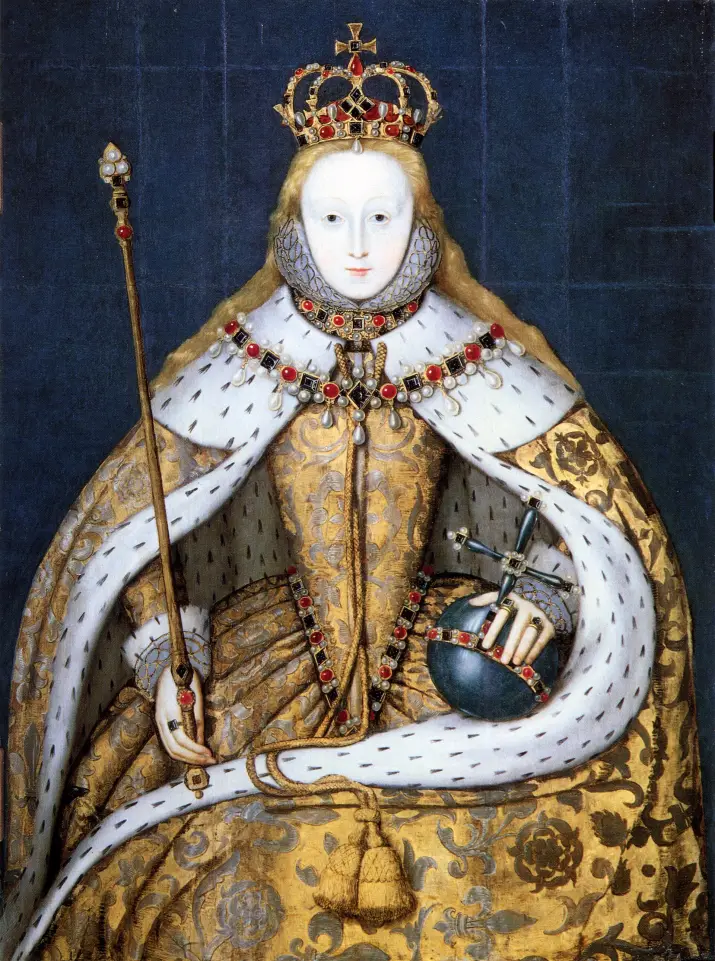
Key points
- The Act of Uniformity and restoration of the prayer book (1559)
- The "Thirty-Nine Articles" (approved 1563, promulgated 1571)
- Moderate Calvinism while retaining the episcopate and liturgy
- The execution of Mary Stuart (1587) and the growth of Puritanism
- Muller: returning exiles formed in Geneva and Strasbourg gave the Geneva Bible its Reformed glosses; Jewel and Grindal gave the Settlement a Reformed tendency, and in the 1580s–1590s Reformed theology dominated the universities, especially Cambridge (Cartwright, Whitaker, Perkins)
- Shelley: under Elizabeth I the Church of England became neither Roman nor Reformed; the queen took the title Supreme Governor. The Thirty-Nine Articles (1563) were Protestant in substance yet open to Catholic readings; the compromise was called Via Media. Puritans returned from Geneva convinced the Bible teaches about Church and society; who chooses the clergy became the issue. Elizabeth let the Puritans “bark but not bite”; the Church stayed in the hands of bishops and the crown. Puritan zeal was fed by the Geneva Bible, prepared by exiles under Mary, with numbered verses and marginal notes; it stayed among the most widespread until replaced by the King James Version (1611), and Puritans took it to America
- Allen: sixteenth-century Church of England confessions were Reformed on the sacraments; the Articles (art. 25) call them “effectual signs of grace.”
People
- Elizabeth I
- Mary Stuart
- John Jewel
- Matthew Parker
Place
England
Sources
Primary sources
- Thirty-Nine Articles of Religion, art. 25
Textbooks
- J. North – A History of the Church (Russian edition), p. 266–267, 269–270
- Justo L. González – A History of Christian Thought, vol. III: From the Protestant Reformation to the Twentieth Century (Abingdon, rev. ed. 1987), p. 189–190, 194, 198–200, 297–299
- Justo L. González – The Story of Christianity, vol. II (Russian edition), Part 1, ch. 8
- Justo L. González – A History of Christian Thought in One Volume (Abingdon, 2014), p. 332–335
- Alister McGrath – Reformation Thought (Russian edition: «Theological Thought of the Reformation»), p. 34–36, 290, 380
- Tony Lane – Christian Thinkers (Russian edition), p. 150, 202–207
- The Cambridge Companion to Reformation Theology, ed. David Bagchi, David C. Steinmetz (2004), p. 148–149
- Bruce L. Shelley – Church History in Plain Language (Russian edition), Ch. 27, sec. «Уклон в протестантизм»; Ch. 30, sec. «Пуританство: новая жизнь и новый мир»; Ch. 30, sec. «Люди Книги»
- The Oxford Handbook of Sacramental Theology, ed. Hans Boersma, Matthew Levering (2015), p. 345, 356–357
More on the doctrine
Data compiled: 2026-11-09