the late 1st – early 2nd century · 1st century
The Didache (the Teaching of the Twelve Apostles)
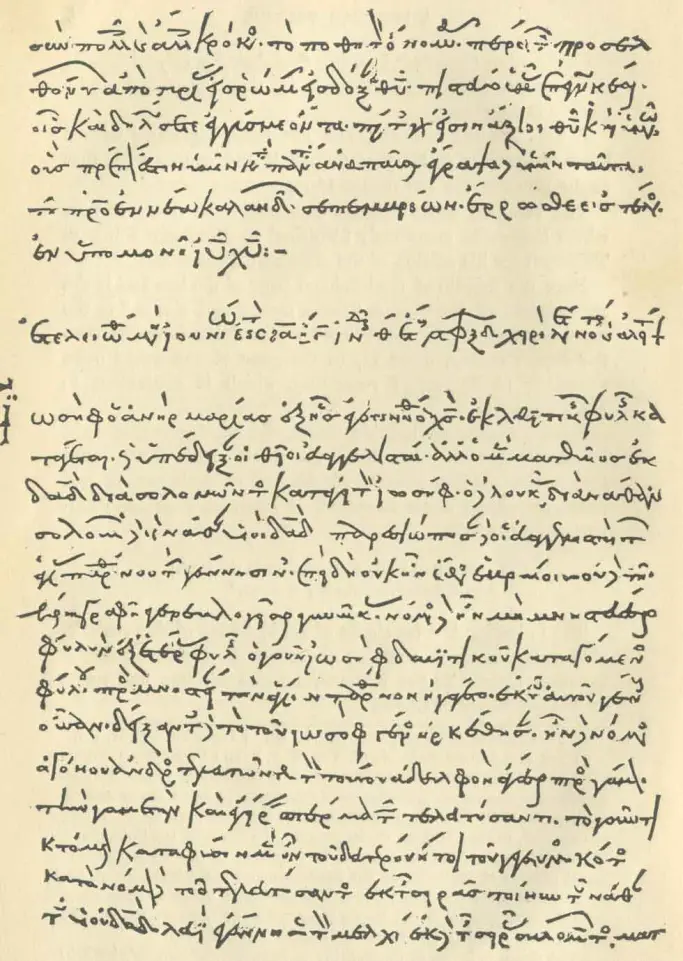
The Didache is an early manual of church life and order. It was presumably composed in Syria or Palestine in the late 1st to early 2nd century from texts of varying date. It was discovered only in the 1870s.
It includes the moral code of the "Two Ways" – to life and to death. The code is similar to the Epistle of Barnabas and the Qumran texts, and catechumens memorized it before baptism. The document also gives instructions on baptism, fasting, prayer, and the Eucharist. Baptism is in the name of the Father, Son and Holy Spirit – the earliest mention of threefold pouring (ch. 7). Fasting is on Wednesdays and Fridays, unlike the "hypocrites". The Lord's Prayer is said three times a day (ch. 8).
The document gives the marks of a false prophet (ch. 11) and calls a newcomer who will not work a "Christ-monger" (ch. 12). It reflects the transition from the ministry of itinerant apostles, prophets and teachers to the settled ministry of bishops (presbyters) and deacons chosen by the community (ch. 15).
An early moralism and legalism, without a systematic statement of doctrine, also characterizes other apostolic-father writings of this time. Examples are Clement of Rome and the Shepherd of Hermas.
Key points
- The "Two Ways" – to life and to death; similarity to the Epistle of Barnabas and the Qumran texts
- Baptism in the name of the Father, Son and Holy Spirit; fasting on Wednesdays and Fridays; the Lord's Prayer three times a day
- Itinerant apostles, prophets and teachers; criteria for recognizing false prophets
- A call to elect bishops and deacons (ch. 15) – the shift to a settled ministry
- Discovered only in the 1870s
Place
Syria or Palestine (presumed)
Sources disagree
The datings differ: Hall does not date the document precisely, calling it early and composite; Lane and González suggest the late 1st to early 2nd century. The exact place and time of origin are disputed.
Sources
Primary sources
- Didache (The Teaching of the Twelve Apostles), ch. 1–15
Textbooks
- Stuart G. Hall – Doctrine and Practice in the Early Church (Russian edition), p. 15–16, 20, 24–25
- Tony Lane – Christian Thinkers (Russian edition), p. 15–16
- Justo L. González – A History of Christian Thought in One Volume (Abingdon, 2014), p. 29–31
- Justo L. González – The Story of Christianity, vol. I (Russian edition), Ch. 3 «Учители церкви», introduction
More on the doctrine
- The Didache and the Apostolic Fathers: baptism, Eucharist and the way of life (late 1st – early 2nd century)
- The Didache: from apostles and prophets to bishops and deacons (c. 100)
Data compiled: 2026-11-09