325 · 4th century
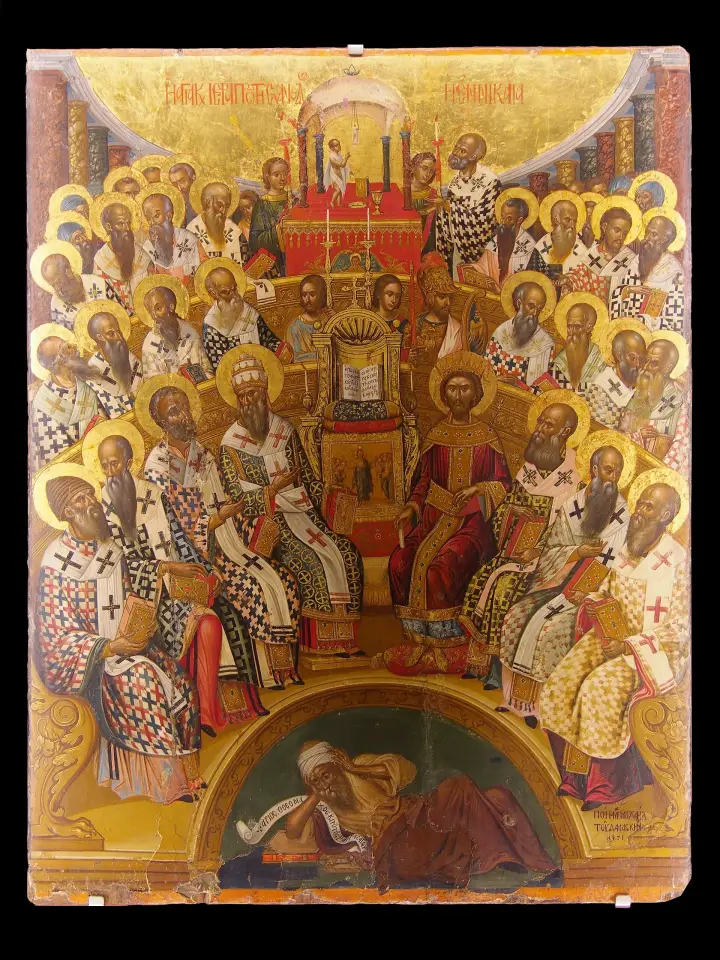
The First Ecumenical Council of Nicaea
Constantine convened a council at Nicaea. By various counts, between 220 and roughly 300 bishops attended, mostly from the East. The treasury covered the costs.
Eusebius of Nicomedia set out Arius's views. The council rejected them, and the scroll containing them was torn up. The creed was based on the baptismal formula presented by Eusebius of Caesarea. At Constantine's insistence the non-biblical term "homoousios" ("of one substance") was added to it – probably under the western influence of Hosius of Cordoba.
The adopted creed confessed the Son as "begotten, not made, of one substance with the Father." It closed with anathemas against formulas such as "there was when He was not." Arius and two bishops refused to sign and were exiled, and Arius's books were burned.
The council also adopted twenty canons establishing the primacy of Alexandria, Rome, and Antioch. It fixed the date of Easter according to the Roman-Alexandrian custom and addressed the lapsed and the Meletians. But the ambiguity of the term "homoousios" prolonged the Arian controversy for more than another half-century.
Key points
- "Begotten, not made, of one substance with the Father"
- The term homoousios added at the emperor's insistence
- Rejection of Eusebius of Nicomedia's creed and Arius's exile
- Twenty canons, including on the primacy of sees and the date of Easter
- The formula's ambiguity prolonged the dispute for over 50 years
- Weinandy: Nicaea’s fathers first drew the creed from Scripture, but Arians allowed both “from the Father” and “like the Father”, so “consubstantial” was adopted. Nicaea first clearly distinguished “begotten, not made”: the made is of a different nature from its maker, the begotten of the same. “Consubstantial” could mean a shared substance (two gods) or one being; Athanasius saw it requires thinking of God as a Father who begets the Son.
- Shelley: general councils began with Constantine (Arles, 314; Nicaea, 325); Nicaea confirmed Alexandria, Antioch and Rome as preeminent, Jerusalem as honorary. The bishops at Nicaea remembered persecution; Constantine hosted them, and later the court alternately exiled and recalled clergy. In the 3rd–4th centuries the Church developed along two lines – the authority of councils and the precedence of some bishops over others. Its order mirrored the empire: metropolitan bishops oversaw provincial ones, and the city bishop ordained rural presbyters.
People
- Constantine the Great
- Arius
- Alexander of Alexandria
- Athanasius the Great
- Eusebius of Nicomedia
- Eusebius of Caesarea
- Hosius of Córdoba
- Eustathius of Antioch
- Marcellus of Ancyra
Place
Nicaea (Bithynia)
Sources disagree
The number of participants varies: the traditional 318 bishops (González (Story of Christianity, vol. I), Lebedev (part I)), Hall's at-least-230, Lane's more-than-220; the books also differ on the season (spring/summer/June).
Sources
- Justo L. González – The Story of Christianity, vol. I (Russian edition), Ch. 10
- Louis Berkhof – History of Christian Doctrines (Russian edition), p. 57–58
- Justo L. González – A History of Christian Thought in One Volume (Abingdon, 2014), p. 116–119
- Stuart G. Hall – Doctrine and Practice in the Early Church (Russian edition), p. 87–90
- Tony Lane – Christian Thinkers (Russian edition), p. 35–38
- A. P. Lebedev – History of the Ecumenical Councils, part I, p. 14–39, 40–50
- J. North – A History of the Church (Russian edition), p. 71–72
- Jaroslav Pelikan – The Christian Tradition: A History of the Development of Doctrine, vol. 1 (Russian edition), p. 213–215
- Jaroslav Pelikan – The Christian Tradition, vol. 2: The Spirit of Eastern Christendom (600–1700) (Russian edition), p. 115–119
- The Oxford Handbook of Christology, ed. Francesca Aran Murphy (2015), p. 662–665
- Bruce L. Shelley – Church History in Plain Language (Russian edition), Ch. 10, sec. «Осмысление тайны»; Ch. 14, sec. «Притязания римских католиков»
More on the doctrine
Data compiled: 2026-11-09