May–July 381 · 4th century
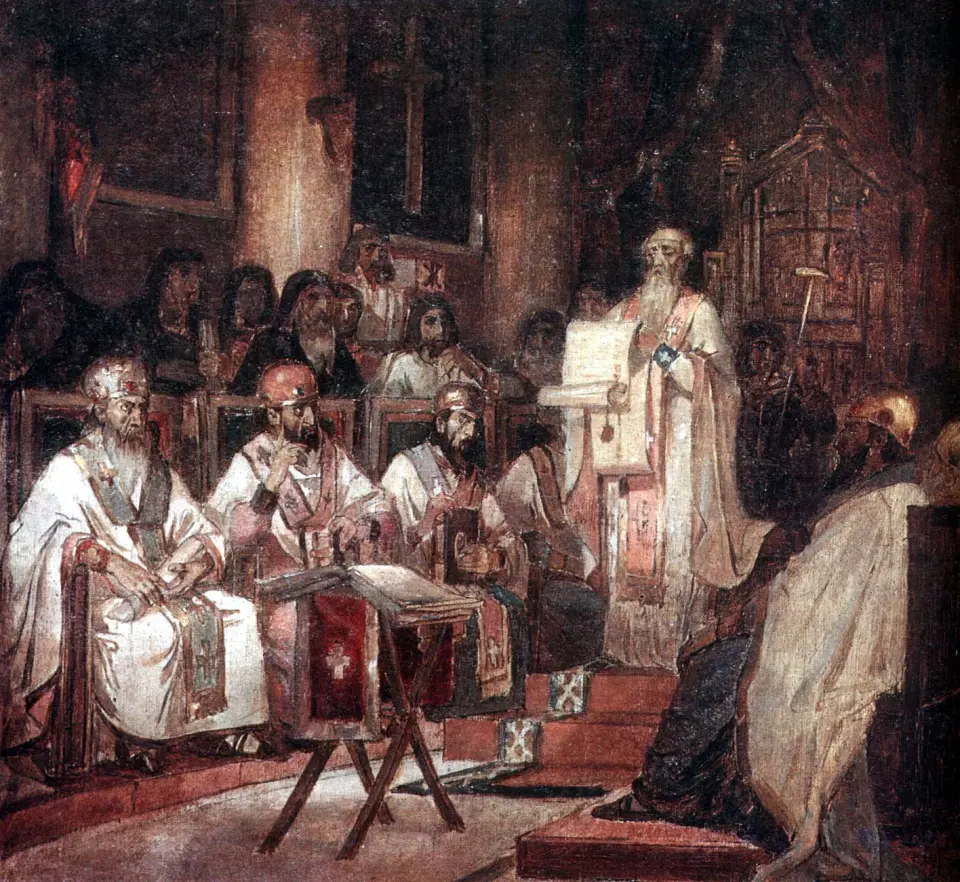
The Second Ecumenical Council of Constantinople
The council was convened by Theodosius I and gathered one hundred fifty eastern bishops. It was initially presided over by Meletius of Antioch and, after his death during the sessions, by Gregory of Nazianzus. Gregory soon resigned the see in favor of the unbaptized senator Nectarius.
The council confirmed the Nicene creed and condemned every form of Arianism – Anomoean and Homoian. It also condemned Pneumatomachianism (the teaching of Macedonius) and Apollinarianism.
The council proclaimed the doctrine of the Trinity and added to the earlier creed an article on the Holy Spirit: "the Lord, the Giver of Life, who proceeds from the Father, who together with the Father and the Son is worshiped and glorified." It did not, however, call the Spirit directly God, and it left open the question of the Spirit's relation to the Son. In this form the text became fixed in later tradition as the Niceno-Constantinopolitan Creed. Its origin and its precise connection to the council itself remain disputed among historians.
The council's third canon gave the bishop of Constantinople, as the "New Rome", primacy of honor immediately after Rome. Both Rome and Alexandria long rejected this rule.
Key points
- Confirmation of the Nicene creed and the final condemnation of Arianism in the East
- Condemnation of the Pneumatomachians (Macedonius) and the Apollinarians
- An addition to the creed on the Holy Spirit, without directly naming Him God
- The third canon: Constantinople's second place after Rome, not accepted by Rome and Alexandria
- The death of the presiding Meletius and Gregory of Nazianzus's resignation of the see
- Barnes: Niceta of Remesiana’s own creed has ‘born of the Holy Spirit and the Virgin Mary’; the Nicene creed does not mention Mary or Luke 1:35 at all, while the creed of Constantinople (381) says the Son was ‘incarnate from the Holy Spirit and the Virgin Mary’. The familiar liturgical phrase ‘by the power of the Holy Spirit’ is not in the original creed; it seems to come from a modern committee translation.
- Shelley: the Council of 381 ruled that Constantinople is the “new Rome”; Damasus rejected this, and a Roman synod in 382 appealed to the Lord’s word to Peter.
People
- Theodosius I
- Meletius of Antioch
- Gregory Nazianzen (the Theologian)
- Gregory of Nyssa
- Nectarius of Constantinople
- Maximus the Cynic
- Macedonius of Constantinople
- Apollinaris of Laodicea
Place
Constantinople
Sources disagree
The name "Second Ecumenical Council" became fixed only from 451; Hall allows that the creed known as the "creed of the 150 fathers" may only have been approved by the council rather than composed by it, since references to it are rare before Chalcedon; Lebedev (part I) and Hall disagree on Gregory of Nyssa's role in composing the creed.
Sources
- Louis Berkhof – History of Christian Doctrines (Russian edition), p. 61
- Justo L. González – A History of Christian Thought in One Volume (Abingdon, 2014), p. 125, 127, 154, 156
- Stuart G. Hall – Doctrine and Practice in the Early Church (Russian edition), p. 105, 109–112
- Justo L. González – The Story of Christianity, vol. I (Russian edition), Ch. 12, sec. 12.3; Ch. 13, sec. 13.3–13.4
- Tony Lane – Christian Thinkers (Russian edition), p. 45–47
- A. P. Lebedev – History of the Ecumenical Councils, part I, p. 103–112, 115, 119–128
- Jaroslav Pelikan – The Christian Tradition, vol. 2: The Spirit of Eastern Christendom (600–1700) (Russian edition), p. 118–119, 134, 321
- J. North – A History of the Church (Russian edition), p. 73–74
- The Cambridge Companion to the Trinity, ed. Peter C. Phan (2011), p. 96
- Bruce L. Shelley – Church History in Plain Language (Russian edition), Ch. 14, sec. «Империя отходит на Восток»
More on the doctrine
- The Controversy with the Pneumatomachi (Macedonians), Basil's On the Holy Spirit and the Council of Constantinople (381) (360–381 (council – 381))
Data compiled: 2026-11-09