c. 563 (Iona) – 590 (Columbanus's continental mission); practice spread in the 7th–8th c. · 6th century
Celtic missions: Patrick in Ireland, Columba at Iona, and the spread of private penance
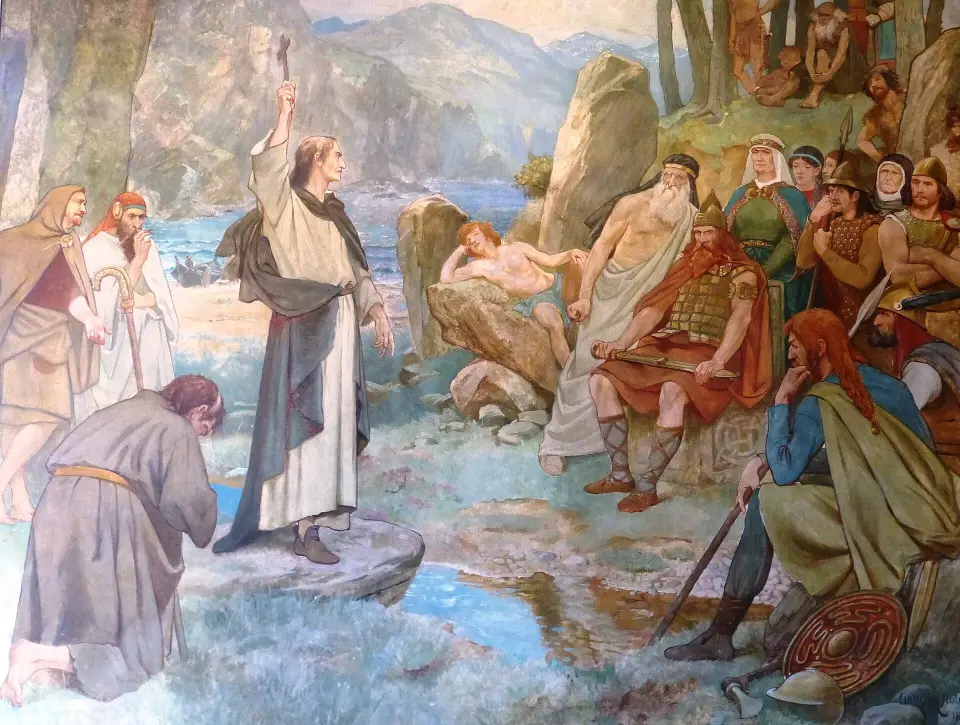
Christianity in Ireland is traditionally linked to Patrick. He escaped Irish slavery and later, guided by a vision, returned to preach there. Untouched by invasions, Irish monasteries preserved knowledge of antiquity.
Around 563 the Irish monk Columba and twelve companions founded a monastery on the island of Iona. It became a center for mission in Scotland and later among the Angles and Saxons.
In 590 another Irish monk, Columbanus, came to Gaul. There he founded a series of monasteries, later also in Switzerland and Italy. He was eventually exiled for rebuking the morals of rulers.
In the Celtic church authority belonged to abbots rather than bishops, and it observed its own date for Easter. It developed a practice of repeatable private confession before a priest. This replaced the ancient public and unrepeatable confession. In the 7th–8th centuries wandering Celtic missionaries spread the practice throughout the Latin Church – in Gaul, Spain, and beyond.
Key points
- Patrick – preaching in Ireland; Irish monasteries preserved ancient learning
- Columba founds the Iona monastery (c. 563) – a center for mission in Scotland
- Columbanus brings Celtic monasticism to the continent (Gaul, from 590)
- Distinctive features of the Celtic church: abbots' authority, its own Easter reckoning
- The Celtic practice of repeatable private penance spreads through the Latin Church in the 7th–8th centuries
- Shelley: from Patrick’s short autobiography we know he grew up in a Christian family (his father a deacon) but took religion lightly. Irish raiders carried him into slavery and he became a swineherd: “The Lord opened to me my unbelief”. After six years he escaped, reached the coast and boarded a ship carrying hunting dogs; back home he dreamed of Irish infants begging him to return and tell them of Christ, and after preparation (by some accounts with the pope’s approval) he went to those whose slave he had been. A century later the Irish Church was mainly monastic: he suggests a monastery on a tract of land suited farming Celts better than Rome’s parishes. Celtic monks (Columbanus, Bobbio, the monastery of St Gall) founded houses in Germany, Switzerland and northern Italy; their independent spirit eventually began to trouble Rome
People
- Patrick
- Columba
- Columbanus
Place
Ireland, Iona (Scotland), Gaul, Spain
Sources
- J. North – A History of the Church (Russian edition), p. 91
- Justo L. González – The Story of Christianity, vol. I (Russian edition), Ch. 20, sec. 20.1
- Justo L. González – A History of Christian Thought in One Volume (Abingdon, 2014), p. 209–210
- Bruce L. Shelley – Church History in Plain Language (Russian edition), Ch. 16, sec. «Миссии на север»
More on the doctrine
- Penance after baptism: from Hermas to private confession (2nd–8th centuries)
Data compiled: 2026-11-09