1902–1914 · 20th century
Catholic modernism and its condemnation by Pius X
At the turn of the twentieth century a younger generation of Catholic scholars emerged – Alfred Loisy, George Tyrrell, Friedrich von Hügel. They began applying German biblical and historical criticism to Scripture and tradition. Their approach paralleled Protestant liberalism. They were labelled "modernists" and were opposed by conservative "integralism."
Loisy answered Harnack's "What Is Christianity?" with "The Gospel and the Church" (1902). He argued that the essence of Christianity lies not in its origins but in what it became under the Spirit's guidance.
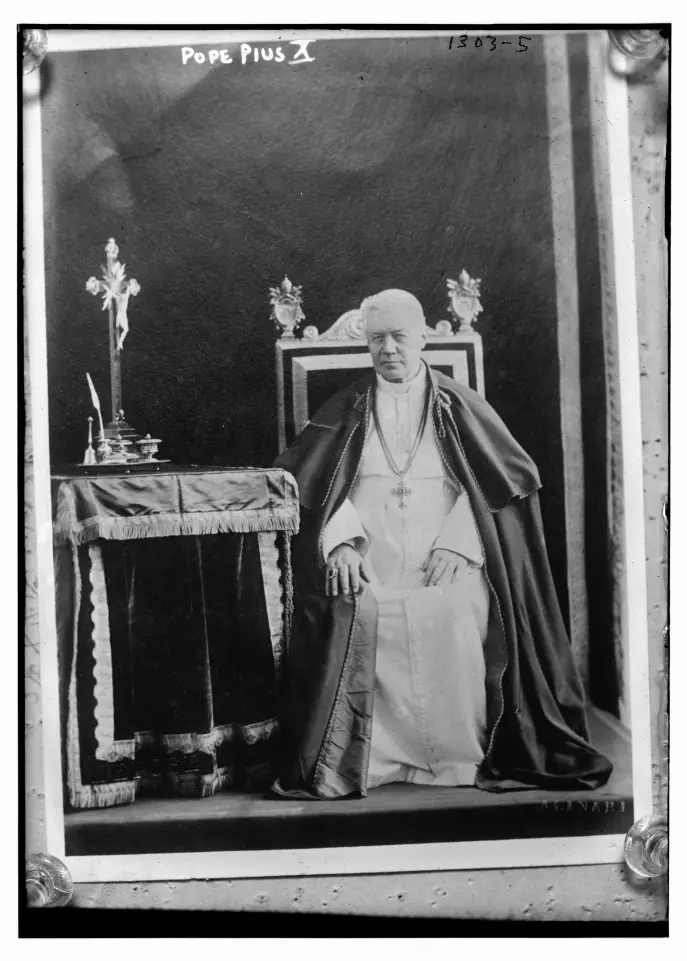
Pope Pius X condemned the movement in 1907 with the decree Lamentabili (67 condemned propositions) and the encyclical Pascendi. Loisy was soon excommunicated. Tyrrell was expelled from the Jesuits and excommunicated.
The condemnation of modernism fixed a conservative course for Catholic theology for decades, until John XXIII and Vatican II.
Key points
- Loisy's "The Gospel and the Church" (1902) – a response to Harnack
- Decree Lamentabili and encyclical Pascendi (1907) – 67 condemned propositions
- Excommunication of Loisy and Tyrrell; Fogazzaro's novel "The Saint" placed on the Index
- Decades-long ban on even mentioning modernism in Catholic theology
People
- Pius X
- Alfred Loisy
- George Tyrrell
- Friedrich von Hügel
- Antonio Fogazzaro
- Adolf von Harnack
Place
Rome; France; England; Italy
Sources
Primary sources
- Loisy – The Gospel and the Church, introduction
Textbooks
- Stanley Grenz, Roger Olson – 20th-Century Theology: God and the World in a Transitional Age (Russian edition), p. 359, 362
- Justo L. González – A History of Christian Thought, vol. III: From the Protestant Reformation to the Twentieth Century (Abingdon, rev. ed. 1987), p. 397, 415–419
- Justo L. González – The Story of Christianity, vol. II (Russian edition), Part 3, ch. 29, section «Пий X»
- Justo L. González – A History of Christian Thought in One Volume (Abingdon, 2014), p. 402–404
Data compiled: 2026-11-09