1922–1958 · 20th century
The papacy and fascist regimes: from the Lateran Accords to the end of Pius XII's pontificate
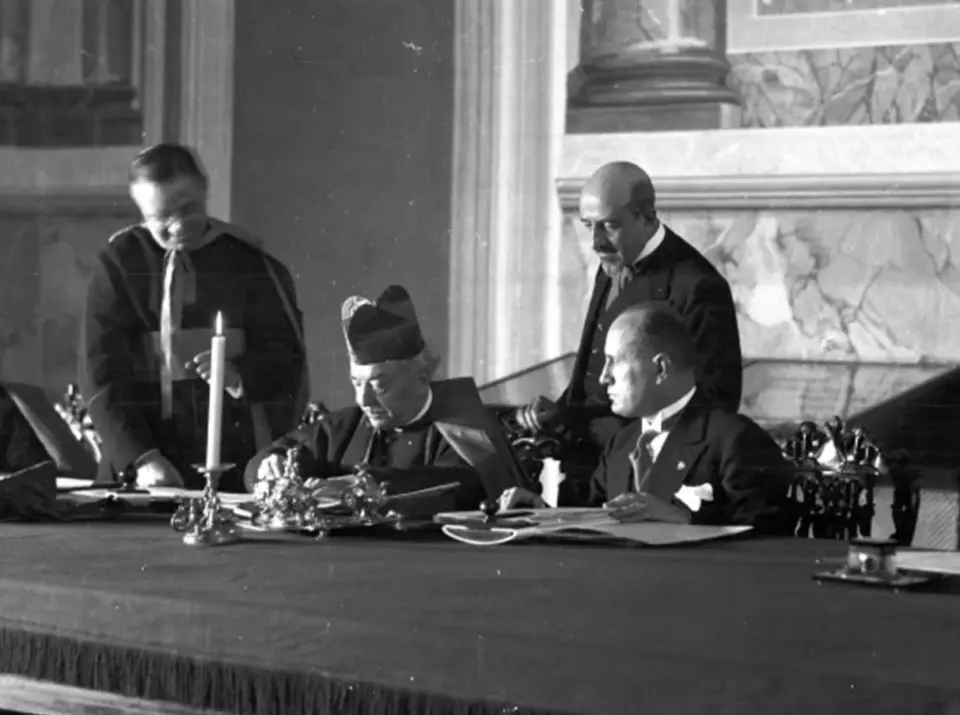
After Mussolini's rise to power in Italy (1922) the papacy sought accommodation with secular fascist regimes. The 1929 Lateran Accords created the sovereign state of Vatican City and settled the loss of the Papal States (1870). Pius XI initially supported Italian fascism and recognized Franco's victory in Spain as a "crusade."
A 1933 concordat was signed with Hitler's Reich. But Nazi repression of Catholic organizations led Pius XI in 1937 to condemn Nazism in the encyclical "Mit brennender Sorge." Five days later he condemned communism in "Divini Redemptoris."
Pius XII (1939–1958) maintained public neutrality on the persecution of Jews during the war. He excommunicated communists in 1949 and restricted theological innovation with "Humani generis" (1950). At the same time, the internationalization of the College of Cardinals and liturgical preparations under him laid groundwork for the future Second Vatican Council.
Key points
- 1929 Lateran Accords with Mussolini – creation of Vatican City
- Concordat with the Reich (1933); encyclical "Mit brennender Sorge" against Nazism (14 March 1937): the pope charges the other party with emasculating the concordat (§ 5) and condemns those who divinize "race, or the people, or the State" (§ 8)
- Pius XII: wartime neutrality, excommunication of communists (1949), "Humani generis" (1950)
- Groundwork (internationalized curia, liturgical reform) for the future Vatican II
- Shelley: Hitler, raised Catholic, abandoned Christian principles but “flirted” with the churches; Catholics supported the new government. In 1933 pope and Führer signed a concordat that raised Hitler’s prestige and excluded Catholics from politics; he never meant to keep it. When Hitler’s intentions became clear, the Church was alarmed by the “new paganism” and growing restrictions; priests appealed to the Vatican. On 14 May 1937 Pius XI, helped by Cardinal Pacelli (the future Pius XII), drew up the encyclical Mit brennender Sorge (“With Burning Concern”), “the first major church document criticizing Nazism”. It was smuggled into Germany and read on Palm Sunday from all Catholic pulpits until a copy fell into Nazi hands. Per Pierard, the encyclical protested the Church’s persecution, called on Catholics to resist the idolatrous cult of race and state, not to allow the perversion of doctrine and morals and to keep loyalty to Christ, the Church and Rome. Hitler at first raged but avoided a break with Rome and met the encyclical with total silence; knowing he had lay German Catholics’ support, he increased pressure on the churches, ruling out organized resistance. In March 1937 Pius XI in Divini Redemptoris condemned the “errors of communism” and offered Church teaching as the alternative; it came four days after the one criticizing Nazi Germany, and the Vatican stood with believers persecuted in totalitarian states
People
- Pius XI
- Pius XII
- Benito Mussolini
- Adolf Hitler
- Francisco Franco
Place
Rome / Vatican; Italy; Germany; Spain
Sources
Primary sources
- Pius XI – Encyclical Mit brennender Sorge, para. 3–5, 8
- Pius XII – Encyclical Humani generis, para. 45
Textbooks
- Justo L. González – A History of Christian Thought, vol. III: From the Protestant Reformation to the Twentieth Century (Abingdon, rev. ed. 1987), p. 469–471
- J. North – A History of the Church (Russian edition), p. 395–397
- Justo L. González – The Story of Christianity, vol. II (Russian edition), Part 4, ch. 33, section «От Бенедикта XV до Пия XII»
- Bruce L. Shelley – Church History in Plain Language (Russian edition), Ch. 42, sec. «Христиане в дни власти Гитлера»; Ch. 42, sec. «Русская революция»
Data compiled: 2026-11-09