1509–1536 · 16th century
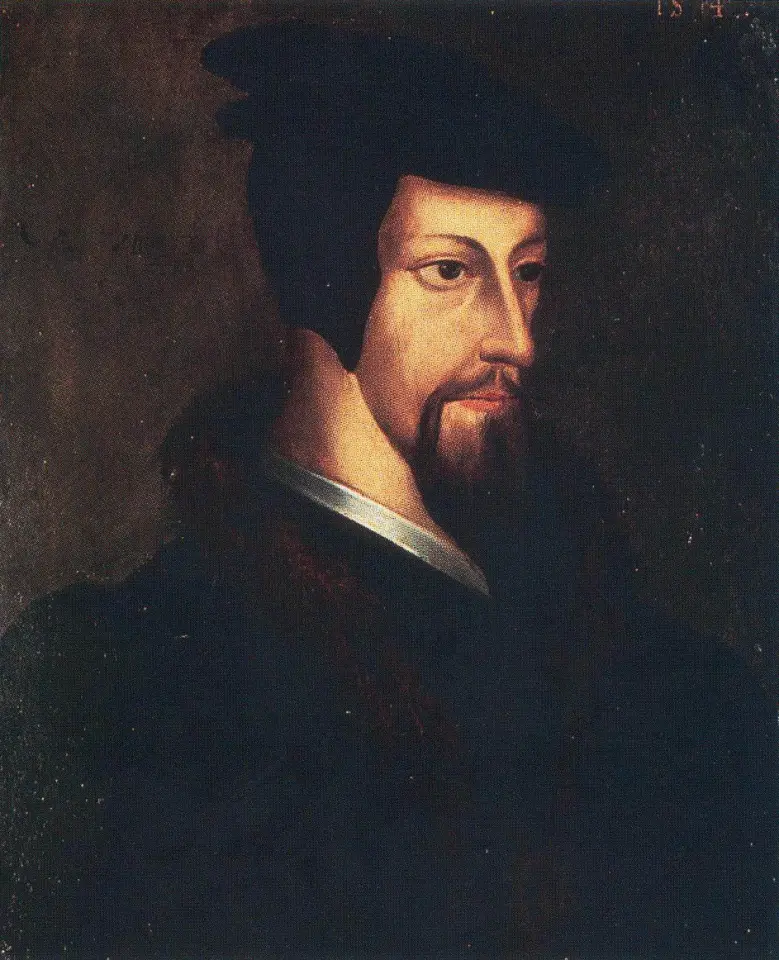
The early years and conversion of John Calvin
John Calvin was born on 10 July 1509 in Noyon. He studied in Paris, at the Collège de Montaigu, and then law in Orléans and Bourges. There he encountered Guillaume Budé's French legal humanism. In 1532 he published a humanist commentary on Seneca's treatise "On Clemency".
On 2 November 1533 a speech by the rector Nicolas Cop with cautious Lutheran overtones caused a scandal. Calvin, who probably helped draft it, fled Paris. Between late 1533 and 1534 he underwent a "sudden conversion", which he himself ascribed to divine providence.
The "Affair of the Placards" (18 October 1534) and Francis I's ensuing persecution forced him to leave France for good in January 1535. He settled in Basel.
Key points
- Commentary on Seneca's "De clementia" (1532)
- Nicolas Cop's speech (2 November 1533) and Calvin's flight from Paris
- The "sudden conversion" ascribed to divine providence
- The "Affair of the Placards" (18 October 1534) and the move to Basel
- Gunton: the Reformers returned to Scripture and the Fathers; Calvin’s Institutes, an introduction to Scripture, contrast starkly with the Sentences.
People
- John Calvin
- Nicolas Cop
- Francis I
- Guillaume Budé
Place
Noyon; Paris; Orléans; Bourges; Basel
Sources disagree
The exact time and circumstances of Calvin's conversion are called unknown by the sources; a date between 1533 and 1534 is given.
Sources
- Tony Lane – Christian Thinkers (Russian edition), p. 177–183
- Justo L. González – The Story of Christianity, vol. II (Russian edition), Part 1, ch. 7
- Justo L. González – A History of Christian Thought, vol. III: From the Protestant Reformation to the Twentieth Century (Abingdon, rev. ed. 1987), p. 76–77, 123–125, 138–139
- Alister McGrath – Reformation Thought (Russian edition: «Theological Thought of the Reformation»), p. 182–183, 379, 443
- The Cambridge Companion to Christian Doctrine, ed. Colin E. Gunton (1997), p. 31
Data compiled: 2026-11-09