376–378 · 4th century
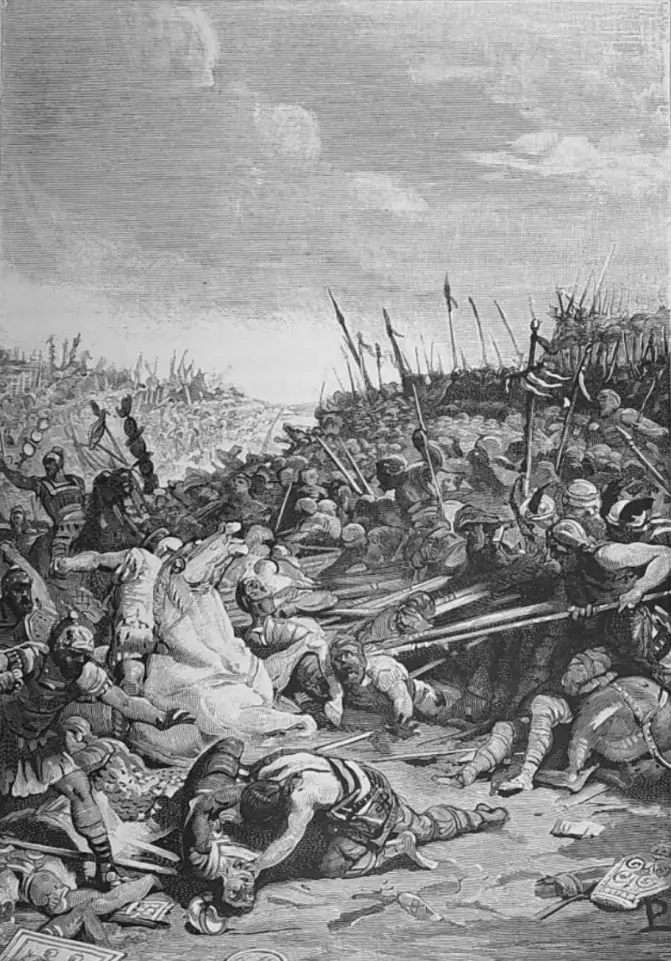
The Battle of Adrianople and the Death of Emperor Valens
Fleeing the Hunnic invasion, the Visigoths received permission from Emperor Valens to settle in the empire as federates. Oppression by Roman officials led to a revolt. On August 9, 378, the Goths crushed the Roman army at Adrianople, and Valens himself died in the battle.
This ended the official Homoian (Arian) policy in the East. Valens's co-emperor Gratian sent the Spanish general Theodosius against the Goths. Theodosius eventually became emperor of the East and, more than anyone before him, sought to identify the Church with the empire.
Key points
- The Visigoths admitted into the empire as federates, fleeing the Huns
- Valens's death ended Homoian policy in the East
- Theodosius drives out the Goths and becomes emperor of the East
- Under Constantius, Ulfilas created a Gothic alphabet and translated the Bible, leading the Goths to adopt Arianism
- Shelley: the Germans came to orthodoxy by two routes: directly from paganism and through Arianism, spreading among them since the fourth century. Their Arianism was more ecclesiastical than theological: their Christ was a first-born creature, a glorified war chief; the main difference from the orthodox was church organization: Arian churches belonged to the clan and had no centre, and even after converting to orthodoxy the Arian Germans hated the idea of centralization through Rome. Half a century after Nicaea the missionary Ulfilas crossed the Danube and laboured forty years among the barbarians; he translated the whole Bible into Gothic except Kings, too warlike for a fierce people; from the Goths Arianism spread to other tribes. The battle destroyed the myth of the legions’ invincibility and opened the way to chaos that lasted a century and a half
People
- Valens
- Gratian
- Theodosius I
- Ulfilas
- Constantius II
Place
Adrianople, the Balkans
Sources disagree
North dates the Visigoths' admission to the empire to 372 and the revolt to 376, while the battle itself is dated to 378, as in the other books.
Sources
- Stuart G. Hall – Doctrine and Practice in the Early Church (Russian edition), p. 106
- J. North – A History of the Church (Russian edition), p. 94
- Justo L. González – The Story of Christianity, vol. I (Russian edition), Ch. 16, 17, 18, 20
- Bruce L. Shelley – Church History in Plain Language (Russian edition), Ch. 16, sec. «Пришествие варваров», «Миссии на север»
Data compiled: 2026-11-09