1221–1274 · 13th century
Thomas Aquinas and Bonaventure: the Peak of Scholasticism
Albert the Great taught in Paris and Cologne. His pupil Thomas Aquinas became a Dominican in 1244, against his family's wishes, and studied and taught in Paris. His main works were the unfinished "Summa Theologiae", written in his last decade, and the "Summa contra Gentiles", intended to convince Jews and Muslims. Shortly before his death in 1274, Thomas had a mystical vision, called his writings "straw", and stopped working. He was canonized in 1323, but he did not win acceptance right away.
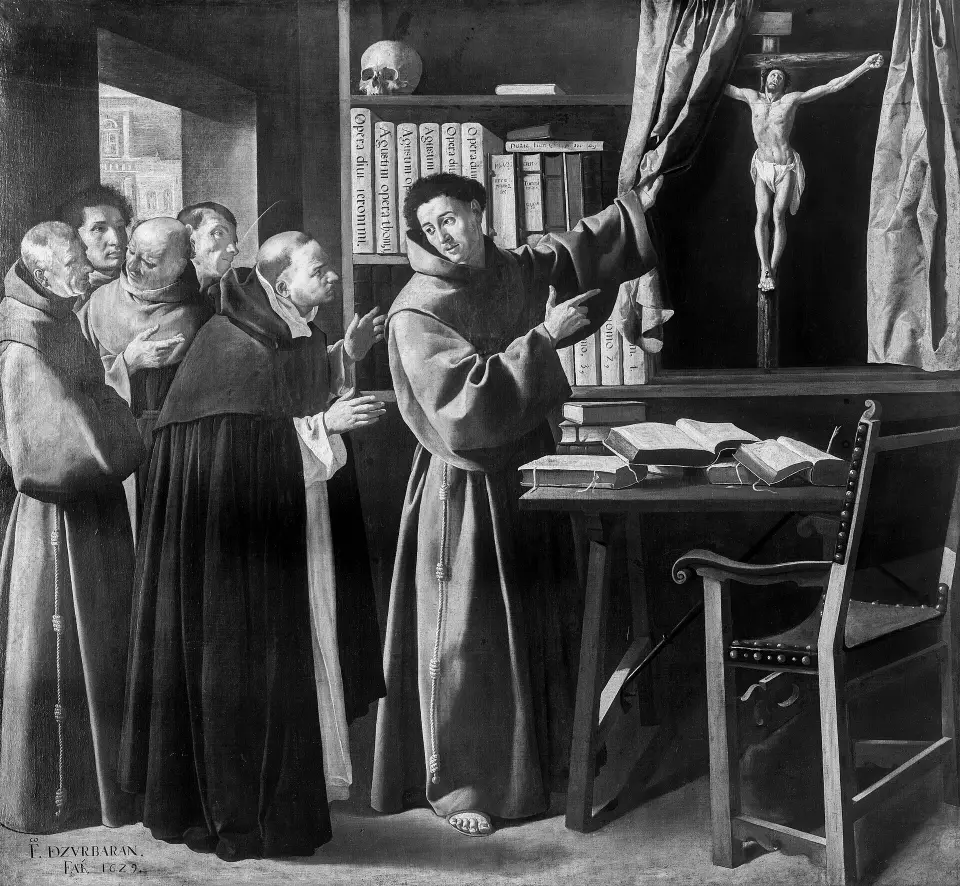
Bonaventure was elected Minister General of the Franciscans in 1257 and was called the order's "second founder". He reconciled strict and moderate Franciscans, built his theology on the Augustinian tradition, and opposed the extremes of Aristotelianism. Both theologians died in 1274, on the way to, or during, the Council of Lyon.
Key points
- Thomas Aquinas's "Summa Theologiae" and "Summa contra Gentiles"
- Thomas's canonization in 1323, though acceptance did not come at once
- Bonaventure – Minister General and "second founder" of the Franciscans
- The death of both theologians in 1274, on the way to or during the Council of Lyon
- Wawrykow: after his first Paris regency (1256–1259) Thomas found in Italy Latin acts of the early councils, forgotten in the West since Carolingian times, and his Christology grew sharper and ‘Cyrillian’ (one subject, the Word); he came to know Nestorius better. No one in the thirteenth century knew the early patristic debates about Christ as deeply as Thomas: he now called Lombard’s first and third opinions heresy and the second orthodox truth (III, q. 2, a. 6), though in the Scriptum he did not yet call the first opinion heresy. The Christ ‘treatise’ in the Summa theologiae (III, qq. 1–59) repeats neither Lombard’s Sentences, nor Damascene, nor the Summa of Brother Alexander; its second part (qq. 27–59), retelling Christ’s life from entry to resurrection, is new – Thomas’s innovation (Scheffczyk). On Christ’s earthly knowledge (III, q. 12, a. 2) Thomas says outright that he changed his position from the Scriptum.
- Gunton: Aquinas held a two-source theory of truth: truth is one but comes through reason, left unimpaired by the Fall, and through revelation; unlike Anselm, he did not treat God’s existence as part of the creed – the Summa establishes it first, with concepts drawn from Aristotle.
- McGinn: Bonaventure created the main line of Franciscan mysticism: The Mind’s Journey into God, The Triple Way, the Large Life of Francis
People
- Thomas Aquinas
- Albert the Great
- Bonaventure
- Alexander of Hales
- Peter Lombard
- John Duns Scotus
Place
Naples; Cologne; Paris
Sources
Primary sources
- Thomas Aquinas – Summa Theologiae, pt. III, q. 2, art. 6; q. 12, art. 2
Textbooks
- Justo L. González – A History of Christian Thought in One Volume (Abingdon, 2014), p. 249–258
- Tony Lane – Christian Thinkers (Russian edition), p. 90–91, 123–132
- Justo L. González – The Story of Christianity, vol. I (Russian edition), Ch. 25, sec. 25.3
- Louis Berkhof – History of Christian Doctrines (Russian edition), p. 79, 128–130, 155–157, 191–195
- Alister McGrath – Reformation Thought (Russian edition: «Theological Thought of the Reformation»), p. 101–108
- The Oxford Handbook of Christology, ed. Francesca Aran Murphy (2015), p. 295–296, 295–298
- The Cambridge Companion to Christian Doctrine, ed. Colin E. Gunton (1997), p. 37
- The Oxford Handbook of Mystical Theology, ed. Edward Howells, Mark A. McIntosh (2020), Ch. 4, sec. «Franciscan Mysticism»
More on the doctrine
- Thomas Aquinas: The Synthesis of Reason and Revelation, the Summa contra Gentiles and the Summa Theologiae (1260–1274)
- Thomas Aquinas: The Five Ways and the Doctrine of Analogy (1264–1274)
- Thomas Aquinas on the Trinity: two processions and "subsisting relations" (13th century)
- Bonaventure on the Trinity: the relational nature of God and "fontal fullness" (1248–1273)
Data compiled: 2026-11-09