1215 · 13th century
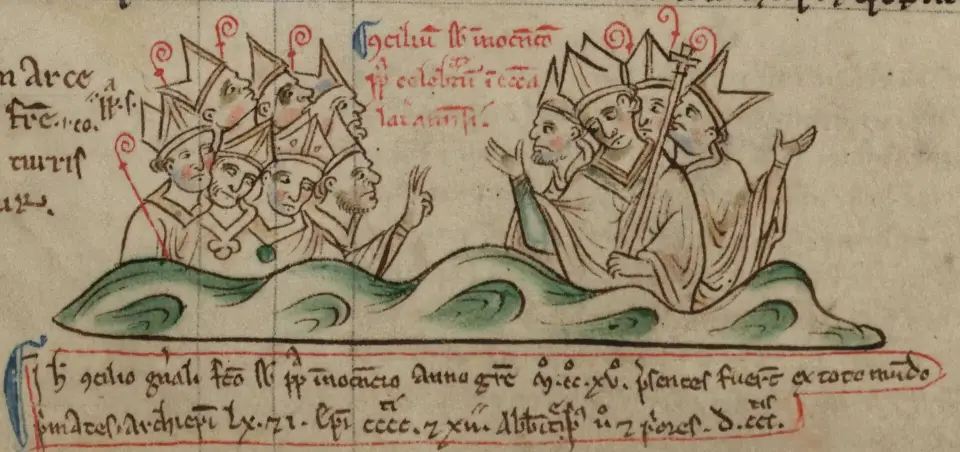
The Fourth Lateran Council
The council was convened by Innocent III and confirmed his program in three one-day sessions. For the first time it officially proclaimed the dogma of the transubstantiation of bread and wine into the body and blood of Christ. The term "substance" was later interpreted through Aristotelian metaphysics.
The council required all adult Catholics to confess to a priest and to receive communion at least once a year at Easter. It also protected the seal of confession.
It condemned the Waldensians, the Albigensians, and Joachim of Fiore's trinitarian teaching. Peter Lombard's views, by contrast, were vindicated.
The council banned the founding of new monastic orders with their own rules. It required schools for the poor attached to cathedrals. New relics without papal approval were banned, as was payment for sacraments. Jews and Muslims were required to wear distinctive dress.
The council is considered the most significant of the Middle Ages. Its decisions, however, were not debated but only approved by those assembled.
Key points
- The first official definition of the dogma of transubstantiation
- Mandatory annual confession and Easter communion
- Condemnation of the Waldensians, the Albigensians, and Joachim of Fiore's teaching
- A ban on new monastic orders with their own rules
- Kuhlmann: Lateran IV (1215) used the word “transubstantiation” without defining it; the term arose in Paris c. 1140, probably with Robert Pullen.
People
- Innocent III
- Joachim of Fiore
- Peter Lombard
- Robert Pullen
Place
Rome (the Lateran)
Sources
- Jaroslav Pelikan – The Christian Tradition: A History of the Development of Doctrine, vol. 1 (Russian edition), p. 54
- Justo L. González – The Story of Christianity, vol. I (Russian edition), Ch. 25, sec. 25.2; ch. 22, sec. 22.2
- J. North – A History of the Church (Russian edition), p. 155
- Justo L. González – A History of Christian Thought in One Volume (Abingdon, 2014), p. 215, 228, 243
- Tony Lane – Christian Thinkers (Russian edition), p. 119–121
- Louis Berkhof – History of Christian Doctrines (Russian edition), p. 186
- Alister McGrath – Reformation Thought (Russian edition: «Theological Thought of the Reformation»), p. 151–152, 242
- The Oxford Handbook of Sacramental Theology, ed. Hans Boersma, Matthew Levering (2015), p. 255–256, 256
More on the doctrine
Data compiled: 2026-11-09