1523–1527 · 16th century
The origins of Anabaptism and the Schleitheim Confession
Radical followers of Zwingli – Conrad Grebel, Felix Manz and others – broke with him over infant baptism and the union of church and state. They demanded a "church of believers" founded on a personal confession of faith.
On 21 January 1525 in Zurich, the former priest Georg Blaurock asked Grebel to baptize him as an adult. He then began baptizing others himself. This was the first "rebaptism" and the birth of the movement its opponents called Anabaptism.
The authorities applied ancient laws prescribing death for rebaptism. In February 1527 at Schleitheim, under Michael Sattler's leadership, seven articles were adopted. They are the most authoritative Anabaptist confession: believers' baptism, separation from the world, refusal of the sword and of oaths. Sattler himself was soon burned at the stake.
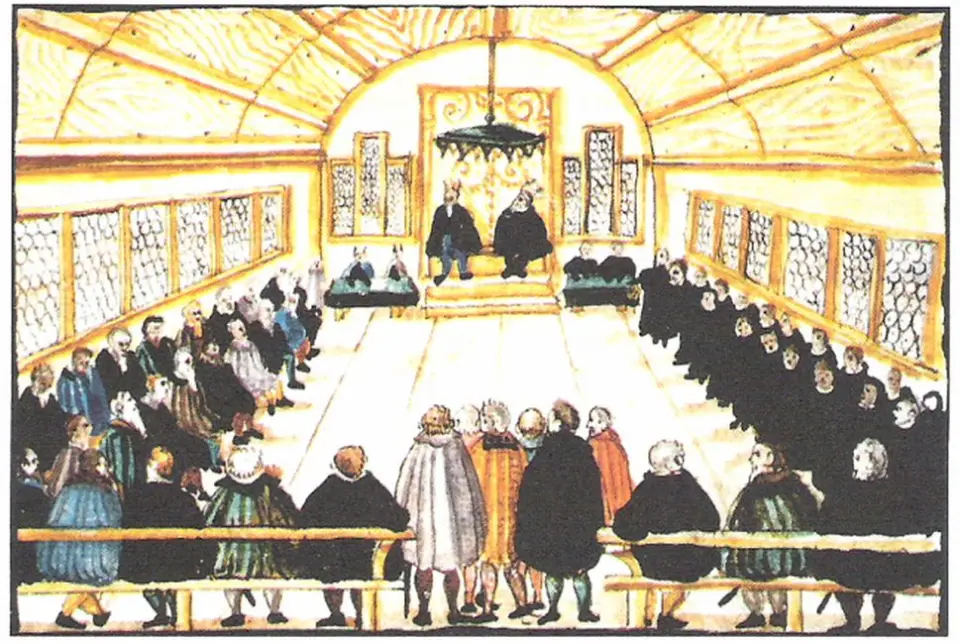
Key points
- First adult baptism in Zurich (21 January 1525)
- The church as a voluntary gathering of believers, separate from the state
- The Schleitheim Confession (24 February 1527) – Michael Sattler's seven articles
- Mass executions of Anabaptists in Switzerland and Germany
- Packull: the radicals’ break with Zwingli turned not only on infant baptism but on politics: the Zurich council extended its power over rural areas. The first refusals to baptize infants came at Witikon and Zollikon; adults were probably baptized on 21 January 1525. The Schleitheim Articles (1527) – seven “boundary” marks: believers’ baptism, Supper, separation, discipline, no sword or oath. Hubmaier became early Anabaptism’s leading theologian and a martyr (1528); the community order passed to Marpeck and the Hutterites. Persecuted Anabaptists fled to Moravia, where nobles let them settle on estates; Gabrielites, Philipites and Hutterites arose there. The Hutterites became most numerous, kept a Chronicle and through Riedemann produced the most substantial early Anabaptist Confession (1542)
- Shelley: on 17 January 1525 the Zurich debate declared Zwingli the winner, and the council ordered infants baptized on pain of exile; on 21 January at Manz’s house Blaurock asked Grebel to baptize him on confession of faith, and the first Anabaptist congregation arose at Zollikon. In 1526 Zurich ordered Anabaptists drowned; on 5 January 1527 Felix Manz became the first Anabaptist martyr. In 1529 the Diet of Speyer declared Anabaptism heresy; four to five thousand were executed, Blaurock burned in the Tyrol. Persecuted Anabaptists found refuge in Moravia and founded the Bruderhof, a Christian commune; they were called Hutterites after Jakob Hutter (d. 1536). Anabaptist descendants became the “Quiet in the Land,” fine farmers; by the late 20th c. they numbered over half a million
- Rempel: Anabaptism arose as a liturgical act – the “rebellious” baptism and Supper in Zurich in January 1525.
People
- Conrad Grebel
- Felix Manz
- Georg Blaurock
- Michael Sattler
- Huldrych Zwingli
- Balthasar Hubmaier
Place
Zurich; Schleitheim (canton of Schaffhausen)
Sources
- Tony Lane – Christian Thinkers (Russian edition), p. 173, 191–193
- Justo L. González – A History of Christian Thought, vol. III: From the Protestant Reformation to the Twentieth Century (Abingdon, rev. ed. 1987), p. 90–95, 104
- Alister McGrath – Reformation Thought (Russian edition: «Theological Thought of the Reformation»), p. 19–20, 288–289, 378
- Justo L. González – A History of Christian Thought in One Volume (Abingdon, 2014), p. 302–305
- Justo L. González – The Story of Christianity, vol. II (Russian edition), Part 1, ch. 6
- Louis Berkhof – History of Christian Doctrines (Russian edition), p. 173–174, 181–182, 184, 192
- The Cambridge Companion to Reformation Theology, ed. David Bagchi, David C. Steinmetz (2004), p. 206, 206–207, 207
- Bruce L. Shelley – Church History in Plain Language (Russian edition), Ch. 25, introduction; sec. «Радикалы в Швейцарских Альпах»; Ch. 25, sec. «Радикалы в Швейцарских Альпах»; Ch. 25, sec. «Радикалы в Швейцарских Альпах», «Основоположники современного христианства»
- The Oxford Handbook of Sacramental Theology, ed. Hans Boersma, Matthew Levering (2015), p. 364–365
More on the doctrine
- The Anabaptists: a believers' Church separated from the world and the state (1525–1527)
- The Anabaptists and believers' baptism: the dispute over infant baptism (1525)
Data compiled: 2026-11-09