3rd–4th centuries · 2nd century
Tertullian and Latin Anthropology: Traducianism, Inherited Sin and Infant Baptism
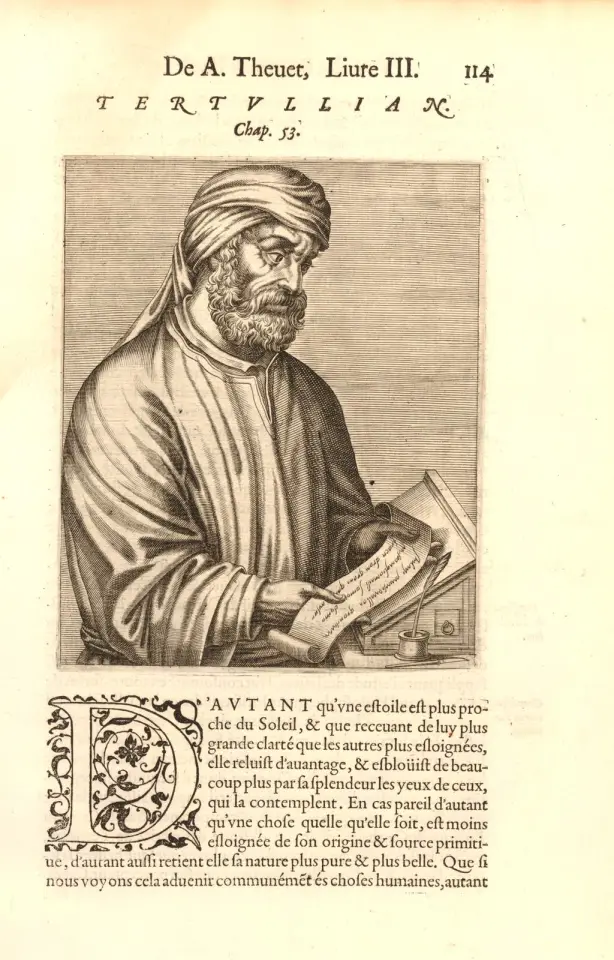
Tertullian's Stoic worldview led him to regard the soul as a bodily entity derived from the souls of the parents, as the body from bodies (On the Soul 5, 27); on this traducianism rests his claim that sin is passed from parents to children: "the inheritance of the soul is the inheritance of sin". According to González (HCT), it was largely under Tertullian's influence that this understanding of original sin became widespread in the West. Berkhof traces the gradual emergence of the Western doctrine in the 3rd–4th centuries: Cyprian leaned toward original sinfulness, Ambrose and Hilary clearly taught that all sinned in Adam but retained synergism. Pelikan shows that the practice of infant baptism became a premise for the doctrine of original sin: Cyprian was the first to link it clearly with the "contagion of the ancient death" (Epistles 58.5).
Positions
- Greek anthropology (according to Berkhof)
- Each soul is created separately; guilt is not transmitted
- Tertullian
- The soul is corporeal and is inherited together with sin (On the Soul 5, 27, 40); free will is nevertheless not denied; against infant baptism as an innovation: "why should the innocent age hasten to the remission of sins?" (On Baptism 18)
- Origen
- Infant baptism is an apostolic tradition; the "filth of birth" is washed away by baptism
- Cyprian, Ambrose
- The infant has contracted the contagion of the ancient death through birth (Cyprian, Epistles 58.5); "I fell in Adam... in Adam I died... guilty as I was in Adam, I am now justified in Christ" (Ambrose, Death of Satyrus 2.6)
Key points
- Berkhof: Tertullian combined traducianism with realism: God created a generic human nature, individualized through procreation
- Tertullian called Plato “the caterer to all these heretics” (On the Soul 23), yet turned to the Stoics on the nature of the soul (ibid. 5)
- Pelikan: here is the inevitable influence of philosophy on doctrine
- The biblical grounds for infant baptism were not clear; the argument rested on worship rather than on theory
- Augustine, relying on Cyprian and Ambrose, argued that baptism and exorcism bear witness to the inescapable sin of infants
Outcome
The hereditary transmission of sin became the prevailing teaching of the West; Berkhof and Lane see in the Latin Fathers the preparation of Augustine's doctrine of original sin.
People
- Tertullian
- Origen
- Cyprian of Carthage
- Hilary of Poitiers
- Ambrose of Milan
Terms
- traducianism
- The teaching that the soul derives from the souls of the parents, as the body from bodies.
- creationism
- The teaching that each soul is created by God separately.
- body – corpus
- For Tertullian, the mode of being of God and of the soul: materiality, a tangible breath.
Place
Carthage, Milan
Sources disagree
The books do not date Tertullian's treatises (late 2nd – early 3rd century); Berkhof: "in the third and fourth centuries"; Ambrose – 374–397 (Lane).
Sources
Primary sources
- Tertullian – A Treatise on the Soul, ch. 5, 23, 27, 40
- Tertullian – On Baptism, ch. 18
- Cyprian of Carthage – Epistles, letter 58
- Ambrose of Milan – On the Death of Satyrus, bk. II, ch. 6
Textbooks
- Stuart G. Hall – Doctrine and Practice in the Early Church (Russian edition), p. 48
- Jaroslav Pelikan – The Christian Tradition: A History of the Development of Doctrine, vol. 1 (Russian edition), p. 59–61, 307–313
- Louis Berkhof – History of Christian Doctrines (Russian edition), p. 89–90
- Justo L. González – A History of Christian Thought in One Volume (Abingdon, 2014), p. 76–77
- Tony Lane – Christian Thinkers (Russian edition), p. 48
Related entries
- Grew out of: Baptism in the pre-Nicene Church: rite, gifts and infant baptism (late 2nd – 3rd century)
- Developed in: Original Sin and Free Will: Augustine against Pelagius, Celestius and Julian of Eclanum (409–430)
Data compiled: 2026-11-17