1st–2nd centuries · 1st century
The Bible of the Early Church: The Septuagint and the Old Testament Canon
The Greek translation of the Hebrew Bible – the Septuagint (LXX), made according to legend by seventy Alexandrian translators – was the Bible of the first known Christian writers and of almost all the New Testament authors. To render Hebrew concepts, the translators had to use Greek terms with connotations foreign to biblical thought, and even the accurate translations reflect the religious ideas of the Hellenes. After the fall of Jerusalem in 70, the rabbis adopted a limited list of books (a canon), which became the basis of the Christian Old Testament canon. Around 170, Melito of Sardis, in a letter quoted by Eusebius (Church History 4.26.13–14), writes that he went East, “to the place where these things were preached and done”, learned accurately the books of the Old Testament and sends their list; the list is close to the shortened rabbinic canon, but Esther is not in it.
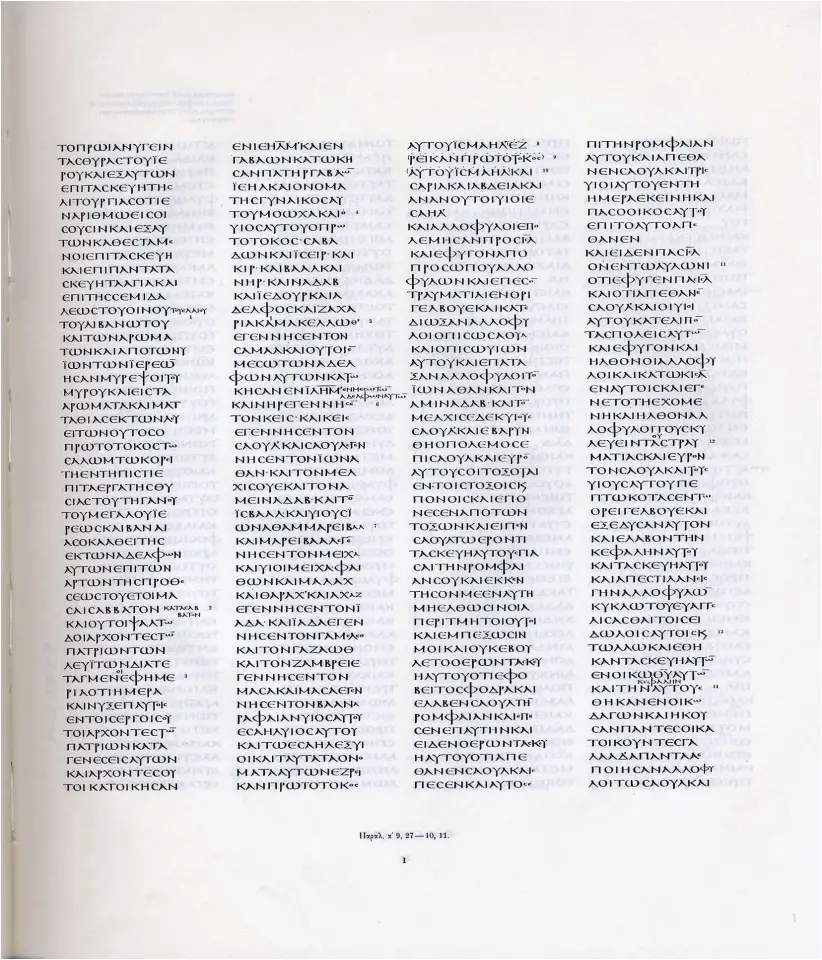
Positions
- Sadducees and Samaritans
- Recognized only the Law (the Pentateuch)
- Pharisees
- Revered the Prophets and the Writings alongside the Pentateuch
- Origen (according to Hall)
- Cited the same short list so as to appeal in debates with Jews only to texts they accepted, but himself regarded many more books as sacred and cited the Septuagint as the Word of God
Key points
- Hall: Christians assigned to the Septuagint all the books in Greek versions, although the legend concerned only the Law; the Church apparently did not doubt the inspiration of these books until it entered into debates with the Jews
- In the first centuries more accurate translations appeared (Theodotion, Symmachus, Aquila), but Christians held to the traditional version
- Christians found in the traditional version nuances that supported their ideas
- González: the LXX was the matrix in which the language of the New Testament was formed
- The rabbinic canon excluded Sirach, the Maccabees and Daniel’s chapters on Susanna and on Bel and the Dragon
- Some of the excluded books survived in the full Bible as “apocrypha”
- Shelley: Christians almost without exception accepted the Old Testament and inherited from Jesus an approach to interpreting it. Scholars often cite the 39-book canon (Law, Prophets, Writings) as more typical of Palestinian Jews; Greek translations added the 12–15 “apocrypha”. Augustine accepted the Apocrypha, most 16th-century Protestants removed them; the Catholic and Orthodox churches accepted them. He thinks Jesus quoted only the smaller canon’s books, which is “probably wrongly” called Palestinian
Outcome
The Greek Bible became the basis of early Christian preaching and of the language of the New Testament; the question of the longer (Greek) and shorter (rabbinic) list of Old Testament books remained open.
People
- Philo of Alexandria
- Josephus
- Melito of Sardis
- Origen
Terms
- Septuagint – LXX
- The Greek translation of the Old Testament made in Alexandria.
- He Who Is – ho on
- The rendering of Exod. 3:14, "I am He Who Is"; according to Hall, an adaptation to Greek philosophy, in which "being" is eternal and truly present.
- canon
- A limited list of the sacred books of Scripture.
Place
Alexandria, Palestine, Asia Minor
Sources disagree
Hall: the Septuagint appeared no later than 200 BC; González does not date the translation and speaks of its role in the 1st century. The rabbinic canon – after 70 (Hall); Melito's list – c. 170 (Hall).
Sources
Primary sources
- Eusebius of Caesarea – Church History, bk. IV, ch. 26
Textbooks
- Stuart G. Hall – Doctrine and Practice in the Early Church (Russian edition), p. 21–23
- Justo L. González – A History of Christian Thought in One Volume (Abingdon, 2014), p. 19–20
- Bruce L. Shelley – Church History in Plain Language (Russian edition), Ch. 6, sec. «Основы Библии», «Вопрос об апокрифах»
In church history
- The Septuagint – the Greek translation of the Old Testament (3rd century BC (not later than 200 BC))
Data compiled: 2026-11-17