second half of the 2nd century · 2nd century
The resurrection of the body and the immortality of the soul: Tatian, Athenagoras and the dispute over the nature of the risen body
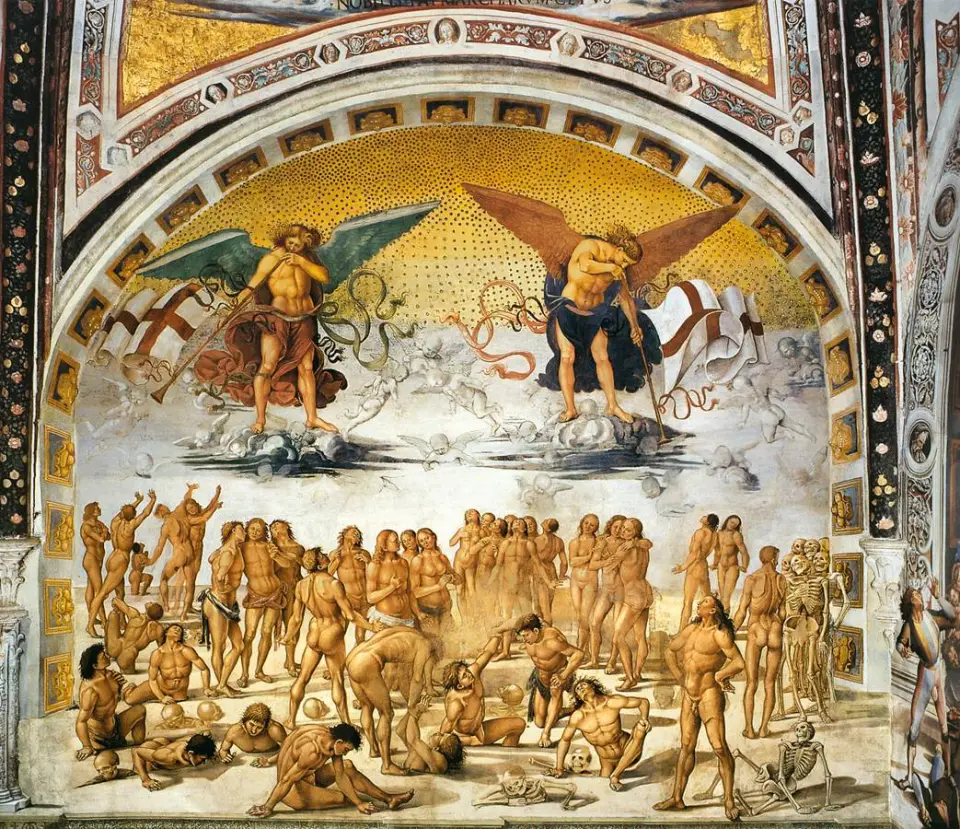
Against the Gnostics, who rejected bodily resurrection and saw the end as the return of the soul, freed from matter, to the Pleroma, the church writers of the 2nd century insisted on the resurrection of the flesh: the sermon attributed to Clement teaches that believers "shall receive the reward in this flesh" (2 Clement 9). Tatian (Address to the Greeks 13) asserted that the soul is mortal in itself, yet does not die if it acquires the knowledge of God; Athenagoras (On the Resurrection of the Dead 11–15) argued that the resurrection accords with the nature of God the Creator and is required by the nature of man, who is man only in the unity of soul and body. According to Pelikan, Athenagoras's argument already points to the synthesis that Ambrose expressed: the philosophers' teaching on immortality is not false but incomplete without the resurrection. Later there was dispute over the identity of the risen body with the former one: Origen taught a purified spiritual body, Jerome insisted on the same hair and teeth, and the view that the body is identical became dominant.
Positions
- The Gnostics (according to Berkhof)
- Bodily resurrection is rejected; the end is the return of the soul to the Pleroma
- Tatian
- "The soul is not in itself immortal… but mortal" (Address to the Greeks 13); the soul that knows God does not die
- Athenagoras
- The resurrection of the body is required by human nature and does not contradict the immortality of the soul but complements it
- Origen and the Eastern Fathers (the two Gregories, Chrysostom, Synesius)
- The risen body is not the same but purified, spiritual
- Jerome, John of Damascus, Augustine (later)
- The same body will rise; John of Damascus uses the image of the seed, Augustine was at first close to Origen, then accepted the majority view
Key points
- Pelikan: the idea of an immortal rational soul is a Greek legacy; it was identified with bodily resurrection once separated from preexistence of souls
- Berkhof: the East understood the resurrection more spiritually than the West
- The scholastics, Thomas in particular, taught resurrection in the prime of life, subtle and luminous bodies of the righteous, and disfigured bodies of the wicked
Outcome
The immortality of the soul was joined to the biblical resurrection of the body; the view that the risen body is identical with the present one became dominant.
People
- Tatian
- Athenagoras
- Ambrose of Milan
- Origen
- Jerome
- Augustine
- John of Damascus
- Thomas Aquinas
Terms
- Pleroma
- "Fullness" – a term of Ephesians and Colossians; in Gnosticism, the fullness of divine reality formed by the Highest God and the aeons, to which the liberated soul returns.
Sources disagree
González (HCT) places Second Clement in the first half of the 2nd century and Athenagoras in the second half of the 2nd century (a contemporary of Tatian); Pelikan places Tatian and Athenagoras in the 2nd century and Ambrose in the 4th; Berkhof does not date the disputes over the nature of the risen body or the scholastic teaching.
Sources
Primary sources
- Second Epistle of Clement to the Corinthians, ch. 9
- Tatian – Address to the Greeks, ch. 13
- Athenagoras – On the Resurrection of the Dead, ch. 11–15
Textbooks
- Jaroslav Pelikan – The Christian Tradition: A History of the Development of Doctrine, vol. 1 (Russian edition), p. 38, 61–63
- Louis Berkhof – History of Christian Doctrines (Russian edition), p. 28–29, 194
- Justo L. González – A History of Christian Thought in One Volume (Abingdon, 2014), p. 28–29, 46–47
Related entries
- Response to: Dualism against the Good Creator: Gnostics, Manichees, Paulicians, Bogomils, Cathars – and the Doctrine of Creation out of Nothing (2nd–13th centuries)
In church history
- Second-century apologists (Aristides, Tatian, Athenagoras, Theophilus of Antioch, Melito of Sardis) (120–200)
Data compiled: 2026-11-17