1978 · 20th century
Rahner: transcendental christology and the incarnation as the goal of creation
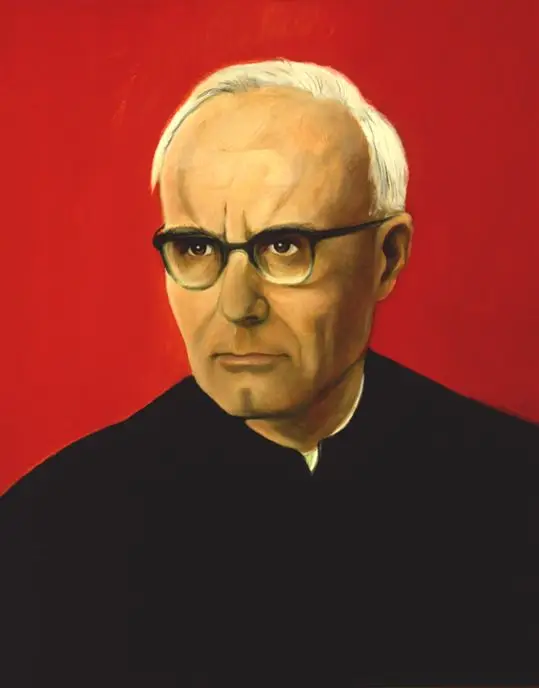
Karl Rahner, a former student of Heidegger, held that each generation must understand anew the truth hidden behind the formulas of orthodoxy. Agreeing with the Chalcedonian Definition, he thought it was too often interpreted in a Monophysite or almost docetic spirit, as if the incarnation diminished the genuine humanity of Jesus; Christian anthropology must be grounded in what is seen in Jesus as true and full humanity. In Foundations of Christian Faith (1978) he builds christology from the question of the "absolute Savior": absolute salvation requires the real presence of God, so Jesus is God incarnate and not a prophet, yet a genuine man whose divine consciousness was transcendental and unreflexive. The incarnation is not merely a response to sin but the very goal of creation: "When God wants to be what is not God, man comes to be."
Positions
- Rahner
- The incarnation is the fulfilment of creation and of the human search for a Savior; docetism is rejected
Key points
- The foundation of christology is Jesus' self-consciousness (the coming of God's kingdom) and his resurrection (Grenz–Olson)
- González: since the incarnation is the goal of creation, there is no "natural" man without grace, and every good human act is an act of grace
- Independence and nearness to God are not inversely proportional (Grenz–Olson)
Outcome
González calls Rahner the great teacher and systematizer of 20th-century Catholic theology; a number of his ideas (on the catholicity of the Church) were taken up by the Second Vatican Council.
People
- Karl Rahner
- Martin Heidegger
Terms
- absolute Savior
- The God-man in whom final salvation is accomplished.
- divine cipher
- An image of humanity as the vehicle of God's self-expression.
- mystery
- Rahner's recurring motif: a call to wonder and reflection.
Sources disagree
Grenz–Olson: Foundations of Christian Faith – 1978; González does not date the positions and gives only Rahner's life dates (1904–1984).
Sources
- Justo L. González – A History of Christian Thought in One Volume (Abingdon, 2014), p. 423–424
- Justo L. González – A History of Christian Thought, vol. III: From the Protestant Reformation to the Twentieth Century (Abingdon, rev. ed. 1987), p. 473–474
- Stanley Grenz, Roger Olson – 20th-Century Theology: God and the World in a Transitional Age (Russian edition), p. 379–382
In church history
- Karl Rahner and "anonymous Christianity" (1904–1984)
Data compiled: 2026-11-17