381 (acceptance – 451) · 4th century
The Niceno-Constantinopolitan Creed: composition, the debate over its origin, and acceptance
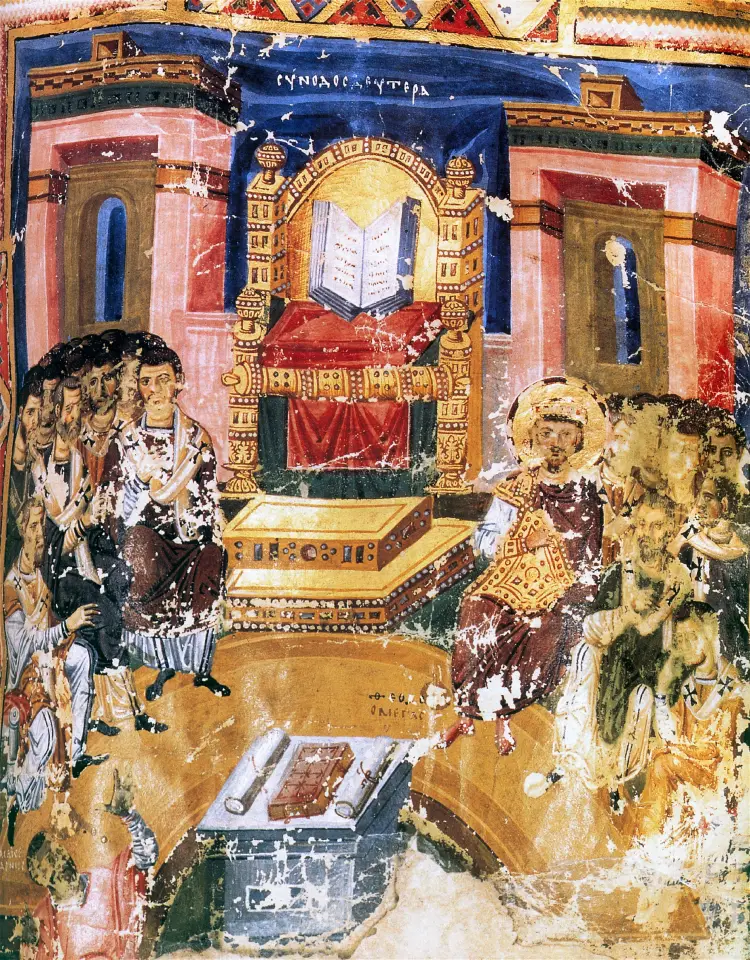
According to Lebedev, the creed of the Second Ecumenical Council corrected and supplemented the Nicene one: "God from God" and "from the substance of the Father" were omitted (replaced by "begotten before all ages"), the teaching on the incarnation was set out more fully ("from the Holy Spirit and the Virgin Mary", "crucified under Pontius Pilate", "of whose kingdom there shall be no end"), and the article on the Holy Spirit was unfolded ("the Lord, the Giver of life, who proceeds from the Father…"). Lebedev holds that the creed was directed above all against Marcellus and Apollinaris rather than against the Macedonians, and that the idea of a new creed could only have come from the Antiochenes who led the council. An almost identical baptismal creed is already given in Epiphanius's Ancoratus (373 or 374); Harnack's hypothesis that the creed was only later attributed to the council of 381 rested on this fact, and Lebedev rejects it. Rome and Alexandria long refused to recognize the council and its creed; the creed was finally established at the Council of Chalcedon in 451.
Positions
- Lebedev
- The creed was composed at the council of 381 by the Antiochenes against Marcellus and Apollinaris; Harnack's conclusion of a "forgery" is a "bold and fantastic undertaking": the creed contains no fewer than 70 Nicene expressions, and by the same logic one would have to deny that the Nicene Creed derives from the Caesarean one.
- Hefele and Caspari (according to Lebedev)
- The council merely adopted and abridged an already existing creed, which probably arose in Syria some 15 years before 381.
- Harnack (1881, according to Lebedev)
- The creed is the Jerusalem baptismal creed revised by Cyril of Jerusalem between 362 and 373 and attributed to the council of 381 only shortly before 451; of the creed's 178 words only 33 are taken from the Nicene one.
- The Alexandrians
- Relied on the decree of the Council of Ephesus of 431 forbidding the composition of any faith other than the Nicene; the Alexandrian Monophysites wrote: "We do not know the council of the hundred and fifty fathers."
Key points
- The Holy Spirit is not explicitly called God in the creed of 381
- Lebedev: possibly (as a hypothesis) Gregory the Theologian, who said “the Spirit is God”, disliked the new creed – he never quotes it. The council of 382 in its letter to Pope Damasus confessed “one being” of Father, Son and Spirit and Christ’s complete humanity, but the letter does not mention the new creed itself – perhaps out of caution
- The creed in the Ancoratus differs from that of Constantinople by “from the substance of the Father”, “in heaven and on earth” and anathemas
- Caspari: the creed was known to Chrysostom and Nestorius; even opponents of Chalcedon confirmed it, and from the late 5th century it displaced the Nicene Creed in Eastern baptismal practice
- At Chalcedon the creed of the 150 fathers was read in the second session: legates and the “left” side accepted it, Illyrians and Palestinians with reservations
- At Chalcedon the Egyptians mentioned only the Nicene Creed, and the definition calls the creed of 381 “wise and saving”
- Marcian in his edicts placed the Creed of Constantinople beside the Nicene one; Proterius was the first Alexandrian patriarch to recognize it
Outcome
According to Lebedev, the creed of 381 was finally established at the Council of Chalcedon; under Justinian the authority of the Second Ecumenical Council became unquestionable, and from the end of the 5th century the creed became the baptismal creed of the East.
People
- Meletius of Antioch
- Gregory of Nazianzus
- Epiphanius of Salamis
- Cyril of Jerusalem
- Marcellus of Ancyra
- Apollinaris of Laodicea
- Damasus of Rome
- Marcian
- Proterius of Alexandria
- Hefele
- Caspari
- Hort
- Adolf von Harnack
Place
Constantinople, Chalcedon
Sources disagree
Lebedev: the council – May–July 381; the sources do not say when during the council the creed was composed. Epiphanius's Ancoratus – 373 or 374 (according to Harnack); Caspari places the creed itself a few years before 373. Acceptance in the West – not before the time of Pope Leo, in Alexandria – by the middle of the 5th century.
Sources
- A. P. Lebedev – History of the Ecumenical Councils, part I, p. 103–112, 119–130, 155, 187, 204–205, 209–213, 228, 237–239, 245–279, 336–338, 340
Related entries
- Develops: The Nicene definition: "consubstantial with the Father" (325)
- Rejects: After Nicaea: the ambiguity of "consubstantial", Marcellus of Ancyra and the split between East and West (325–346)
Data compiled: 2026-11-17