1965 · 20th century
Moltmann, Theology of Hope: eschatology at the center of theology
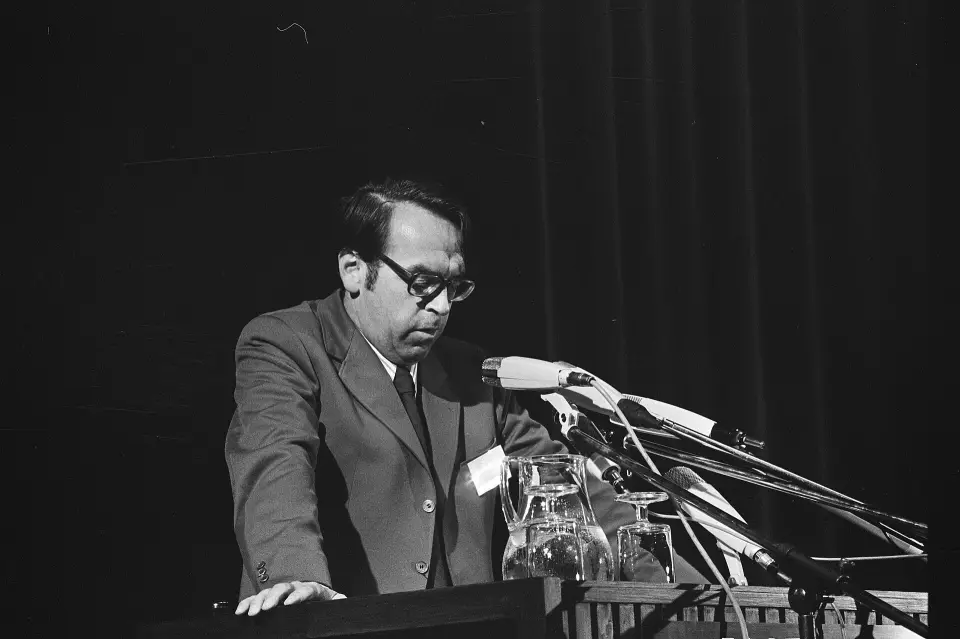
Weiss and Schweitzer showed that apocalyptic occupied a central place in Jesus' preaching, but Schweitzer held that the unfulfilled expectation of an imminent end discredits the New Testament, while Bultmann reinterpreted it existentially: eternal life by faith is a present reality. Jürgen Moltmann, having read Ernst Bloch's The Principle of Hope, asked why theology avoids a theme that should be its own, and in Theology of Hope (1965) restored eschatology to the center: it is not a final chapter about the last events but what the Church hopes for and the very hope by which it lives – "from first to last Christianity is eschatology, is hope." Revelation for him is promise, grounded in the resurrection of Christ, and God is not above us or within us but ahead of us, as the power of the future; the Church "is like an arrow shot into the world and aimed at the future," and therefore eschatological faith is necessarily political. Together with Pannenberg, Metz and Braaten, Moltmann began a movement that answered Kant's question "What may I hope?"; the theology of hope influenced the World Council of Churches and liberation theology.
Positions
- Earlier systematic theology
- The doctrine of the last things is an appendix, the last chapter
- Bultmann
- The expectation of an imminent kingdom was not fulfilled, but its true meaning is existential: a call to decision in the present
- Bloch
- Hope is attainable without God; "transcending without transcendence"
- Moltmann
- Eschatology determines every doctrine; without God utopia is an illusion, and Christian hope is grounded in the resurrection of Christ
- Pannenberg
- World history and salvation history are not distinguished; the resurrection of Jesus is the eschatological event through which the end can be discerned
Key points
- The movement sought transcendence not in space but in time, as an alternative to the Greek circle of time and Bultmann's existential time
- Barth gave Moltmann the theological raw material, Bloch the conceptual apparatus; Moltmann criticized Barth for neglecting the historical and the eschatological
- In The Crucified God the emphasis shifted to God in the poor and suffering
- Moltmann acknowledged that in his first book he had been overly taken with the possibility of immediate political change
- The goal of mission is not only the salvation of the individual but also the hope of justice and peace for all creation
Outcome
Eschatology was restored to the center of Christian faith; the work made Moltmann's reputation as one of the leading theologians of the generation after Barth and Bultmann and influenced the World Council of Churches and liberation theology.
People
- Jürgen Moltmann
- Ernst Bloch
- Rudolf Bultmann
- Johannes Weiss
- Albert Schweitzer
- Wolfhart Pannenberg
- Johannes Metz
- Carl Braaten
- Karl Barth
Terms
- theology of hope
- A movement of the 1960s that places eschatology at the center of theology and sees God as the power of the future.
- Kingdom of Glory
- The promised manifestation of God's glory in human freedom and community and the liberation of creation, where God will be all in all.
- novum, ultimum – novum; ultimum
- The new brought into history by the resurrection of Christ, and the ultimate horizon of hope, not the end of history.
- prolepsis
- The anticipation of the future in history; Moltmann calls his system "eschatological Trinitarian panentheism".
Place
Tübingen
Sources disagree
Lane dates Theology of Hope to 1964; González (both books) and Grenz and Olson to 1965 (English edition 1967); Grenz and Olson date The Crucified God to 1973, González cites the English edition of 1974; Grenz and Olson place Bultmann's existential interpretation in the period of his teaching (1921–1951).
Sources
- Justo L. González – A History of Christian Thought in One Volume (Abingdon, 2014), p. 419–420
- Justo L. González – A History of Christian Thought, vol. III: From the Protestant Reformation to the Twentieth Century (Abingdon, rev. ed. 1987), p. 462–465
- Tony Lane – Christian Thinkers (Russian edition), p. 283–284
- Stanley Grenz, Roger Olson – 20th-Century Theology: God and the World in a Transitional Age (Russian edition), p. 124–125, 256–263, 269–270
Related entries
- Rejects: Bultmann: Kerygma and the Demythologization of the New Testament (1941)
- Leads to: Liberation Theology and "Third World" Theologies: Theology as Critical Reflection on Praxis (1971–1988)
In church history
- Jürgen Moltmann and the theology of hope (1926–1990)
Data compiled: 2026-11-17