Middle Ages · 11th century
Scholastic disputes on the Trinity: Roscelin, Gilbert of Poitiers, Abelard
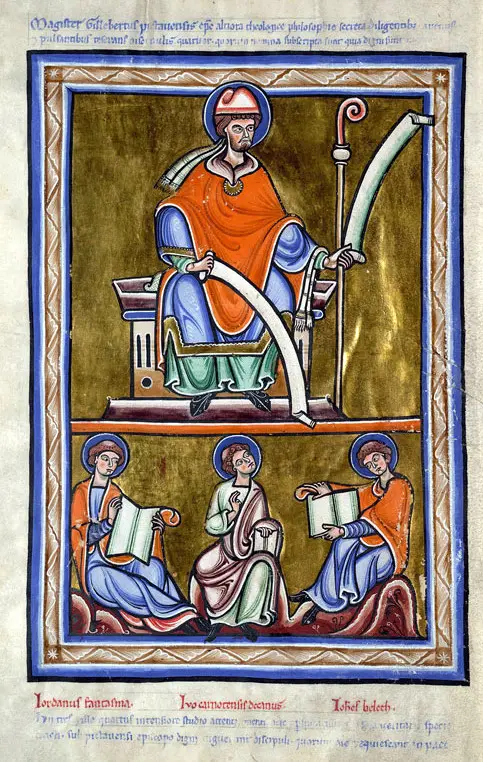
Berkhof describes three medieval attempts to interpret the Trinity through philosophical theories. Roscelin applied the nominalist understanding of universals as subjective concepts: the three Persons are three essentially distinct individuals, one only in origin, name, will and power; Anselm objected that this logically leads to tritheism. Gilbert of Poitiers, from the standpoint of moderate Aristotelian realism, distinguished the divine essence from God – the essence is the "form" of God, common to the three Persons – and was accused of "quaternity". Abelard apparently identified the Persons with power (the Father), wisdom (the Son) and goodness (the Spirit) and was accused of Sabellianism.
Positions
- Roscelin
- The three Persons are three individuals; their unity is a unity of will and power.
- Anselm
- Roscelin's position leads to tritheism; universals are true and real (Berkhof considers the objection just).
- Gilbert of Poitiers
- The essence is not God but the form of God, that which makes him God; the relation of essence and God is like that of humanity and individual men.
- Abelard
- The Father is power, the Son wisdom, the Spirit goodness; he also used expressions implying real personal distinctions, but his illustrations, according to Berkhof, clearly pointed to modalism.
Key points
- The dispute over the Trinity became intertwined with the dispute over universals: Roscelin's nominalism against Anselm's realism.
- Roscelin wanted to avoid the difficulty of combining numerical unity with the distinction of Persons.
- Berkhof: the usual presentation of the doctrine of the Trinity, prevailing in the Church of that time, was given by Thomas Aquinas.
Outcome
Anselm opposed Roscelin, Gilbert was accused of quaternity, Abelard of Sabellianism; the prevailing view of the Church remained the usual doctrine as presented by Thomas Aquinas (Berkhof).
People
- Roscelin
- Anselm of Canterbury
- Gilbert of Poitiers
- Peter Abelard
- Thomas Aquinas
Terms
- form – forma
- That which makes a thing what it is; for Gilbert – the divine essence in relation to God.
- quaternity
- The charge against Gilbert: distinguishing the essence from the three Persons supposedly yields a fourfold God.
Sources disagree
Berkhof gives no dates and assigns these disputes to the Middle Ages; the years 1050–1200 in the article are nominal and mark the period of the named theologians according to the general order of presentation.
Sources
- Louis Berkhof – History of Christian Doctrines (Russian edition), p. 64
Data compiled: 2026-11-17