c. 500 · 5th century
The Athanasian Creed (Quicunque vult) – "condensed Augustinianism"
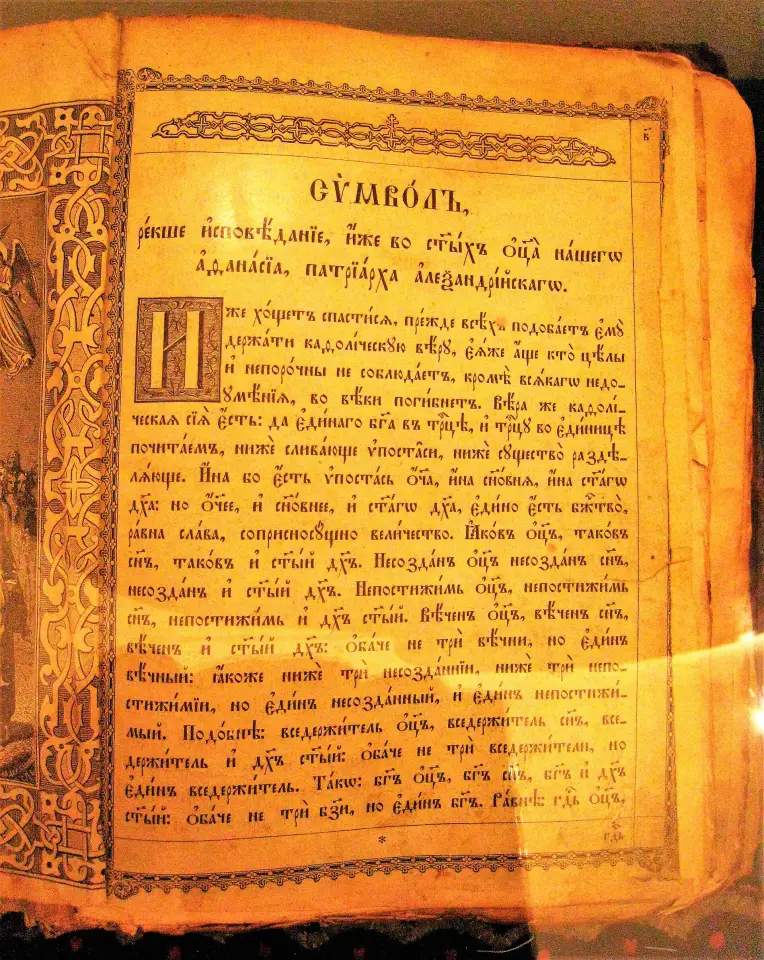
The Athanasian Creed, named after its first Latin words Quicunque vult ("Whoever wishes to be saved"), was not written by Athanasius: Lane assigns it to about 500 and southern Gaul, and the first indisputable witness to it, according to Pelikan, comes from Caesarius of Arles. Its trinitarian section sums up Western teaching on the basis of Augustine: "to worship one God in Trinity and Trinity in unity, neither confounding the persons nor dividing the substance". The Father, the Son and the Spirit are not three eternals, not three uncreated, not three almighties, but one; the Son is begotten of the Father, the Spirit proceeds from the Father and the Son. Pelikan and Lane call the creed "condensed" or "codified" Augustinianism.
Positions
- Monarchianism (against which the creed is directed, according to Lane)
- The Father is the Son and the Holy Spirit – "confounding the persons".
- Arianism (against which the creed is directed, according to Lane)
- The Son is less than the Father; "dividing the substance"; according to Lane, in fact the teaching of Origen adopted by the Gothic rulers.
Key points
- Lane: three elements of the teaching – one God; God is Father, Son and Spirit; the Father is not the Son nor the Spirit. Authorship by Athanasius was ascribed in the 7th century, questioned in the 16th century and rejected in the 17th century; strictly speaking, it is a definition rather than a creed.
- Pelikan: the formula "not three almighties, but one almighty" is taken almost verbatim from Augustine; the creed may have been composed in a “Semi-Pelagian” milieu that admired Augustine’s trinitarian and christological teaching, so it would more properly be called the “Augustinian Creed”
Outcome
The creed served as an examination for the clergy and a short summary of the faith for the laity; by the 13th century it had become in the West one of the "three creeds" alongside the Nicene and the Apostles', was accepted by the Protestant churches (Thirty-Nine Articles, Formula of Concord, Synod of Dort), and in the 20th century fell out of church use (Lane). Pelikan sees in it the expression of the catholic consensus of the West and of Augustinianism as the official way of expressing doctrine.
People
- Augustine
- Athanasius the Great
- Caesarius of Arles
Terms
- Quicunque vult
- The first words of the creed in Latin: "Whoever wishes to be saved".
Place
Southern Gaul
Sources disagree
Lane: c. 500; Pelikan places the creed in the 6th century (the first witness is Caesarius of Arles, without a precise date).
Sources
- Jaroslav Pelikan – The Christian Tradition: A History of the Development of Doctrine, vol. 1 (Russian edition), p. 380–381
- Tony Lane – Christian Thinkers (Russian edition), p. 92–94
Related entries
- Grew out of: Augustine: The Spirit as Gift and Bond of Love – The Roots of the Filioque; the "Athanasian" Creed (c. 414)
- Develops: Augustine, On the Trinity: from the unity of substance to the Persons, relations and psychological analogies (399–419)
In church history
- The Athanasian Creed (Quicunque vult) (c. 500 (first attestation – Caesarius of Arles, d. 542))
Data compiled: 2026-11-17