2nd–3rd centuries · 1st century
Spirit, Angel, Logos, Son: pre-Nicene designations of the divine in Christ and the Logos christology of the Apologists
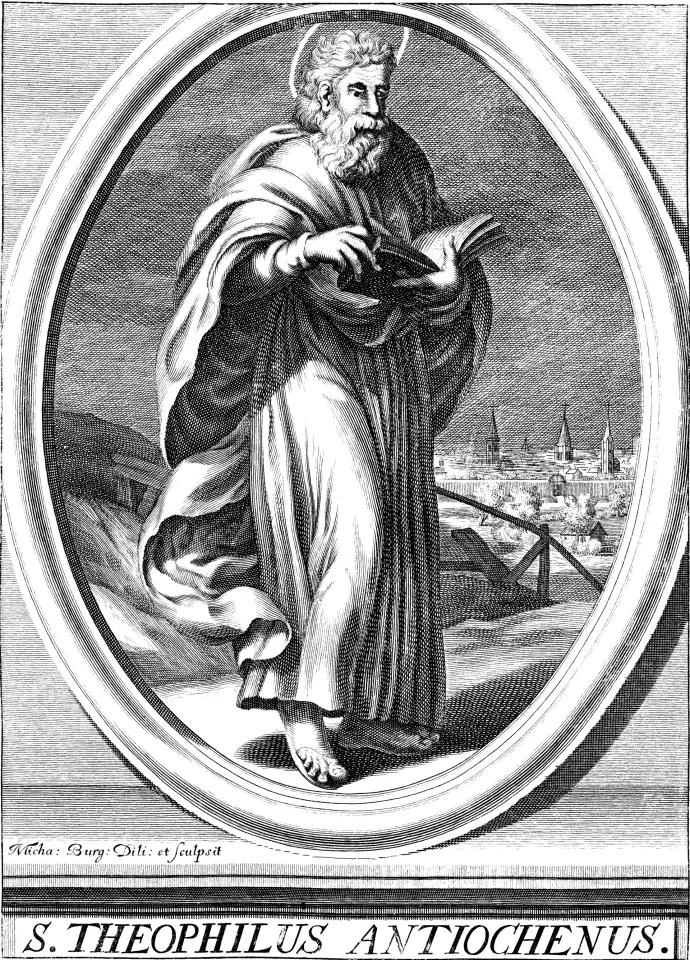
The Apostolic Fathers, according to Berkhof and González, unanimously speak of the preexistence, divinity and humanity of Christ, but are not aware of the problems that arise from this. Pelikan traces the succession of designations for the divine in Christ: "Spirit" (Hermas, Shepherd, Similitude 5.6: “The holy, pre-existent Spirit… God made to dwell in flesh”), "angel" (Justin, Dialogue with Trypho 56; Hermas), then "Logos" and "Son of God". Justin used the Greek concept of the Logos: the Word acts in the world, creates and enlightens sages such as Socrates and Abraham (1 Apol. 46; the "seeds of the Word" – 2 Apol. 8, 13), and in Jesus Christ took flesh. Theophilus explicitly distinguishes the inner Logos from the Logos uttered at creation (To Autolycus 2.10, 2.22). The doctrine of the Logos lent respectability to the title "Son of God", which came to refer to the preexistent Christ.
Positions
- Justin
- Philosophy is partial knowledge of the Word; Christ is the fullness, the incarnate Word
- Tertullian (according to Lane)
- Angrily opposed this approach
- Celsus (according to Origen)
- Christians sophistically identify the Son of God with the Logos
- Athenagoras, Theophilus
- The Son of God is the Word of the Father, not a begetting on the pattern of the myths of the "sons of the gods"
Key points
- Pelikan: the basis for the full exposition of the Logos doctrine was not John 1:1–14 but Proverbs 8:22–31. The hypothesis of an "angel christology" as normative is unprovable; in Justin, "angel" is only one of Christ's titles. The double designation Logos and Son left unresolved the question of unity with the one eternal God
- González: Melito of Sardis reads the history of Israel typologically as pointing to Christ, who is "by nature God and man"
- Hall: the Apologists speak of God and the Word ("duality") rather than of three persons, because they needed points of contact with Greek philosophy
- McGuckin: Celsus in his True Discourse charged Christians with provincialism – how could a religion of folk tales claim universality; only Origen answered him, while the Apologists answered with the Logos as an image of God who is “within God”. For Hermas Christ is a pre-existent power at God’s throne who brings the peace of the next age into the present world order; in the fourth century this vocabulary was drawn into an Arian scheme, and the Shepherd of Hermas dropped from the proto-canon
Outcome
"Logos" became established as the technical term for the divine in Christ, while "Spirit" and "angel" disappeared from the Church's main vocabulary; the unresolved question of the Son's unity with God, according to Pelikan, prepared the controversy with Arianism.
People
- Justin Martyr
- Hermas
- Theophilus of Antioch
- Athenagoras
- Melito of Sardis
- Ignatius of Antioch
- Celsus
Terms
- seminal Logos (seed of the Word) – logos spermatikos
- A Stoic concept; in Justin, the portion of the Word given to people, the seed of reason that gives a partial knowledge of the truth whose fullness is revealed in Christ.
- inner word and uttered word – logos endiathetos / logos prophorikos
- A distinction made earlier by Philo: God's inner reason, always dwelling in his mind, and the Word uttered at creation ("Let there be light"), "the firstborn of all creation".
- sermo
- An early Latin translation of λόγος (Tertullian, Cyprian, Novatian, Jerome).
Sources disagree
The books give no exact dates: the Apostolic Fathers – late 1st to first half of the 2nd century (González), c. 100 (Berkhof); Justin – 140–163 (Hall), before the 160s (Lane); Theophilus – c. 180 (Hall).
Sources
Primary sources
- Hermas – The Shepherd, bk. III, pt. 5, ch. 6
- Justin Martyr – Dialogue with Trypho, ch. 56
- Justin Martyr – First and Second Apology, pt. 1, ch. 46; pt. 2, ch. 8, 13
- Theophilus of Antioch – To Autolycus, bk. II, ch. 10, 22
Textbooks
- Stuart G. Hall – Doctrine and Practice in the Early Church (Russian edition), p. 37–38
- Jaroslav Pelikan – The Christian Tradition: A History of the Development of Doctrine, vol. 1 (Russian edition), p. 36–39, 192–202
- Louis Berkhof – History of Christian Doctrines (Russian edition), p. 21
- Justo L. González – A History of Christian Thought in One Volume (Abingdon, 2014), p. 38, 40, 48
- Tony Lane – Christian Thinkers (Russian edition), p. 17–18
- The Cambridge Companion to the Trinity, ed. Peter C. Phan (2011), p. 70, 65–66
Data compiled: 2026-11-17