late 1st century (c. 96) · 1st century
First Clement: the apostolic succession of ministry
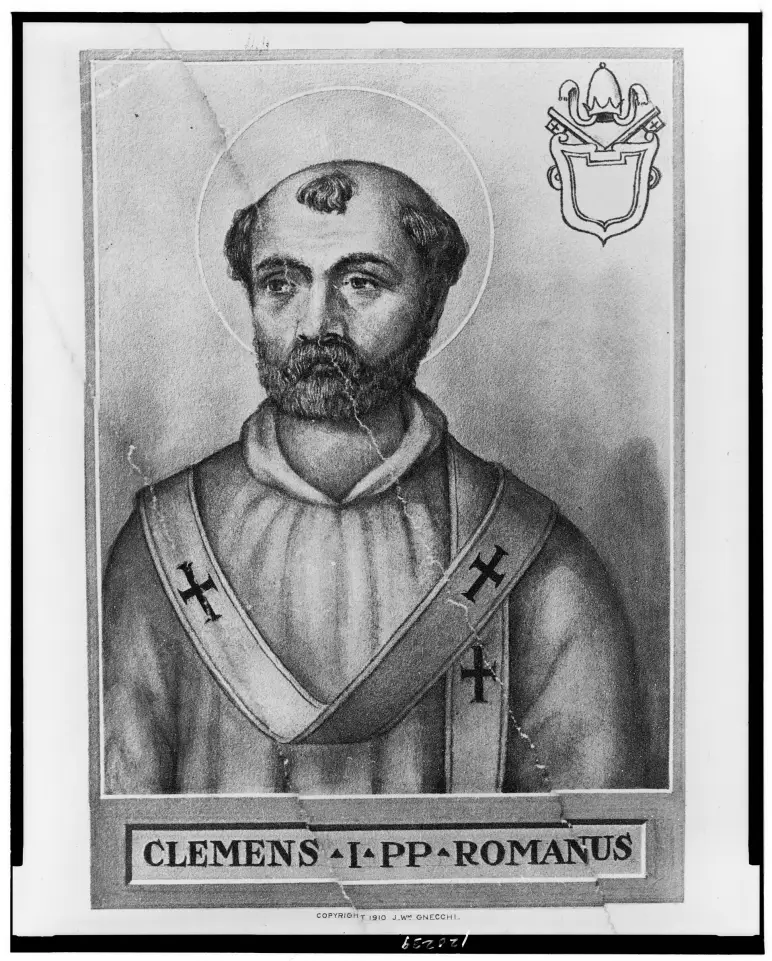
The letter of the Roman church to the Corinthians, long ascribed to Clement, was written about a dispute in Corinth, where the congregation had removed its presbyters. Clement stresses order: God sent Christ, Christ sent the apostles, the apostles appointed bishops and deacons, and these appointed their successors, who cannot be removed without cause (chs. 42, 44). González sees here the first claim to authority on the basis of apostolic succession: the leaders' authority does not come from the congregation, and the congregation cannot depose them. Hall calls this a clear formulation of the doctrine of apostolic succession.
Key points
- The chain of succession: God – Christ – the apostles – bishops and deacons – their successors
- Lane: the words "bishop" and "presbyter" still denote one ministry; Clement does not know the threefold system (so also González)
- 1 Clem. 42: "many ages before it was written concerning bishops and deacons" (Isa 60:17); 44: to eject those who served blamelessly is no "small" sin
- Hall: the letter does not make clear whether Rome or Corinth was governed by one bishop or by a council of presbyters
- González: Clement appeals to succession against schismatics, not heretics
Outcome
The first grounding of church authority in apostolic succession; according to Hall, the doctrine of apostolic succession became one of the tenets of the faith of the catholic Church. The Corinthians probably reinstated their leaders (Lane).
People
- Clement of Rome
Terms
- apostolic succession
- The appointment of church leaders by the apostles and the transmission of their authority to successors; an unbroken chain of bishops leading back to the apostles.
Place
Rome, Corinth
Sources disagree
Lane: 96; Hall and González: "late 1st century" without a year.
Sources
Primary sources
- Clement of Rome – First Epistle to the Corinthians, ch. 42–44
Textbooks
- Stuart G. Hall – Doctrine and Practice in the Early Church (Russian edition), p. 26
- Justo L. González – A History of Christian Thought in One Volume (Abingdon, 2014), p. 27–28
- Tony Lane – Christian Thinkers (Russian edition), p. 14
Related entries
- Developed in: Ignatius of Antioch: the monarchical episcopate and the "catholic church" (early 2nd century (no later than 115))
- Developed in: Irenaeus: the apostolic succession of bishops against the Gnostics (c. 180)
In church history
- The First Epistle of Clement of Rome to the Corinthians (the end of the 1st century (c. 96–97 AD))
Data compiled: 2026-11-17