1536–1559 · 16th century
Calvin, Institutes of the Christian Religion: From the Catechism of 1536 to the System of 1559
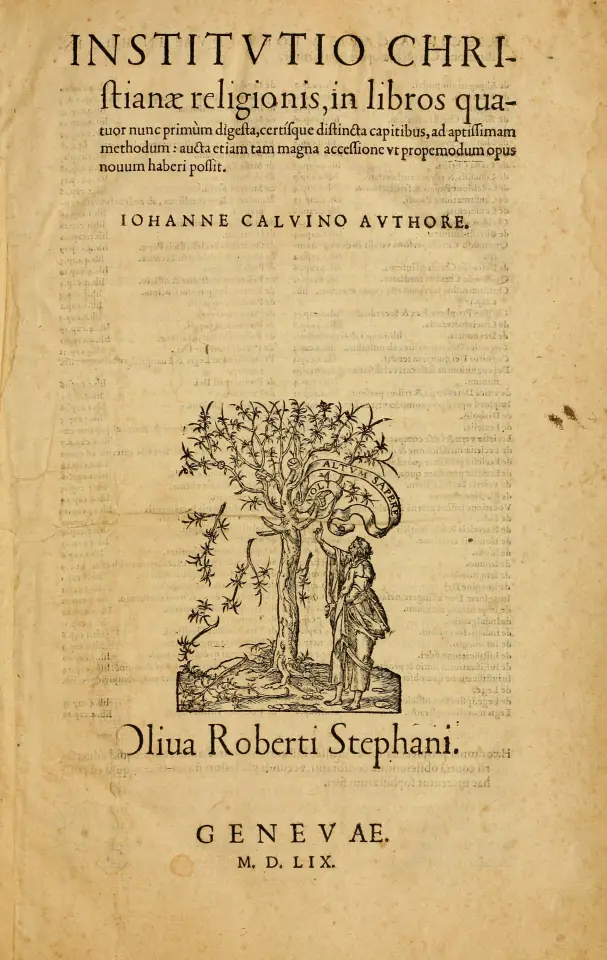
The first edition of the Institutes (Basel, 1536) had six chapters modeled on Luther's catechism, with a dedication to Francis I; the final edition of 1559 had eighty chapters. The intermediate editions (1539, 1543) show the influence of Bucer and polemics against Servetus and the Anabaptists; by 1559 it was a systematic exposition of Reformed theology. Calvin conceived the Institutes as a summary of piety and a companion to his commentaries. McGrath traces his method – going directly to the text in its linguistic and historical context – to the French legal humanism (mos gallicus) of Budé. González sees it as a practical guide for Christians in difficult days, not an eternal system.
Positions
- The Italian custom (mos italicus)
- Reading texts in the light of the annotations and commentaries of medieval jurists
- French legal humanism (Budé) and Calvin
- Going directly to the original sources; commentaries are a distorting filter
Key points
- Farel kept Calvin in Geneva, changing his plans as a scholar
- Lane: theological topics were placed in the Institutes so as not to lengthen the commentaries (so the 1559 Epistle to the Reader: in the commentaries there will be no need "to enter into long discussions of doctrines")
- González: Calvin turned Protestant theology to questions beyond soteriology
- McGrath: in the 1559 edition Cicero leads the reader from natural religion to the gospel
- Steinmetz: an institutio is a handbook of a subject’s basics; in the 1559 Epistle to the Reader Calvin calls the work a “summary of religion in all its parts”, preparing students of theology for the study of Scripture, and the French edition of 1560 a “sum of Christian doctrine”. It has two aims – a summary of basic Christian teaching and an introduction to Bible reading. In the 1539 preface to Romans Calvin compared himself with Bucer, Melanchthon and Bullinger: Melanchthon too concise, Bucer too prolix. Calvin’s ideal was “lucid brevity”: he moved doctrine into the Institutes, so the reader goes from commentaries to the Institutes and back – Ganoczy called this Calvin’s “hermeneutical circle”. The Institutes are organized around topics (loci), not scholastic questions, and four books correspond roughly to the articles of the Apostles’ Creed; Calvin could have called it Loci communes like Melanchthon, but like the scholastics he called it a summa – Lombard’s Sentences also had four books.
- Morgan: Calvin's Institutes owe more to Paul than to anyone; on predestination Calvin pressed the logic further even than Augustine.
Outcome
The principal work of Reformed theology; Calvin's development can be traced through the growth of the Institutes.
People
- John Calvin
- Guillaume Farel
- Martin Bucer
- Guillaume Budé
- Francis I
Terms
- French custom – mos gallicus
- Going directly to the classical legal sources in the original language.
Place
Basel; Geneva
Sources disagree
All books: first edition 1536, final edition 1559; Lane also names the editions of 1539 and 1543 and the completion of the first edition in summer 1535; McGrath gives 1528 as the probable year of Calvin's arrival in Orléans.
Sources
Primary sources
- Calvin – Institutes of the Christian Religion, preface
Textbooks
- Justo L. González – A History of Christian Thought in One Volume (Abingdon, 2014), p. 311–312, 325–327
- Justo L. González – A History of Christian Thought, vol. III: From the Protestant Reformation to the Twentieth Century (Abingdon, rev. ed. 1987), p. 138–140
- Alister McGrath – Reformation Thought (Russian edition: «Theological Thought of the Reformation»), p. 76–77
- Tony Lane – Christian Thinkers (Russian edition), p. 178–179
- The Cambridge Companion to Reformation Theology, ed. David Bagchi, David C. Steinmetz (2004), p. 125, 126, 129–130
- The Cambridge Companion to St Paul, ed. James D. G. Dunn (2003), p. 264
Related entries
- Develops: Northern Humanism and "Back to the Sources" (ad fontes); Erasmus's "Philosophy of Christ" (early 16th century)
- Response to: The Reformation and the antitrinitarians: Calvin, Servetus, the Socini, the Arminians (16th – early 17th century)
- Developed in: Protestant Orthodoxy and "Protestant Scholasticism": The Return of Aristotle (second half of the 16th – 17th century)
In church history
- Calvin's "Institutes of the Christian Religion" (1536–1559)
- The Geneva Academy and the death of Calvin (1559–1564)
Data compiled: 2026-11-17