1927–1956 · 20th century
Barth and Bonhoeffer: christological concentration and the break with liberalism
Barth's principle: God's only Word to humanity is contained in Jesus Christ, and all God's actions pass through him; this excludes natural theology and determines all theology – Barth himself called it "christological concentration", his critics "christomonism". The consequences: God sees all people in Christ as forgiven, sin is known only from the Gospel and is a response to grace, and the incarnation did not happen because man sinned. Bonhoeffer, like Barth, broke with the liberal idea of a "religious a priori": the question "Who is Jesus Christ?" runs through all his works, and God reveals himself only in Jesus Christ. But he criticized Barth for making the Word epistemologically inaccessible to a concrete time, and stressed Christ's real presence in the church, and later in the world.
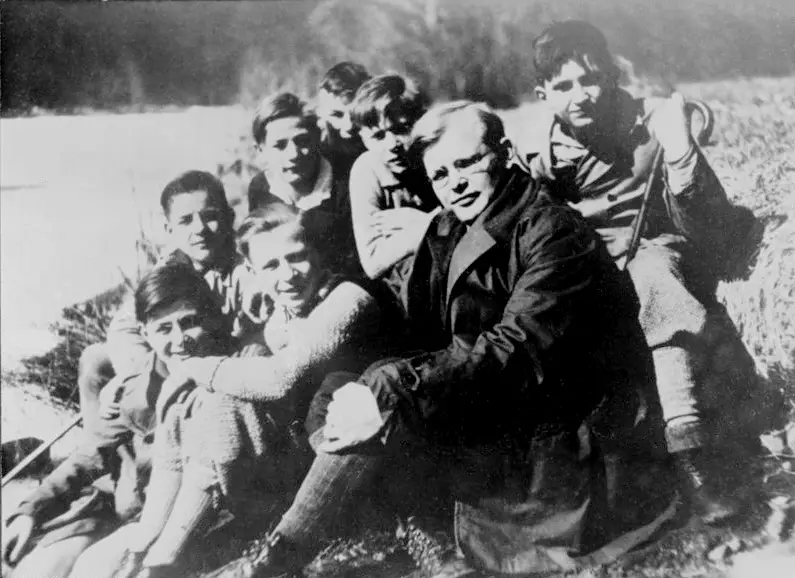
Positions
- Barth
- All people are in Jesus Christ and forgiven; sin is known only from the Gospel; the Word of God is epistemologically transcendent
- Bonhoeffer
- Revelation in Christ is really embodied in the church; the nature of the church cannot be derived from a general concept of religion
- Lane (assessment)
- The principle produces brilliant insights, but its strict control distorts the biblical picture
Key points
- Lane: towards the end of his life Barth acknowledged the one-sidedness of his early emphasis on divinity (The Humanity of God, 1956) and rejected infant baptism
- Kenneth Hamilton (according to Grenz and Olson): the key to Bonhoeffer is his conscious reckoning with Barth's theory
- Bonhoeffer's works Christ the Center and Ethics were reconstructed from students' notes and unfinished manuscripts
- Bonhoeffer was executed on 9 April 1945
Outcome
The christocentric principle became the foundation of Barth's theology and of Bonhoeffer's ecclesiology; over the years Barth's judgments softened, and he acknowledged the importance of the 19th-century theologians (Lane).
People
- Karl Barth
- Dietrich Bonhoeffer
- Reinhold Seeberg
- Eberhard Bethge
Terms
- christological concentration
- Barth's principle: all theology is determined by Jesus Christ.
- neo-orthodoxy
- The movement founded by Barth after the First World War that sought to recover much of the traditional teaching abandoned by the 19th century, though not a return to the old orthodoxy.
Place
Basel, Berlin
Sources disagree
Lane does not date Barth's individual statements; The Humanity of God – 1956. Bonhoeffer – 1927–1945 (Grenz–Olson), the year of the christology lectures is not given.
Sources
- Tony Lane – Christian Thinkers (Russian edition), p. 258–263
- Stanley Grenz, Roger Olson – 20th-Century Theology: God and the World in a Transitional Age (Russian edition), p. 222–225
Related entries
- Rejects: Liberal christology and the quest of the historical Jesus: Ritschl, Harnack, Schweitzer, Bultmann (1870–1921)
- Developed in: Barth: Election in Jesus Christ – and Brunner's Response (1930s–1962)
In church history
- Dietrich Bonhoeffer: "cheap grace" and martyrdom (1906 – 9 April 1945)
Data compiled: 2026-11-17