413–427 · 5th century
Augustine, The City of God: the meaning of history, the two cities and the relation to the state
After the fall of Rome in 410 pagans blamed Christianity for the wrath of the gods, and Augustine replied with his most extensive apologetic work: Christianity does not guarantee temporal success – contrary, according to Lane, to Eusebius' hopes after Constantine's conversion – but gives inner peace and an eternal inheritance. The apologists, rejecting the Greek theory of cycles, turned to the idea of providence, but, according to Pelikan, it was "left" to Augustine to show that history moves toward a final goal. The two cities – of God and of the earth – are not the Church and the state but two groups of people marked by two loves: "love of God to the contempt of self" and "love of self to the contempt of God" (The City of God 14.28); from the first fall to the final consummation they are intermingled, and the outcome is the condemnation of the first and the salvation of the second. Rome received power by God's will so that there would be peace for the spread of the Gospel, and fell because of its own sin; the heavenly Jerusalem has earthly manifestations, including the Church, but the visible Church is afflicted by sin, and the invisible Church consists only of the elect (Hall). Augustine's eschatology is mostly traditional, but he did not claim certainty about what is beyond understanding: he spoke vaguely and hesitantly of a fire in which the dead atone for sins ("this I do not contradict, because possibly it is true", 21.26), and understood the images of Scripture about retribution figuratively.
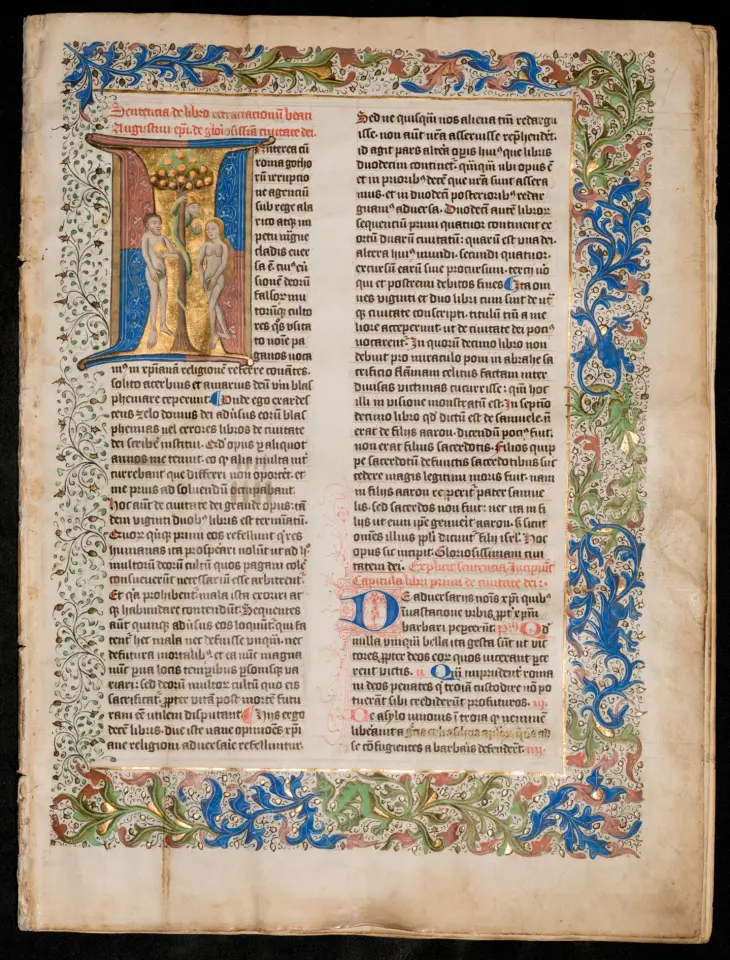
Positions
- Greeks and Romans (as described by Pelikan)
- The theory of cycles; the empire will endure as long as it is faithful to the ideals of the past
- The pagans
- Rome fell because it abandoned the old gods
- Augustine
- Christianity does not guarantee worldly success; the two cities are two kinds of love; empires as expressions of the earthly city must fall, Rome fell because of its own sin; history moves toward a goal
Key points
- The subtitle of the work is "Against the Pagans"
- The first ten books criticize Roman society and paganism, the following ones describe the history of the two cities (The City of God 11.1)
- The doctrine of providence became the standard rubric for considering history
- Hall: for Augustine the state is no more than legalized robbery; Augustine (The City of God 4.4) puts it with a condition: "Justice being taken away, then, what are kingdoms but great robberies?"; the earthly kingdom will be replaced by the heavenly one
- Berkhof: the City of God is opposed to the city of this world as the saints to the wicked, the elect to the non-elect
- González: the barbarian invasions led Augustine to the theory of just war – waged for peace, under lawful authority and with a motive of love
- At Augustine’s request Orosius wrote the History against the Pagans, arguing that pagan times were worse than Christian ones
- Orosius interpreted even the barbarian invasions as a means of the barbarians’ conversion
- Shelley: from Adam to the end humanity divides into two cities: the godless with earthbound passions and a small group of spiritual people born of grace; the earthly city is united by love of temporal things, the City of God by love of God. What led the Romans to great achievements was human praise. For Augustine the Church is only a community of people laboring to build the City of God; the state suppresses crime and keeps peace but rests on the power of sin and must submit to the Christian Church's laws. In the Middle Ages it was Augustine's best-loved work: the Kingdom of God lies in the future, not in the earthly kingdom that could only collapse; for fifteen centuries the book told Christians what they owe to God and what to Caesar
Outcome
A Christian philosophy of history took shape, oriented toward a final goal – the eternal destiny of the city of God; for the medieval church the work became an encyclopedia of religion (Lane), and Christianity survived the collapse of the empire by hoping in the indestructible City (Hall).
People
- Augustine
- Paulus Orosius
- Tertullian
- Origen
- Eusebius of Caesarea
Terms
- two cities
- The city of God and the earthly city – two groups of people distinguished by two kinds of love (of God and of self), not the Church and the state.
- providence
- The one Providence governing the universe, "which orders all things according to appointed times"; most philosophers agreed on its existence.
- purgatory
- A place where the remaining sins of the dead are purged before admission to heaven; in Augustine, the purifying fire of which he spoke vaguely and hesitantly.
Place
Hippo
Sources disagree
Lane: 413–427; Hall: 412–426; González (HCT): the work was occasioned by the fall of Rome in 410, its completion date is not given; Orosius's History is after 414. Pelikan gives the 2nd–5th centuries without exact dates.
Sources
Primary sources
- Augustine – The City of God, bk. IV, ch. 4; bk. XI, ch. 1; bk. XIV, ch. 28; bk. XXI, ch. 26
Textbooks
- Stuart G. Hall – Doctrine and Practice in the Early Church (Russian edition), p. 136–137
- Jaroslav Pelikan – The Christian Tradition: A History of the Development of Doctrine, vol. 1 (Russian edition), p. 46–47
- Louis Berkhof – History of Christian Doctrines (Russian edition), p. 195
- Justo L. González – A History of Christian Thought in One Volume (Abingdon, 2014), p. 171–172, 182–183, 187
- Tony Lane – Christian Thinkers (Russian edition), p. 57–58
- Bruce L. Shelley – Church History in Plain Language (Russian edition), Ch. 13, sec. «Град Божий на руинах Рима»
Related entries
- Rejects: Expectation of the end and chiliasm in the early Church: from Papias and Irenaeus to Augustine (2nd–5th centuries)
- Rejects: Church and empire in the 4th century: Eusebius, Theodosius, Ambrose (4th century)
- Developed in: Purgatory: from Gregory the Great to the Council of Florence and indulgences (6th–16th centuries)
In church history
- The sack of Rome by Alaric and Augustine's "City of God" (410 (sack of Rome); 412–426 ("City of God"); 430 (death of Augustine))
Data compiled: 2026-11-17