2nd century · 2nd century
The Apologists: the Logos as mediator and "another God", threefold worship and the first use of "Trinity"
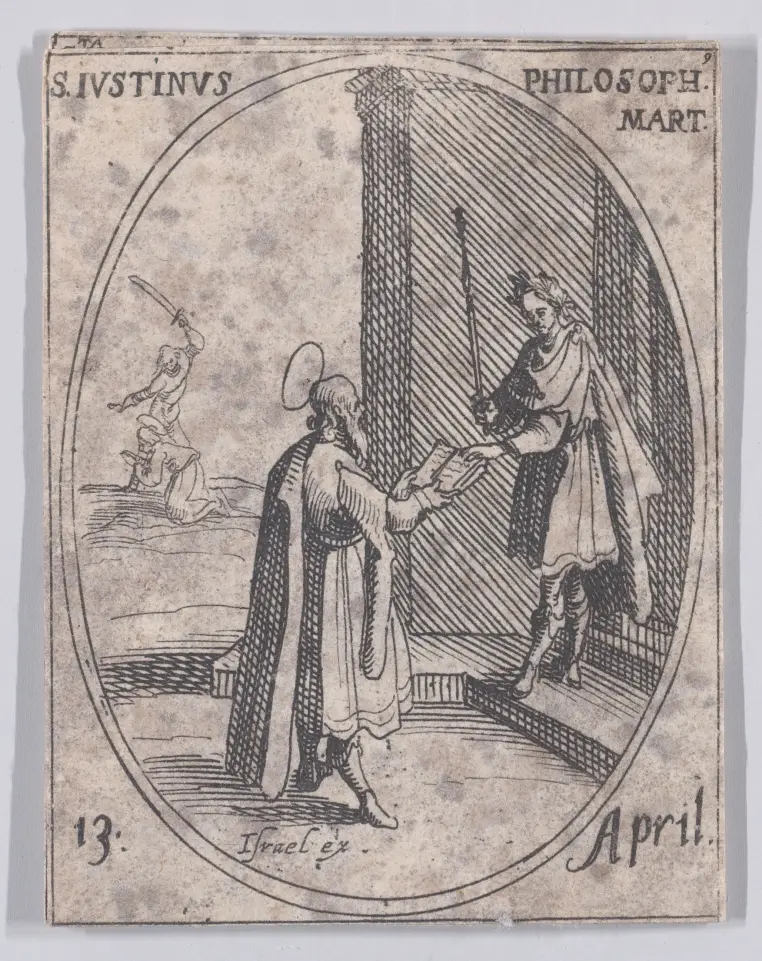
The Apologists, according to Berkhof, presented God as self-existent, unchangeable and eternal, describable only negatively, and preferred to speak of the Son as the Logos – the divine Reason that dwelt in God and received personal existence before the creation of the world. Justin, according to González, thought in the spirit of Middle Platonism: the Logos is the mediator between the transcendent Father and creation, and Justin calls the Word "another God" (Dialogue with Trypho 56: “another God and Lord subject to the Maker of all things”). In the Apology (1 Apol. 6) Justin describes the worship of the Father, the Son, "the host of good angels" and the prophetic Spirit; Hall and Pelikan note that the place of the angels and the Spirit in this formula is unclear. Theophilus of Antioch, c. 180, was the first to use the word "trinity" (To Autolycus 2.15: the three days before the luminaries “are types of the Trinity, of God, and His Word, and His wisdom”) and distinguished the Word always dwelling in God from the Word uttered (2.10, 2.22).
Key points
- Berkhof: the Apologists lacked the biblical concept of the Logos, having something resembling Philo; the Logos can be called a creature, yet essentially remains identical with God
- González: according to Justin, the Old Testament theophanies are appearances of the Logos, not of the Father; the distinction between the immanent and the uttered Word would play a role in the controversies of later centuries.
- Hall: no deeply considered doctrine of the Trinity or Holy Spirit is found in Justin; the Spirit appears as one of the angels subordinate to the Son, though the threefold formula occurs at baptism and the Eucharist (Apology 1.61, 1.65). The Apologists tend to speak of God and the Word, whereas the baptismal formulas are threefold; at the beginning of the 3rd century Tertullian introduced the Latin trinitas.
- McGuckin: in the later second century Christians had to explain to Jewish sages and pagan philosophers how worshiping Christ fits monotheism. Drawing on Philo and Wisdom literature, Logos theology spoke of the Logos as “God of God” rather than “God instead of God”. For Theophilus the Father is the supreme “monad”; on deciding to create he “utters” what he held in mind, so creation knows God through the Logos. The incarnation of the invisible Logos flows from his original mercy: the one who made the fallen world came to repair it. The doctrine of the Spirit is shadowy in apologetics: it addressed catechumens, and the Spirit’s “secret” was told only on the eve of baptism. Origen began, and the Nicene era perfected, extending Logos theology’s dyadic Father–Son dynamic into a triadic one
Outcome
Threefold worship was fixed in the rites and the first terms for threefoldness appeared, but the doctrine itself was not yet worked out; the subordinationist distinction between the Father and the Word, according to Berkhof, became the basis of later controversies.
People
- Justin Martyr
- Tatian
- Athenagoras
- Theophilus of Antioch
Terms
- Logos
- The divine reason inherent in God, to which God gave a separate existence; the rational principle of the universe and at the same time the preexistent Christ of the Fourth Gospel. In Philo, the Word created by God before the world, the instrument of creation.
- triad
- In Theophilus, the first three days of creation as a symbol of the "Trinity": God, His Word and His Wisdom (To Autolycus 2.15).
- immanent and uttered Word
- A distinction made earlier by Philo: God's inner reason, always dwelling in his mind, and the Word uttered at creation ("Let there be light"), "the firstborn of all creation".
Place
Rome, Antioch
Sources disagree
Hall dates Justin's apologies to 140–163; González to the mid-2nd century; Theophilus to c. 180 or a little later (González, Hall).
Sources
Primary sources
- Justin Martyr – Dialogue with Trypho, ch. 56
- Justin Martyr – First and Second Apology, pt. 1, ch. 6, 61, 65
- Theophilus of Antioch – To Autolycus, bk. II, ch. 10, 15, 22
Textbooks
- Stuart G. Hall – Doctrine and Practice in the Early Church (Russian edition), p. 37, 39
- Jaroslav Pelikan – The Christian Tradition: A History of the Development of Doctrine, vol. 1 (Russian edition), p. 153–154
- Louis Berkhof – History of Christian Doctrines (Russian edition), p. 36
- Justo L. González – A History of Christian Thought in One Volume (Abingdon, 2014), p. 44, 47
- The Cambridge Companion to the Trinity, ed. Peter C. Phan (2011), p. 67–68, 68–69, 67, 71
Related entries
- Rejected in: Gnostic Dualism and Irenaeus's Response: The One Creator God and His "Two Hands" (2nd century (Irenaeus – c. 180))
- Answered by: Modalistic Monarchianism: Noetus, Praxeas, Sabellius and the response of Hippolytus (late 2nd – early 3rd century)
In church history
- Second-century apologists (Aristides, Tatian, Athenagoras, Theophilus of Antioch, Melito of Sardis) (120–200)
Data compiled: 2026-11-17